
Northeast Massachusetts (Greater Boston)
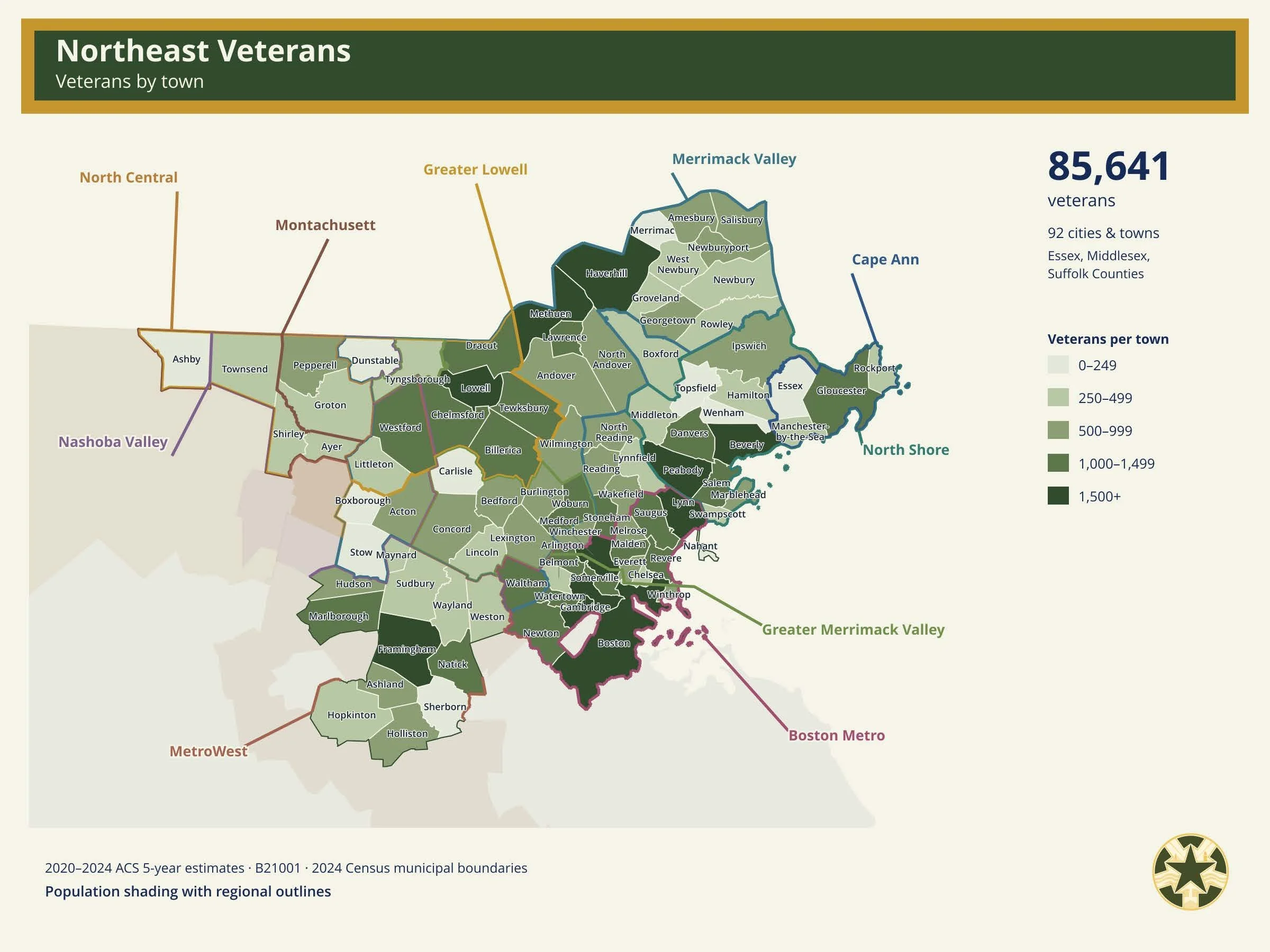
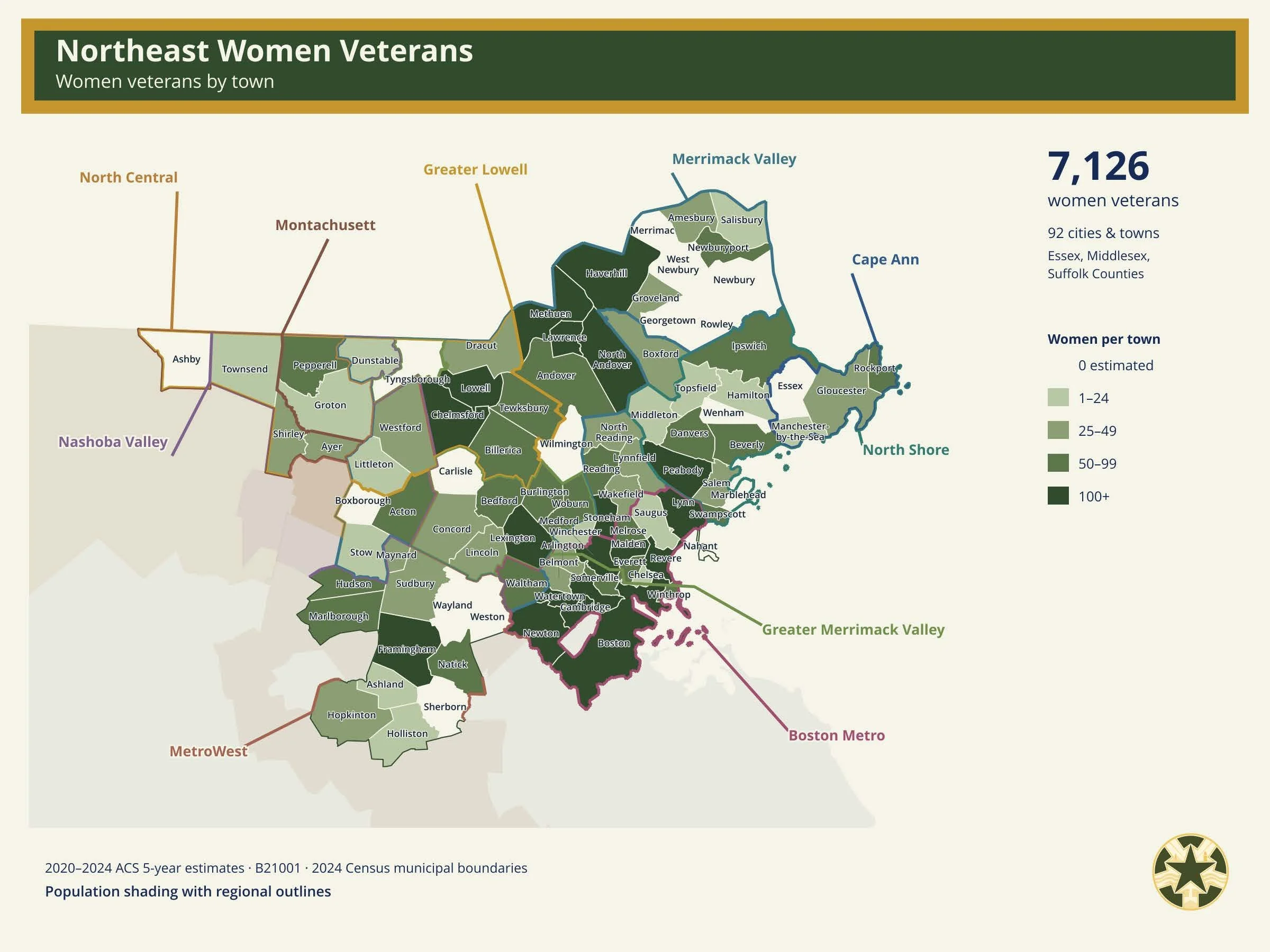
Based on the 2020–2024 ACS 5-year estimates, approximately 85,641 veterans live in Northeast Massachusetts, including 7,126 women veterans. This page includes local events and directories of veterans’ services; VA-accredited representatives, agents, and attorneys; veterans outreach centers; VA healthcare facilities; community behavioral health centers; peer recovery support centers; elder services; community resources; veterans posts and auxiliaries; and veteran owned businesses, as well as veterans census, VA spending, veteran homelessness, and public health data.
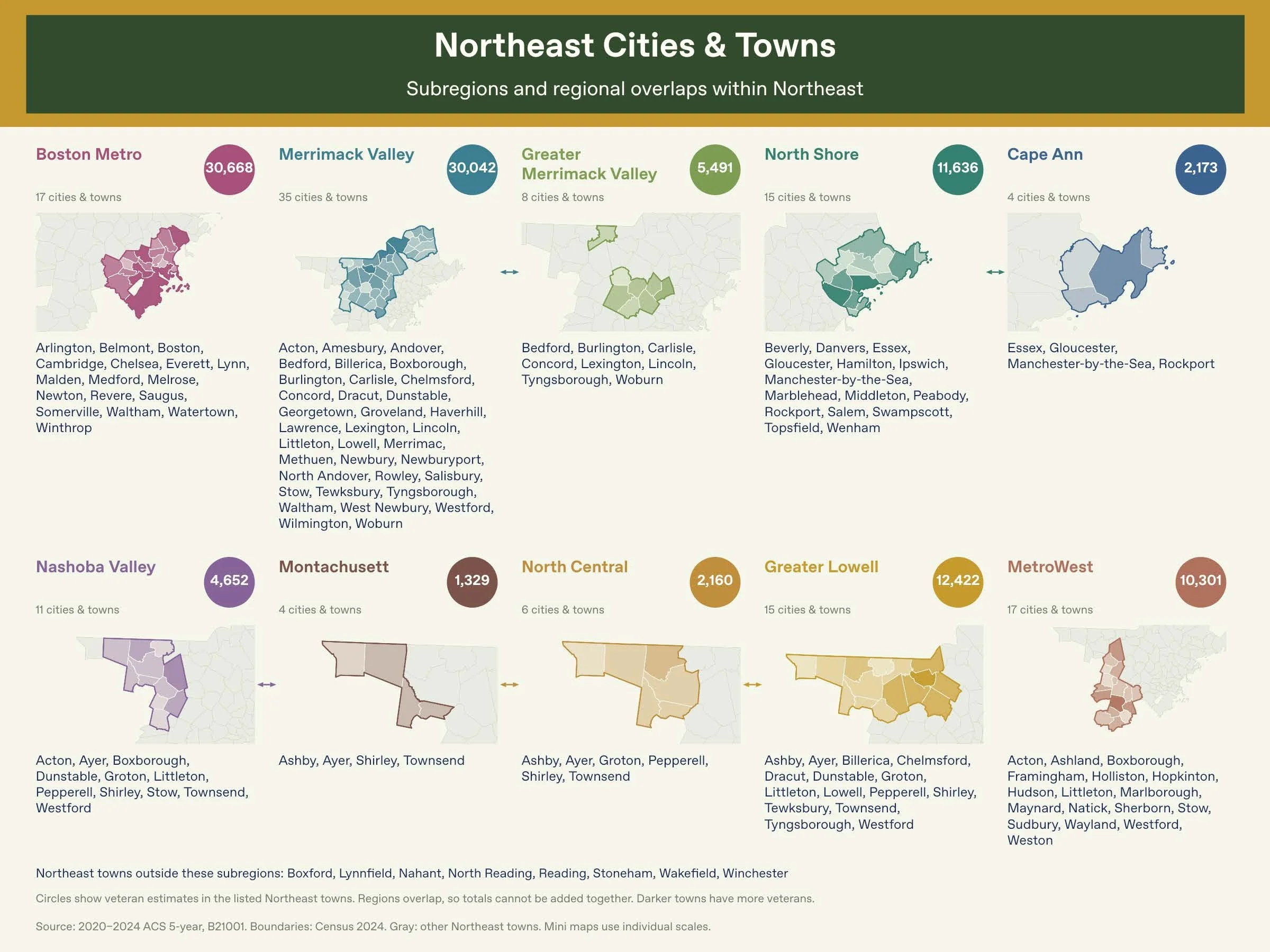
When you submit events, use the greater-boston tag so they automatically show up on here. Events in relevant cities and towns should also be tagged with boston-metro, metrowest, north-shore, and/or merrimack-valley so they also show up on pages for those areas within Northeast Mass. The listing below has links to see events at the city and town level. If you include the city or town where your event is taking place within the event description, it will appear in the relevant local listing.
Local Event Listings
Local Recovery Meetings

The mission of the Massachusetts Executive Office of Veterans’ Services (EOVS) is to act as the primary advocate on behalf of all the Commonwealth’s veterans. The Office provides outreach and support through various programs. EOVS offers assistance to eligible veterans and their surviving spouses through the MassVets Financial Benefits Program, administered by local veterans’ services.
Local Veterans’ Services
Veterans’ Services Districts
Veterans may use the Mass Vet Benefit Calculator to see what they may qualify for and contact their local veterans’ services office to apply. MGL Chapter 115 requires each town/city have a veterans’ agent to administer these benefits, but two or more contiguous towns can also appoint someone to serve as veterans’ agent and form Veterans’ Services Districts. Many municipal veterans’ services office also have VA-accredited staff to assist with federal benefit claims.
Office Hours for Veterans Benefits
VA-Accredited Representatives, Agents & Attorneys
The directory below includes VA-accredited representatives, agents, and attorneys based in Northeastern cities and towns from the VA Office of the General Counsel (OGC) Accreditation Search Tool, updated on a weekly basis. Accreditation ensures VA claimants receive qualified assistance aligned with VA Standards of Conduct. Attorney listings also include available official state bar data, license status, registration dates, and disciplinary history, updated on a monthly basis.
New England Center & Home for Veterans
Located in Downtown Boston, the New England Center and Home for Veterans (NECHV) offers comprehensive supportive services to veterans of all ages and eras throughout the region. Operating 24/7, the Center helps veterans overcome challenges, secure meaningful employment, and transition into dignified independent living. NECHV provides residential stabilization programs, clinical and behavioral health support, and outreach to prevent veteran homelessness. To learn more or access services, veterans can click here or call (617) 371-1800 anytime.
NECHV Merrimack Valley
The New England Center & Home for Veterans (NECHV) assumed operations of the regional programs of the Veteran Northeast Outreach Center (VNEOC). NECHV Merrimack Valley is now providing housing assistance, VA Grant and Per Diem Transition in Place (TIP) and Supportive Services for Veterans and Families (SSVF) services, case management, and support with basic needs for the region. For more information regarding the services NECHV offers in the Merrimack Valley or in the greater region please call (978)-305-9810 or email Christopher Nowak.
Harvard Street Veterans Outreach Center
Supported by EOVS, the Harvard Street Veterans Outreach Center serves as a community hub in Dorchester for Greater Boston veterans and their families offering comprehensive primary care, behavioral health services, health insurance navigation, and direct connections to housing and legal aid. Beyond medical needs, it functions as a drop-in center featuring an on-site food pantry, computer lab access, and workforce development support. Veterans can schedule an intake appointment online or call (617) 825-3400.
Veteran Pathways of New England
Veteran Pathways of New England (formerly Clear Path for Veterans of New England) works to create a safe, supportive, and respectful environment for veterans to seamlessly integrate into their communities in Devens and offers support through community meals, employment, peer-to-peer programs, wellness and clinical services, service/support dogs, community and group spaces, and recreation and training grounds.
VA Healthcare in Northeast Mass
Northeast Region veterans are served by the VA Boston and VA Bedford Healthcare System with three hospitals, seven clinics, and two Vet Centers in the Greater Boston area. Anyone who has served in the military is encouraged to apply to determine their eligibility and Priority Group. Some veterans are exempt from co-pays due to their VA rating, income, or special eligibility factors.
Northeast Mass Community Behavioral Health Centers
Community Behavioral Health Centers (CBHCs) are one-stop shops for mental health and substance use services and treatment. The network includes 12 centers in Northeast Massachusetts offering immediate, confidential care for mental health and substance use needs. CBHCs are open daily for walk-ins, routine appointments, and crisis care, including Mobile Crisis Intervention.
CBHCs are closely connected to the Massachusetts Behavioral Health Help Line (BHHL). The BHHL is a 24/7 clinical hotline staffed by trained behavioral health providers and peer coaches who offer clinical assessment, treatment referrals, and crisis triage services. Staff directly connect callers with the nearest CBHC when appropriate.
Northeast Mass Peer Recovery Support Centers
Peer Recovery Support Centers (PRSC) in Massachusetts are free accessible peer-led spaces that provide individuals in recovery from substance use, as well as their family members and loved ones, an opportunity to offer and receive human connection, community inclusion, peer support, and access to non-clinical resources. There are 14 centers in the Northeast Region.
The Massachusetts Overdose Prevention Helpline is staffed by a dedicated team of harm reductionists and people with lived and living experience with overdose. The hotline is not a recovery or treatment helpline; it connects people using drugs with trained operators who can call for help in case of overdose. It is available to anyone at risk of overdose.
Elder Services in Northeast Mass
Aging Services Access Points (ASAPs) are private, non-profit agencies established under MGL Chapter 19A. ASAPs provide direct and protective services, including information and referrals; interdisciplinary case management; intake and assessment; developing, implementing, and monitoring service plans; reassessing needs; and investigating reports of elder abuse and neglect.
Aging Services Access Points
Councils on Aging
Councils on Aging (COAs) are municipal agencies that provide local outreach, social and health services, advocacy, information and referral for older adults, their families, and caregivers. COAs and Senior Centers serve as advocates and links to support services for elders, families, and caregivers. They offer outreach, transportation, meals, health screenings, health insurance counseling, and life-long learning, social, fitness, wellness, and recreation activities.

MassOptions is a service of the Executive Office of Health & Human Services (EOHHS) that can also help older adults, people with disabilities, and family members or caregivers identify aging and disability services and connect to those that can meet their needs. Call (800) 243-4636 or click here to complete a referral.
Northeast Mass Resource Network
The Veterans Collaborative Network Directory is a shared resource that includes the various organizations and programs participants are affiliated with, as long as they’ve signed in or otherwise participated in our summits to help us map the landscape. This is not an exhaustive list of programs serving the Northeast Region, but you’ll find many here along with their websites and event listings.
Greater Boston Veterans Collaborative
-
Prior to the pandemic, organizers convened more than 50 working group and core team meetings and 29 in person summits convening service providers in the Boston Metro area. After our first summit in Boston in January 2015, the group quickly expanded beyond Boston Metro service providers into the GBVC. GBVC organized dozens of in person summits to gather information and resources and work to identify and address key challenges and gaps in services and outreach. The core team developed shared infrastructure, including this website, the shared calendar and network directory embedded in it, and the shared slack, now expanded and maintained by the statewide Veterans Collaborative.
In March 2020, the GBVC quickly shifted to convene virtual summits, which the Veterans Collaborative continues to host on a monthly basis to create space for service providers to connect, share resources and information, identify gaps and emerging issues, gather and share data, and work to ensure services are understood and accessible to those who need them, when they need them. These summits include an orientation to the shared resources so that regional collaboratives and service providers can leverage them for impact across the state.
Merrimack Valley Veterans Collaborative
-
The original Vision Committee for the MVVC included Nändi Munson, LSW, AgeSpan; Beth Laliberty, Attorney & Lawyer for a Day Coordinator; Gail Hewins, Veterans Northeast Outreach Center; Joe Leblanc, North Andover Veterans’ Services; Karen Tyler, Eastern Essex Veterans Services; and PJ Healy, Fidelity House CRC. The group continues to meet, typically every other month.
North Shore Veterans Collaborative
-
Meetings were held quarterly at sites throughout the North Shore before the pandemic. NSVC is still operating, but is currently on a hiatus. Email Tiffany Lever for info.
Northeast Mass Veterans Posts & Auxiliaries
The Veterans Posts and Auxiliaries directory includes information about the VFW, American Legion, AMVETS, Italian American War Veterans, and United American War Veterans Posts, Marine Corps League Detachments, and Vietnam Veterans of America and DAV Chapters based in cities and towns in Northeastern Massachusetts, as well as information about their auxiliaries and other affiliates.
Posts
Auxiliaries
Veteran Owned Businesses in Northeast Mass
The Veteran Owned Businesses directory is based on publicly available information and listings of veteran owned businesses based in Massachusetts. The listing below includes businesses in Northeastern Massachusetts. Follow the link below to update information or submit a new business.
Northeast Mass Veteran Owned Businesses Estimates
The Annual Business Survey and Nonemployer Statistics by Demographics provide estimates of veteran-owned businesses in Essex, Middlesex, and Suffolk Counties in 2023, including businesses with paid employees and businesses without paid employees.
Suffolk County had an estimated 357 veteran-owned employer firms and approximately 1,100 non-employer businesses, compared with 364 employer firms and 1,100 non-employers in 2022.
Middlesex County had an estimated 1,120 veteran-owned employer firms and approximately 3,400 non-employer businesses, compared with 974 employer firms and 3,500 non-employers in 2022.
Essex County had an estimated 557 veteran-owned employer firms and approximately 2,200 non-employer businesses, compared with 669 employer firms and 2,200 non-employers in 2022.
Businesses without paid employees substantially outnumber veteran-owned employer firms in each county. Middlesex had the largest published estimates in both categories. The employer estimates changed in different directions between 2022 and 2023, but sampling uncertainty, particularly in Essex and Suffolk, limits what these differences tell us about growth or decline.
Explore the 2023 business ownership tables and 2022 comparison tables for firm counts, receipts, employment, and payroll. Select Veteran under veteran status and Total for All Sectors for the figures above. County employer counts should not be added together as a regional total because a firm operating in multiple counties can appear in each county. Non-employer counts are rounded.
Northeast Massachusetts Veterans Census Data
Based on the 2020–2024 ACS 5-year estimates, approximately 85,641 veterans live in Essex, Middlesex, and Suffolk Counties. Veterans make up about 3.3 percent of adults age 18 and older, or 2.6 percent of the total population.
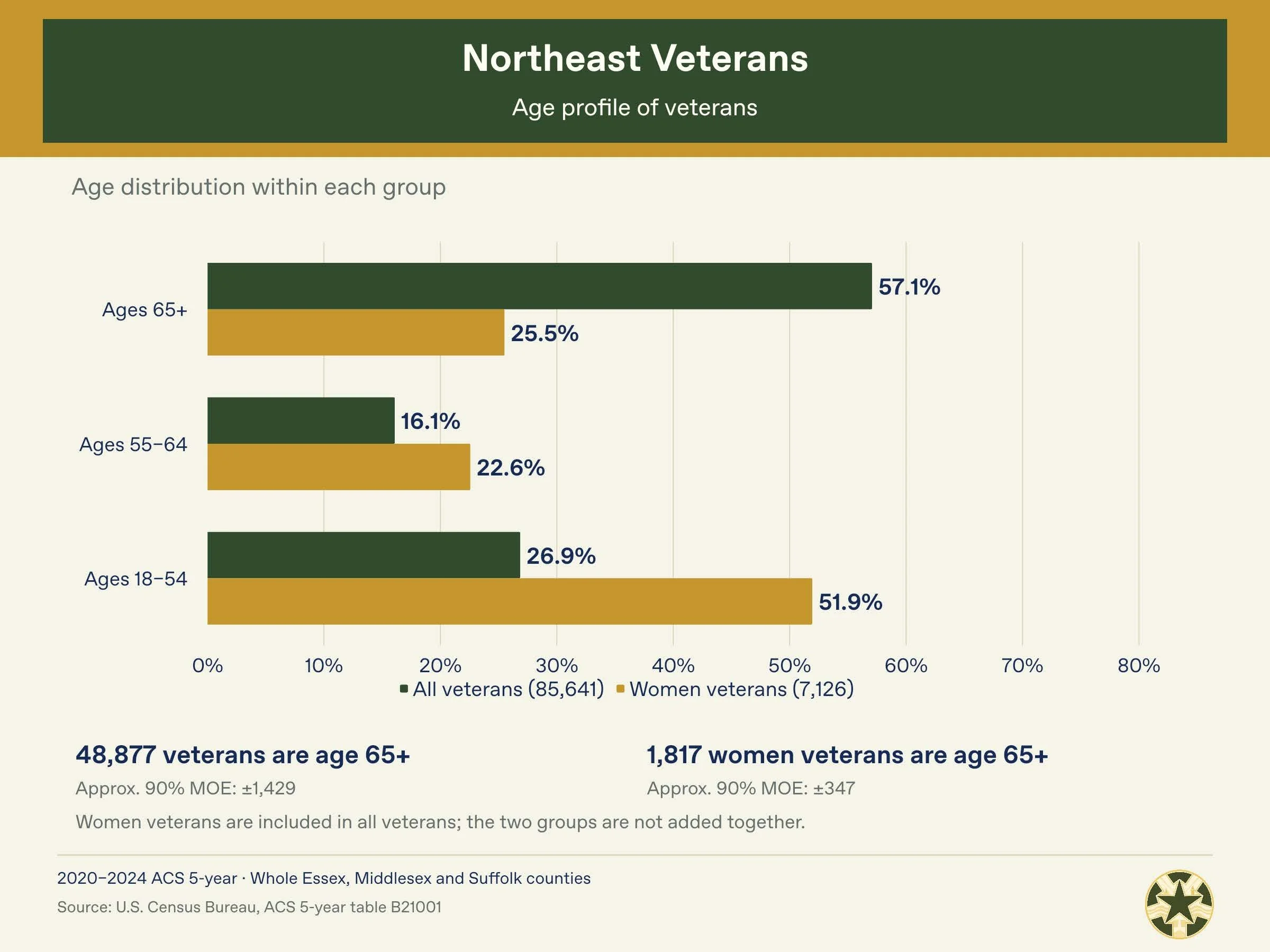
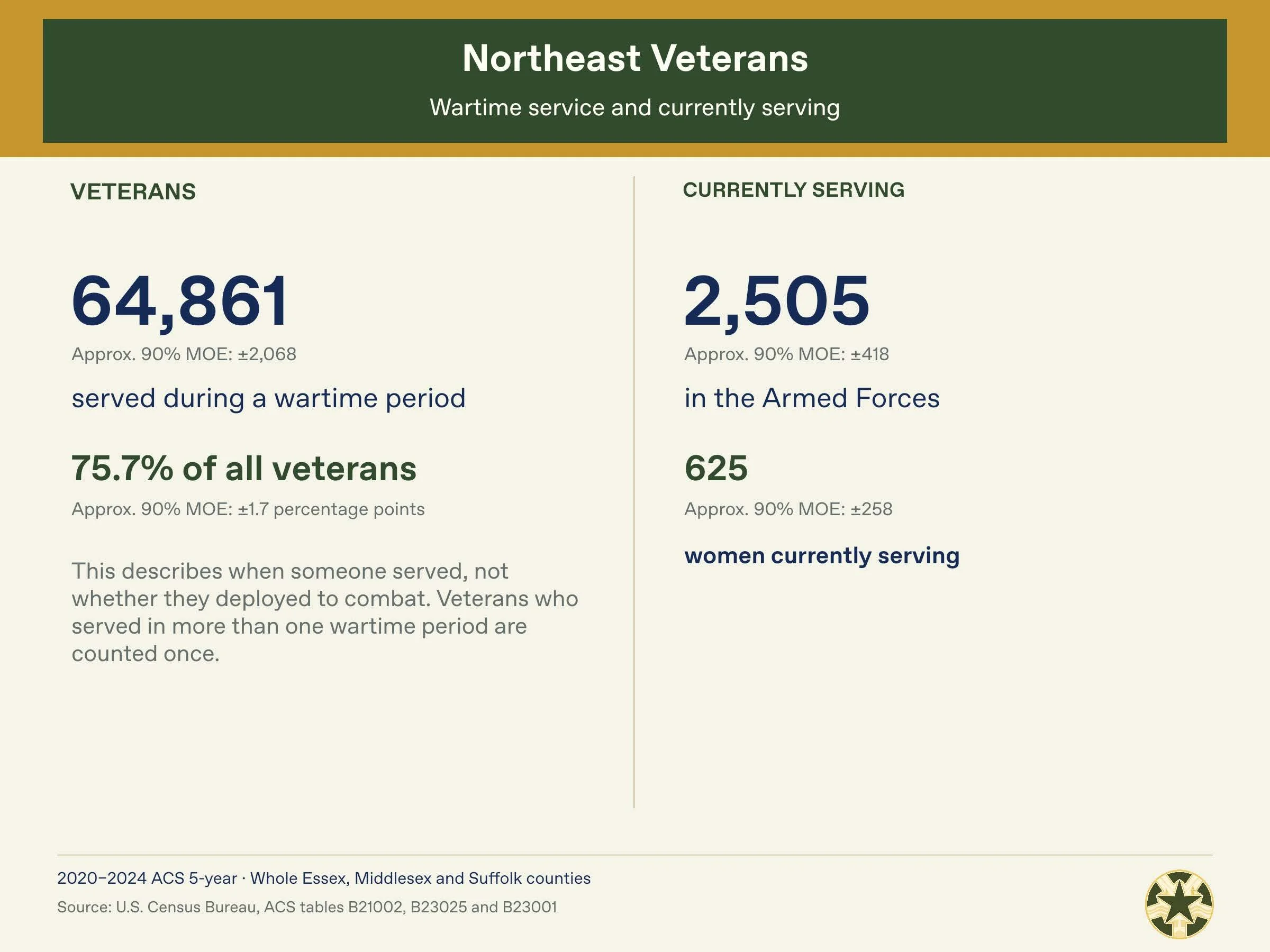
Women account for approximately 8.3 percent of veterans (7,126). Around 57 percent of veterans are age 65 or older (48,877), compared with 25.5 percent of women veterans (1,817). Approximately 76 percent of veterans served during a wartime period (64,861). An estimated 2,505 people are currently serving in the Armed Forces, including 625 women, or about 25 percent.
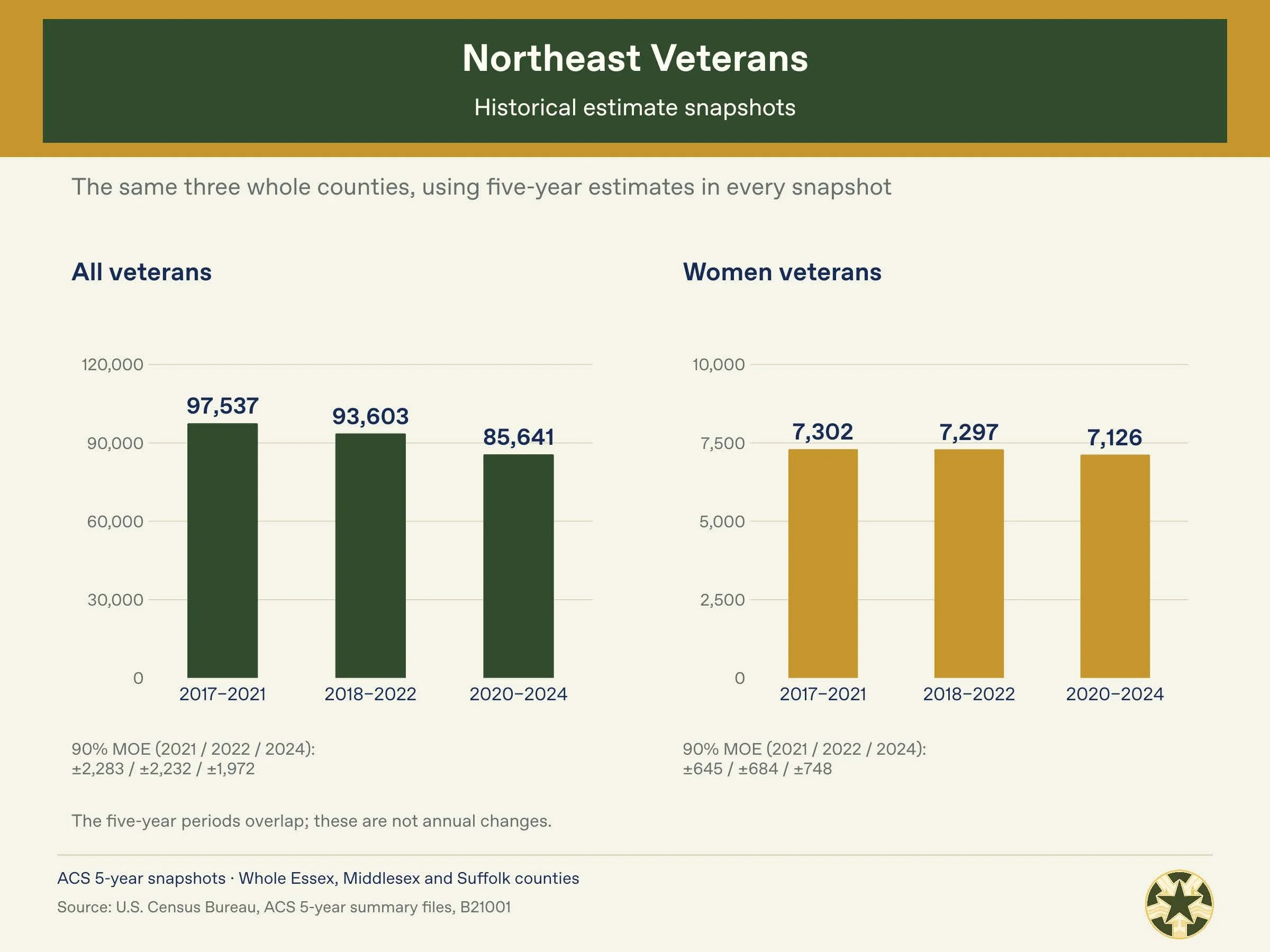
Between the 2021 and 2024 ACS 5-year estimates, the estimated veteran population decreased by 12.2 percent, from 97,537 to 85,641. The estimated number of women veterans decreased by 2.4 percent, from 7,302 to 7,126.
If you serve veterans and are trying to learn more about their demographics, explore the most recent ACS 5-year estimates from Census Reporter for cities and towns in Northeast Mass below.
-
Age by gender and veteran status, service era, service-connected disability, veteran status by educational attainment, age by veteran status and employment, median income by gender and veteran status, and sex by age by employment status with armed forces are available at the city and town level with 5-year estimates (most reliable).
Age by disability by veteran and poverty status is available with 5-year estimates and is used consistently in the analysis below. The more detailed age breakdown is also available with 1-year estimates for these counties. Check the release shown when comparing tables.
Age, sex, and veteran status data are also available by race and Hispanic origin. The links below cover cities and towns in Essex, Middlesex, and Suffolk Counties, along with whole-county data for the same area. City and town tables use ACS 5-year estimates. Check the release shown when comparing county tables.
White alone: cities and towns · whole-county data
Black or African American alone: cities and towns · whole-county data
American Indian and Alaska Native alone: cities and towns · whole-county data
Asian alone: cities and towns · whole-county data
Native Hawaiian and Other Pacific Islander alone: cities and towns · whole-county data
Some other race alone: cities and towns · whole-county data
Two or more races: cities and towns · whole-county data
White alone, not Hispanic or Latino: cities and towns · whole-county data
Hispanic or Latino: cities and towns · whole-county data
Hispanic or Latino includes people of any race. These categories overlap and should not be added together. Estimates for small groups can have substantial uncertainty; review the margins of error alongside them.
Age, Disability & Poverty Status
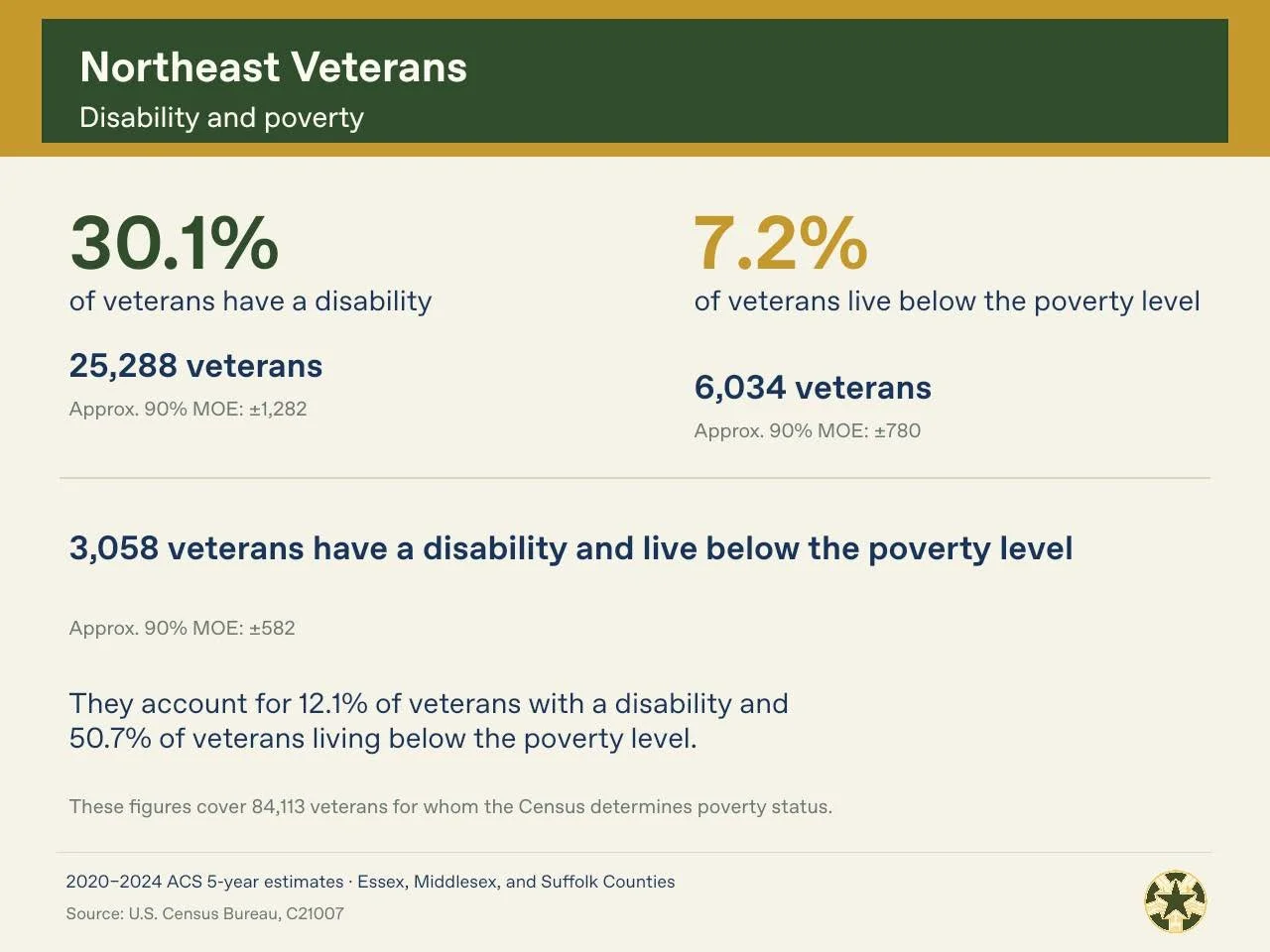
Based on the 2020–2024 ACS 5-year estimates, disability and poverty data are available for 84,113 veterans in Northeast Massachusetts. Around 30 percent reported a disability (25,288), and 7.2 percent had incomes below the poverty level (6,034).
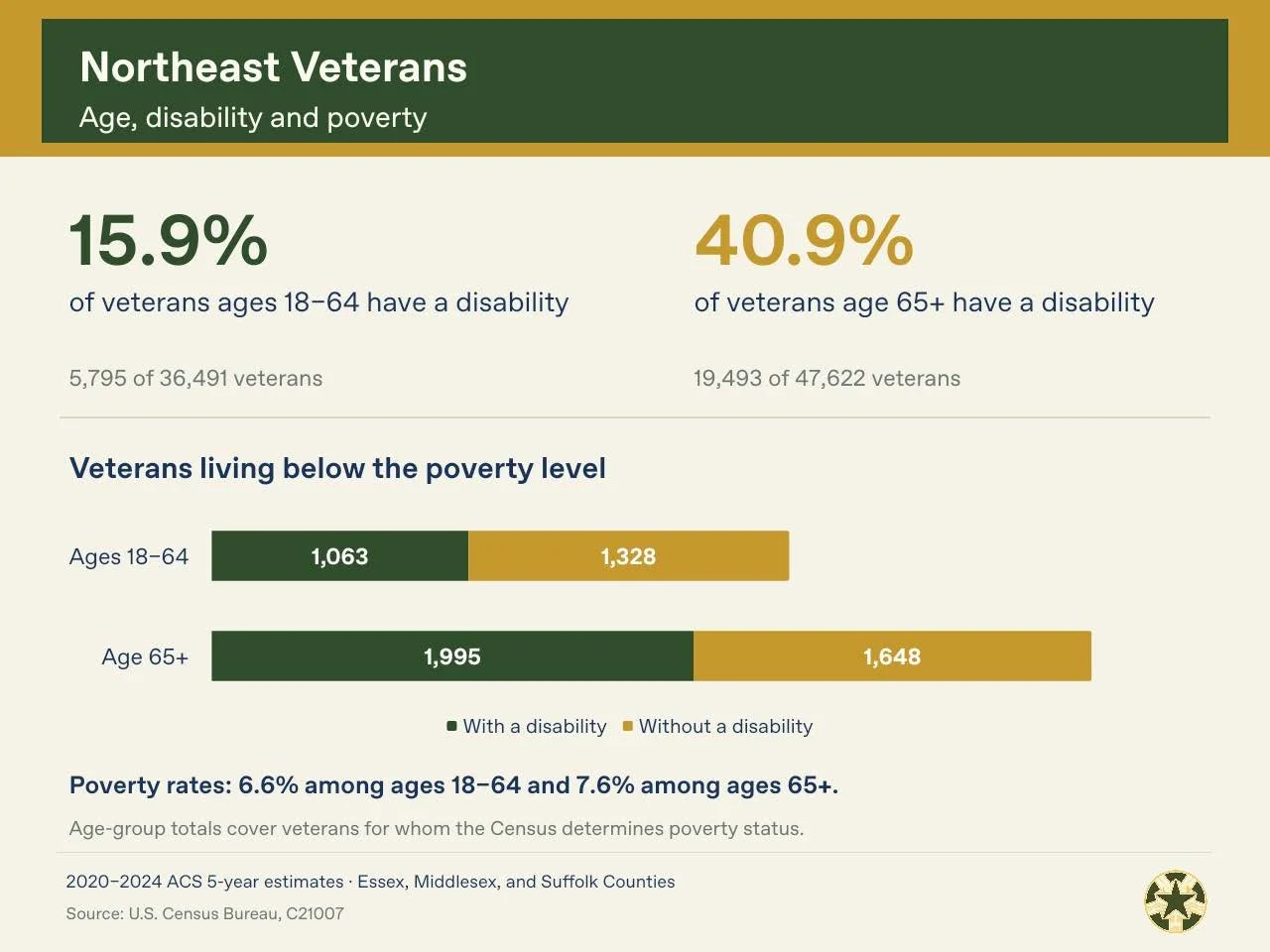
Among veterans age 65 or older with poverty-status data available, approximately 41 percent reported a disability (19,493), and 7.6 percent had incomes below the poverty level (3,643). Around 77 percent of veterans with disabilities were age 65 or older.
An estimated 3,058 veterans had both a disability and incomes below the poverty level. They made up about 12 percent of veterans with disabilities and 51 percent of veterans with incomes below the poverty level.
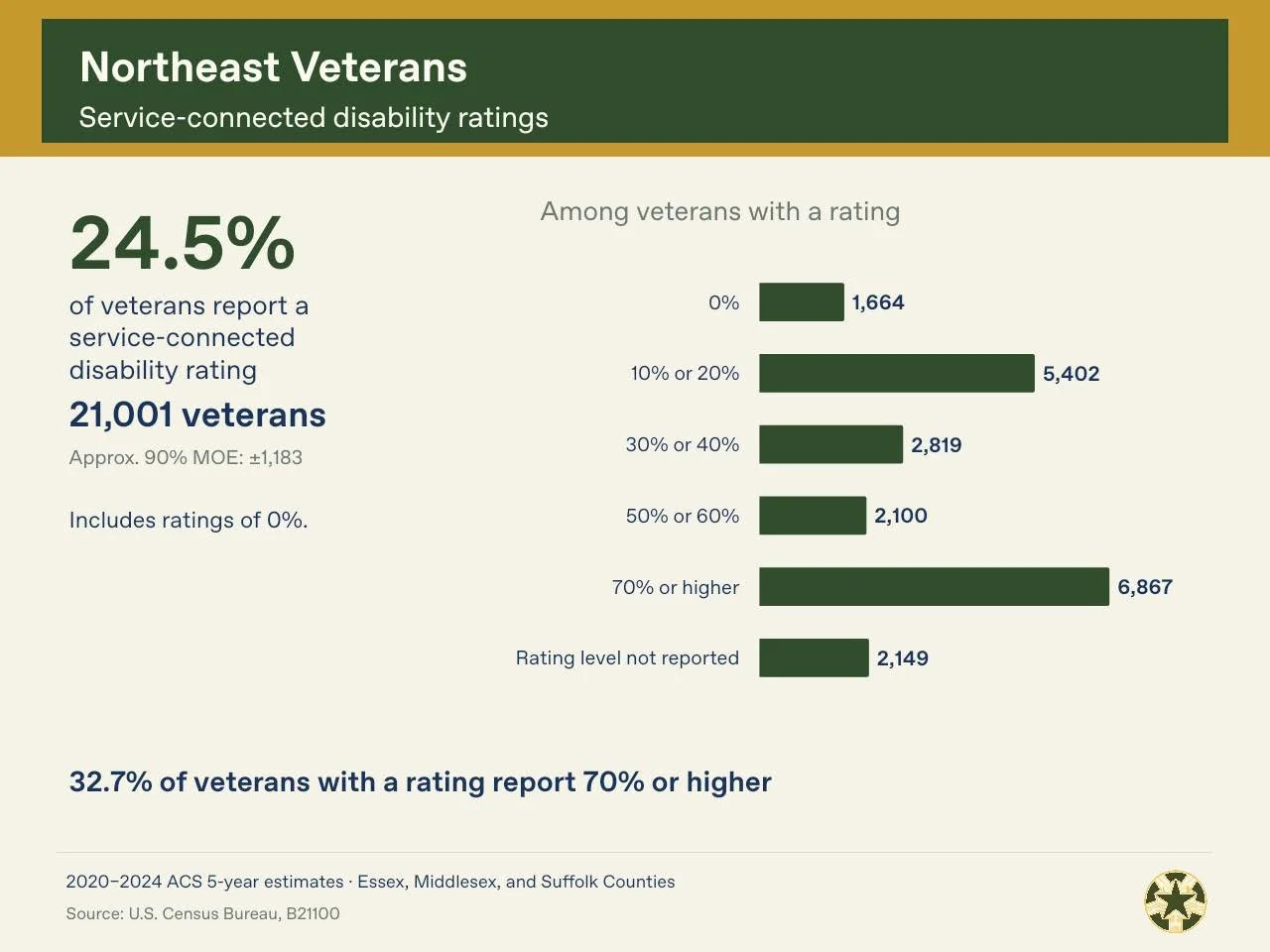
Approximately 24.5 percent of veterans reported a service-connected disability rating (21,001), including ratings of 0 percent. Among veterans with a rating, around 33 percent reported a rating of 70 percent or higher (6,867). Rating level was not reported for 2,149 veterans. These figures measure reported ratings rather than receipt of compensation payments.
Whether or not a veteran has time during a “wartime” service era determines whether a very low income veteran is potentially eligible for a VA Pension. Eligible veterans over age 65 may qualify for a VA pension whether or not they have a qualifying disability.
Approximately 76 percent of Northeast Massachusetts veterans served during a wartime period (64,861). The remaining 24 percent served only during peacetime (20,780). These estimates describe periods of service and do not establish eligibility for VA benefits.
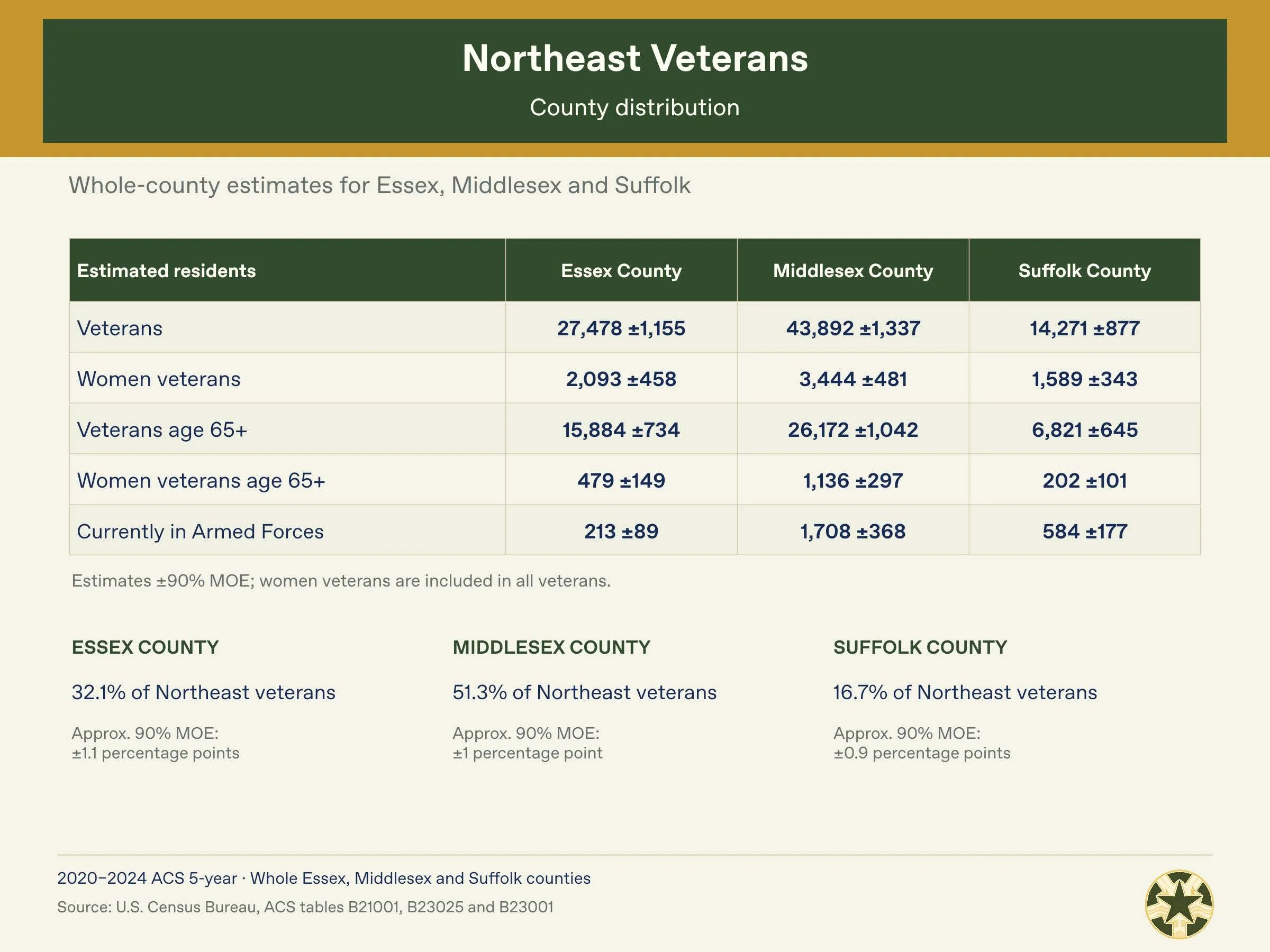
Around 17 percent of Northeast Massachusetts veterans live in Suffolk County (14,271).
Approximately 11.1 percent are women veterans (1,589).
Around 48 percent of veterans are age 65 or older (6,821), including 13 percent of women veterans (202).
Approximately 74 percent served during a wartime period (10,513).
Around 51 percent of Northeast Massachusetts veterans live in Middlesex County (43,892).
Approximately 7.8 percent are women veterans (3,444).
Around 60 percent of veterans are age 65 or older (26,172), including 33 percent of women veterans (1,136).
Approximately 77 percent served during a wartime period (33,639).
Around 32 percent of Northeast Massachusetts veterans live in Essex County (27,478).
Approximately 7.6 percent are women veterans (2,093).
Around 58 percent of veterans are age 65 or older (15,884), including 23 percent of women veterans (479).
Approximately 75 percent served during a wartime period (20,709).
Education, Employment & Median Annual Income
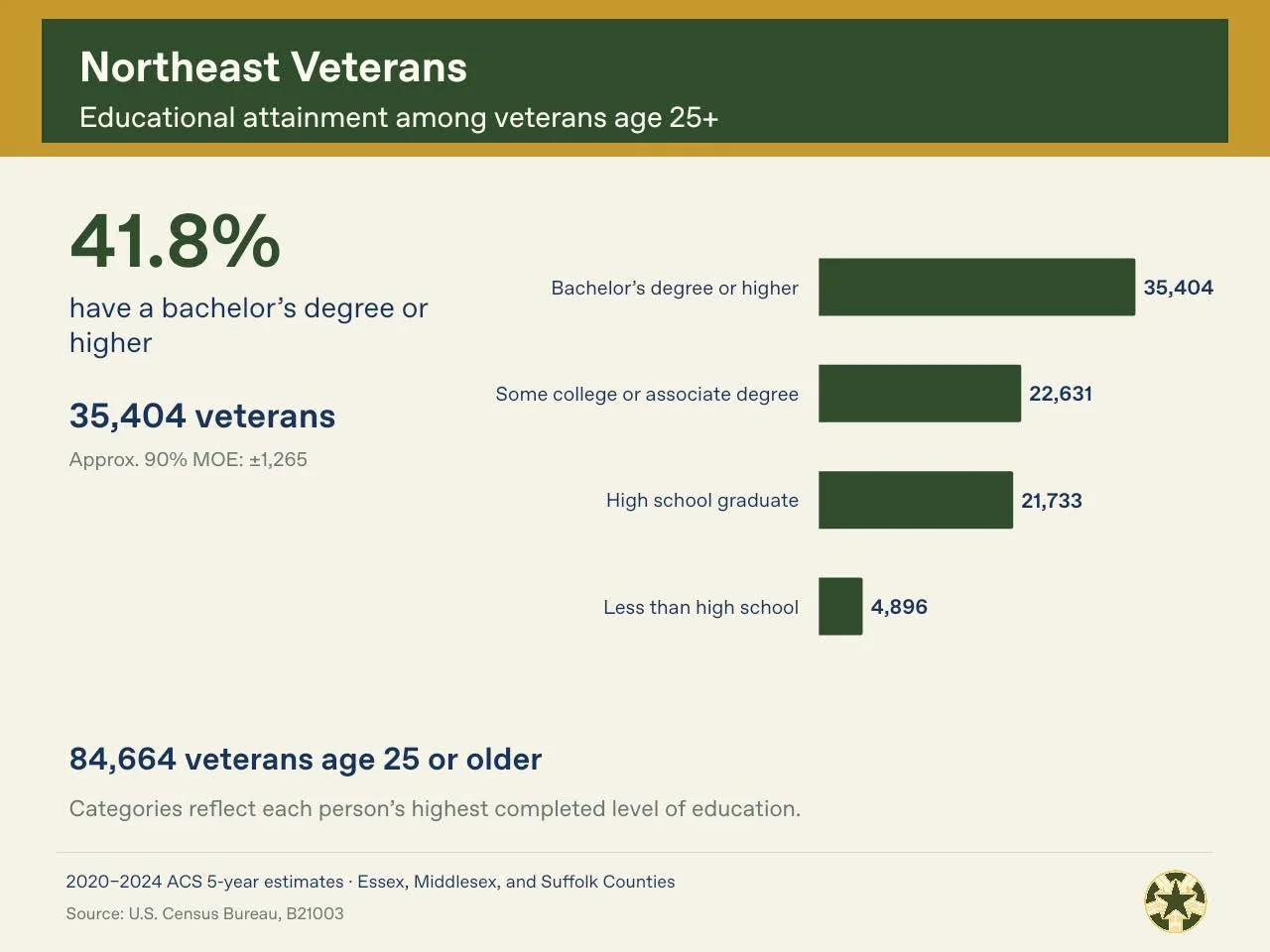
Among veterans age 25 or older, approximately 42 percent had a bachelor’s degree or higher (35,404). Around 27 percent had some college or an associate degree (22,631), 26 percent had a high school diploma or equivalent (21,733), and 6 percent had not completed high school (4,896).
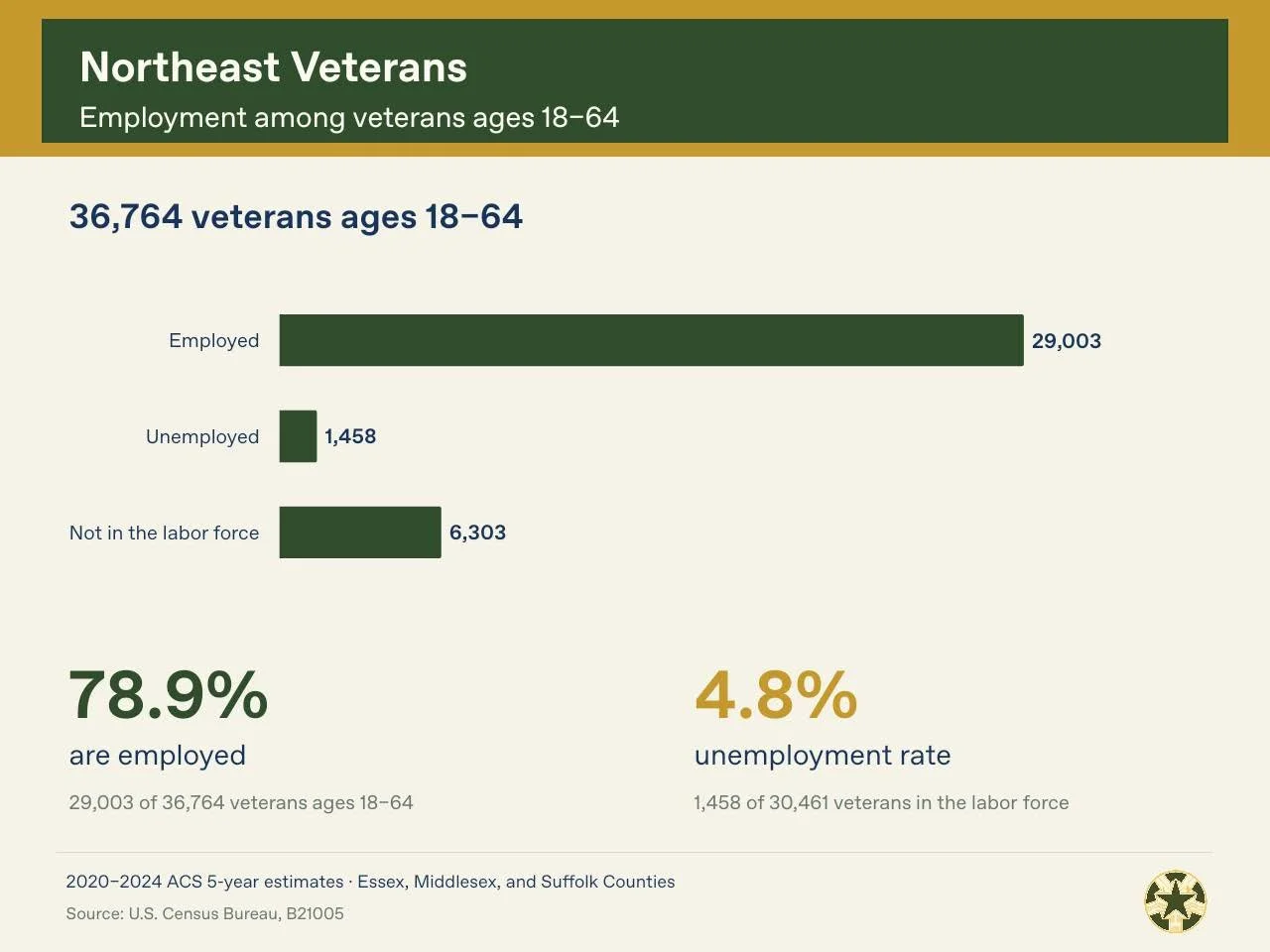
Among veterans ages 18–64, approximately 79 percent were employed (29,003), and 17 percent were outside the labor force (6,303). The unemployment rate was 4.8 percent, representing 1,458 unemployed veterans among the 30,461 in the labor force.
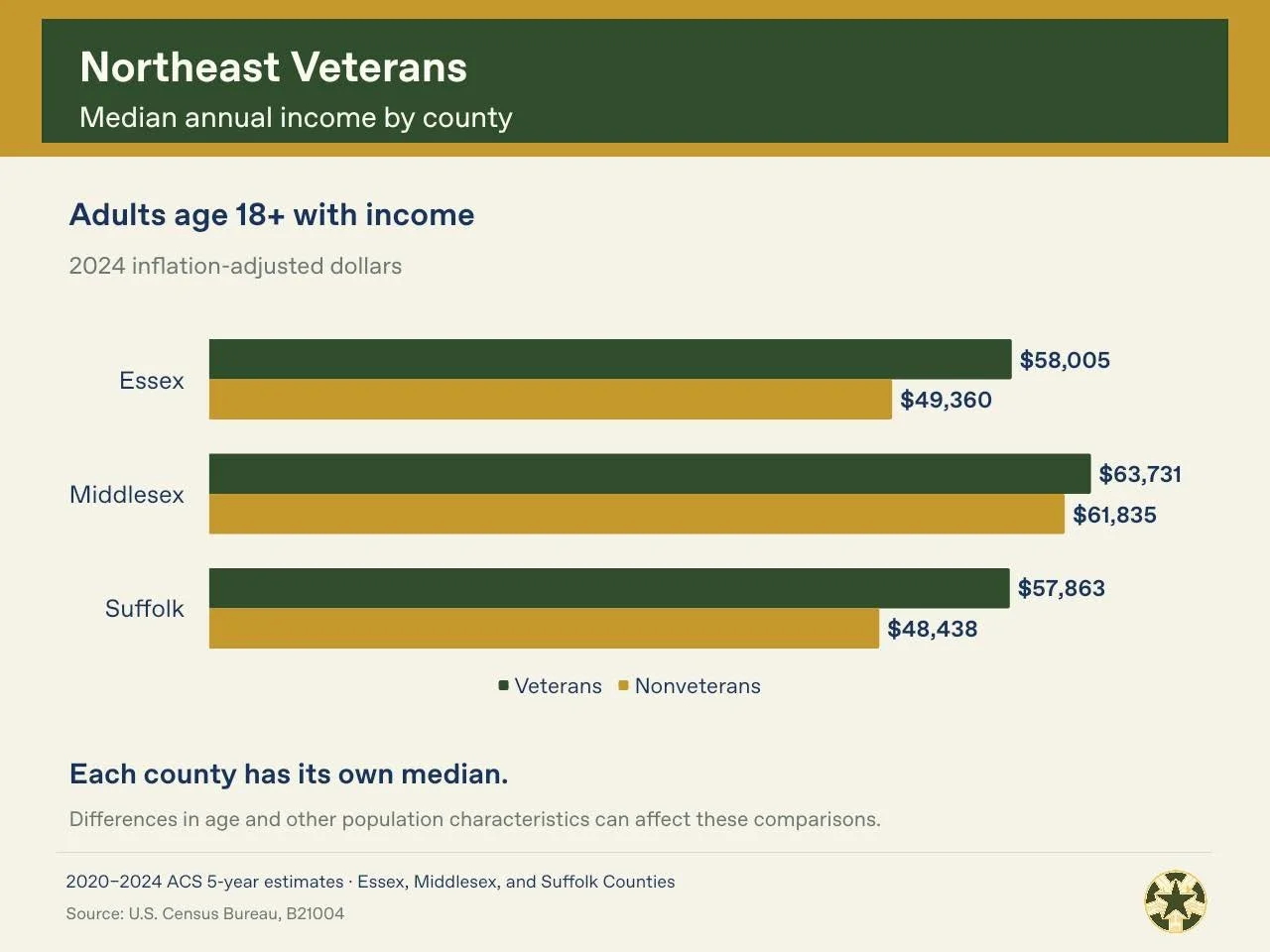
Median annual income among veterans with income was $58,005 in Essex County, $63,731 in Middlesex County, and $57,863 in Suffolk County. For nonveterans, the corresponding figures were $49,360, $61,835, and $48,438. These amounts are expressed in 2024 dollars.
VA Spending in Northeast Mass
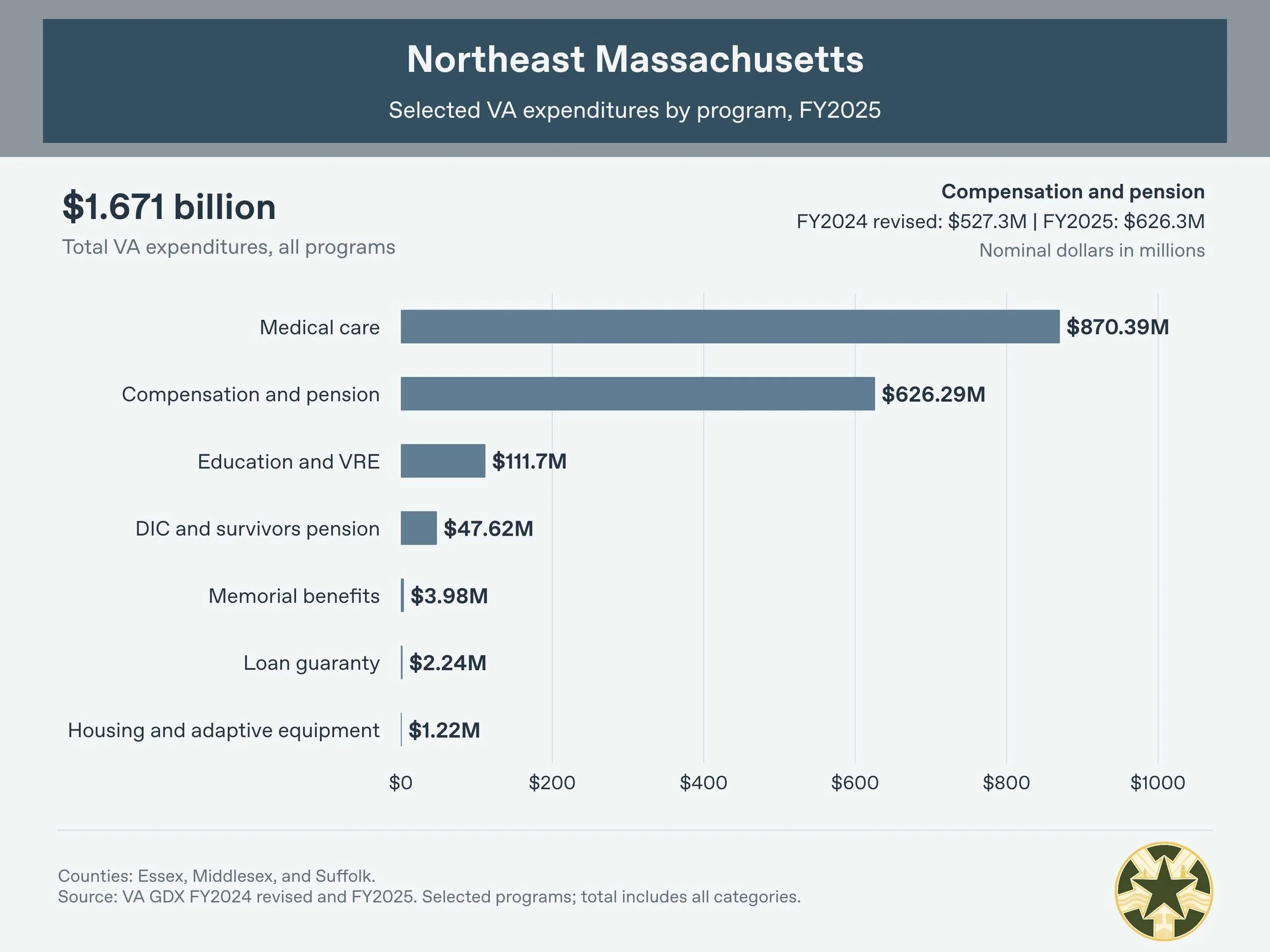
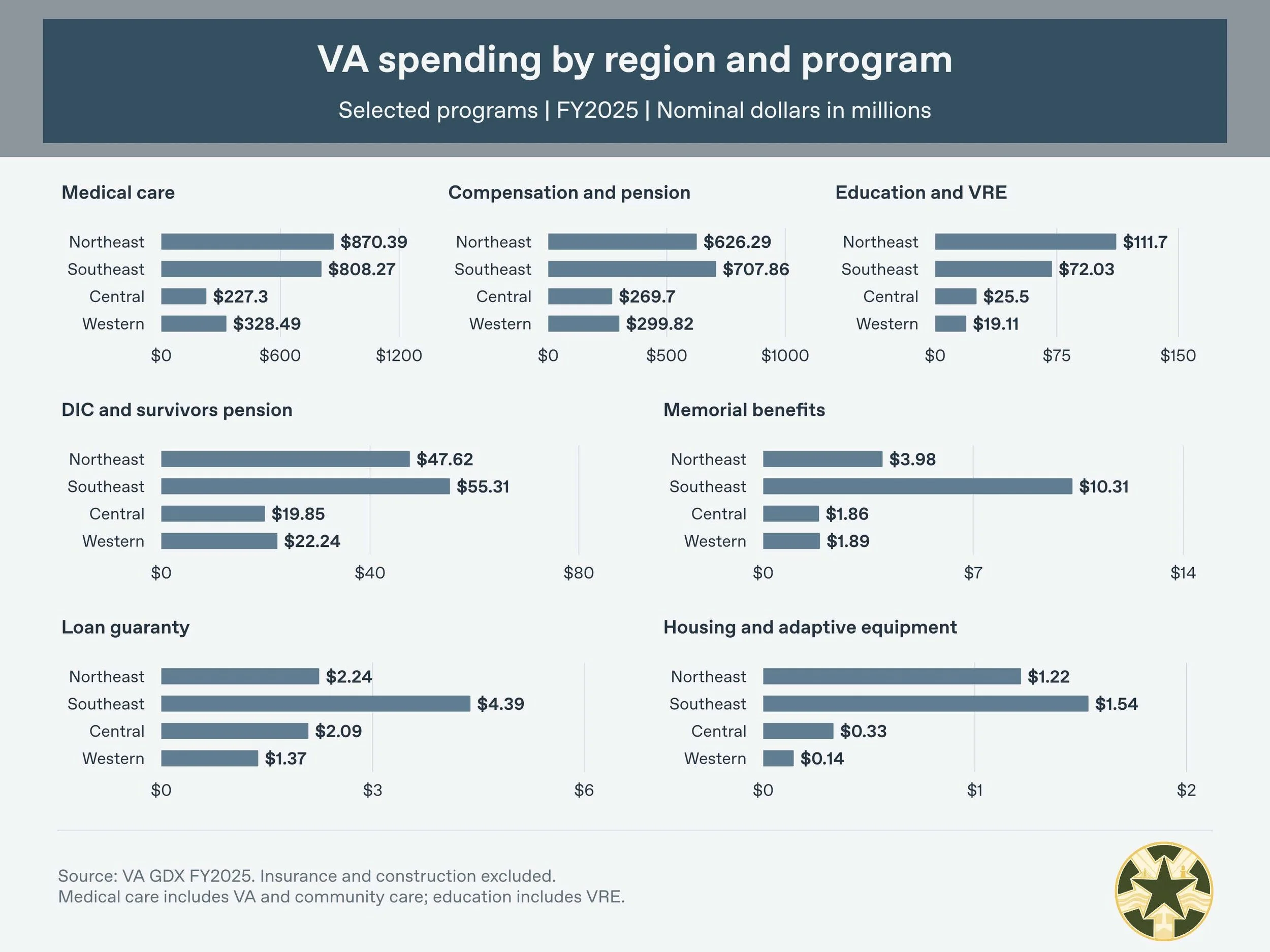
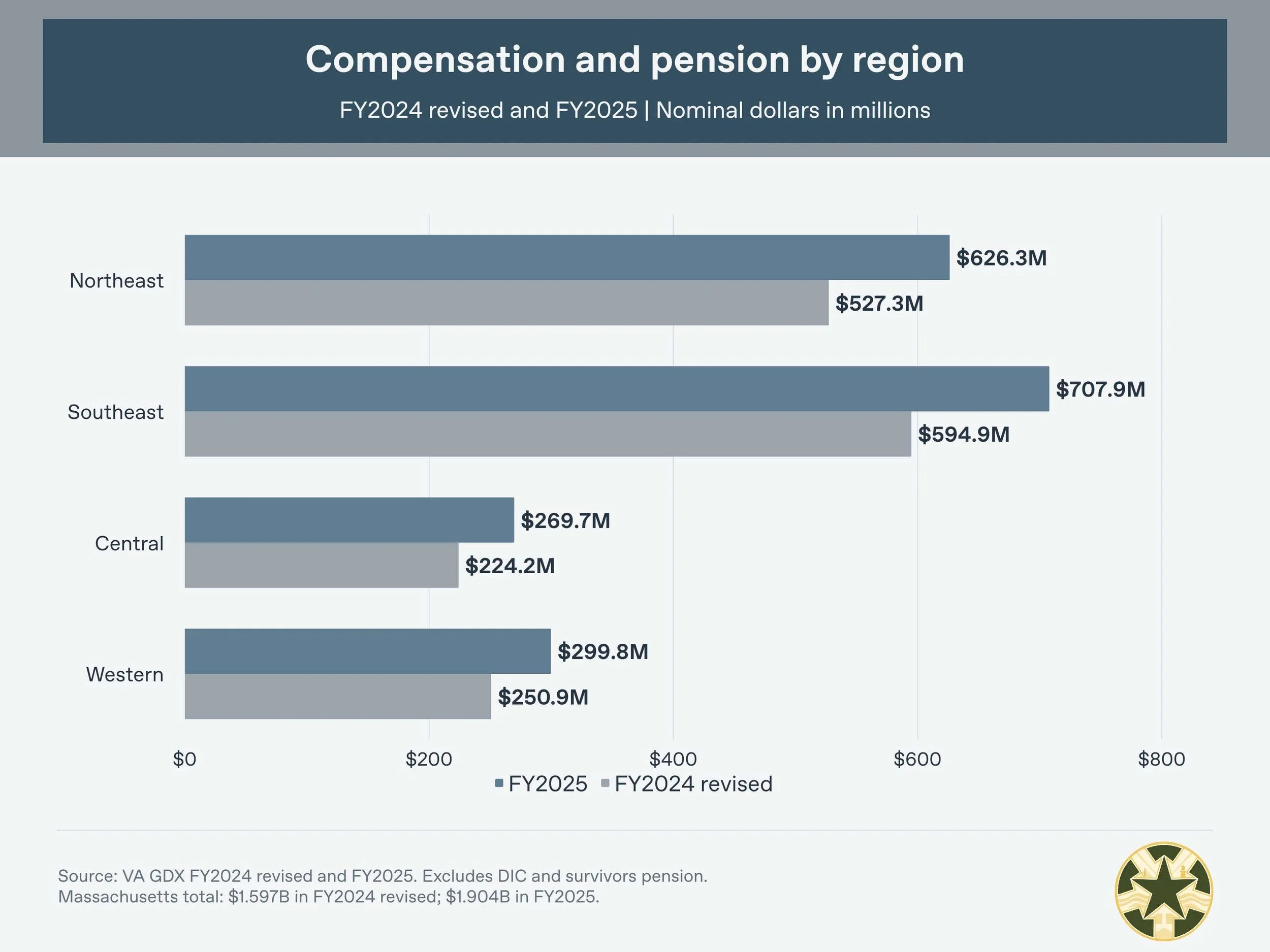
According to the latest VA Geographic Distribution of VA Expenditures (GDX) reports, VA compensation and pension spending in Northeast Massachusetts increased by 18.8 percent from $527.3 million in FY2024 to $626.3 million in FY2025. These figures cover Essex, Middlesex, and Suffolk counties. In FY2025, VA reported $1.671 billion in total spending in the region, including:
$870.4 million for medical care;
$626.3 million for compensation and pension; and
$111.7 million for education and employment programs.
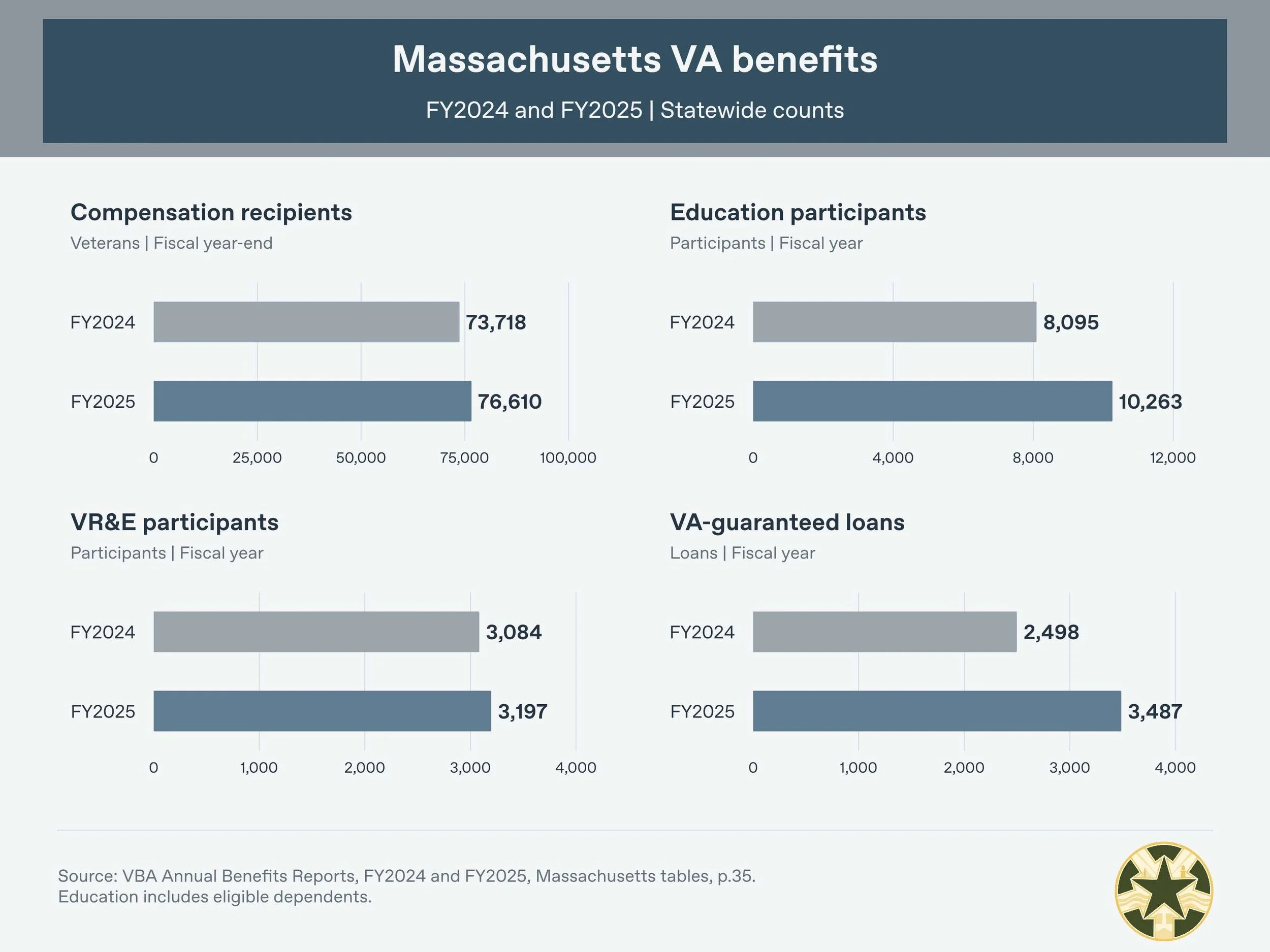
VA Annual Benefits Reports provide additional information about benefit programs, including the number of recipients, their characteristics, and program activity. In FY2025, Massachusetts had 76,610 disability compensation recipients, 10,263 education participants, 3,197 Veteran Readiness and Employment participants, and 3,487 VA-guaranteed loans.
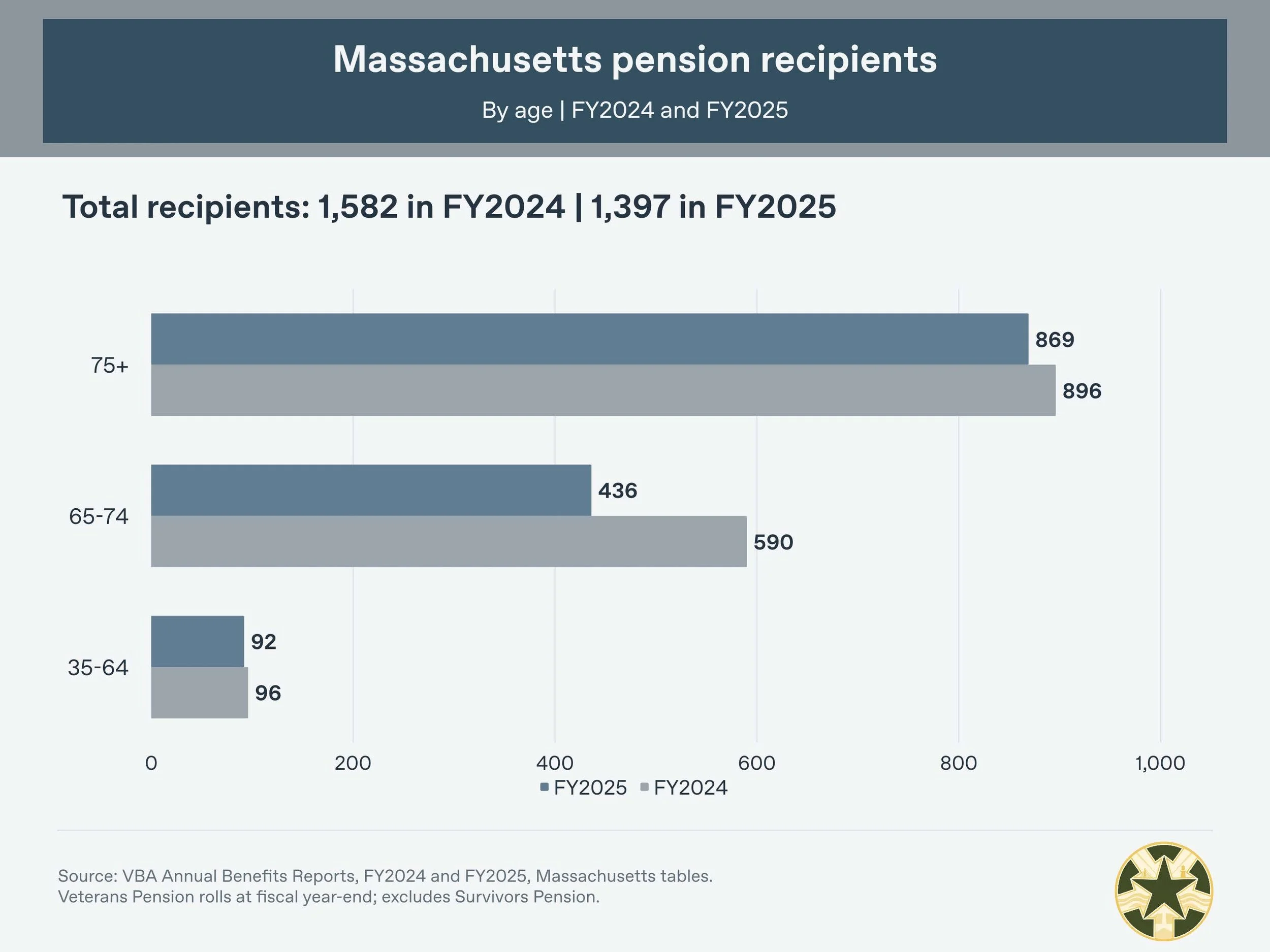
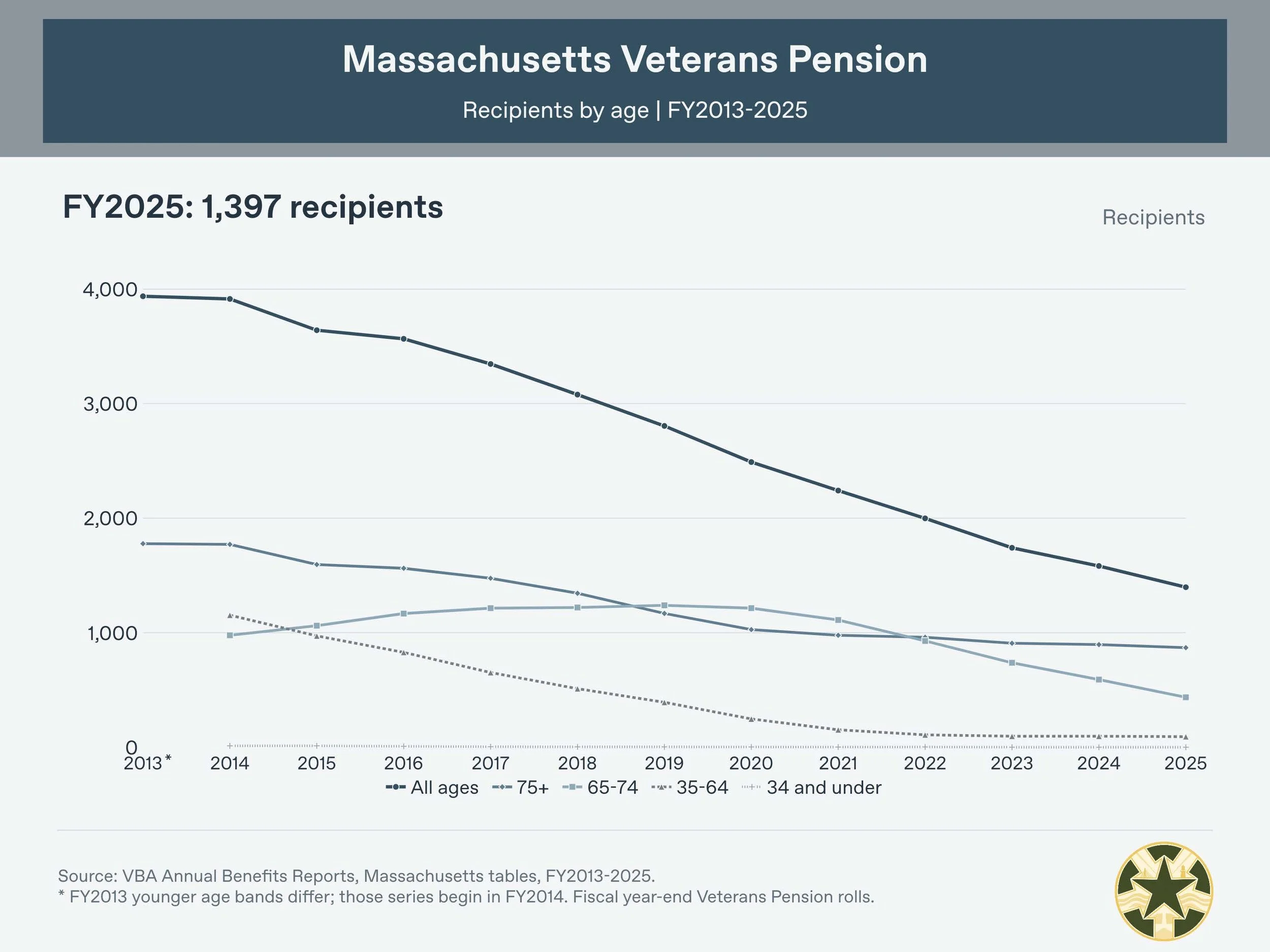
At the end of FY2025, 1,397 veterans were receiving VA pension in Massachusetts, with $18.6 million in estimated annual payments. Approximately 93.4 percent were age 65 or older (1,305). The number of Massachusetts wartime veterans receiving VA pension benefits has continued to decline from 1,582 veterans receiving $21.3 million in payments in FY2024, 1,998 veterans receiving $25.2 million in payments in FY2022, and 3,937 veterans receiving $43.1 million in FY2013.
These figures cover the whole state and are not broken down by county. The chart below shows pension recipients by age through FY2025. The payment estimate is a benefit-program measure rather than a GDX expenditure total.
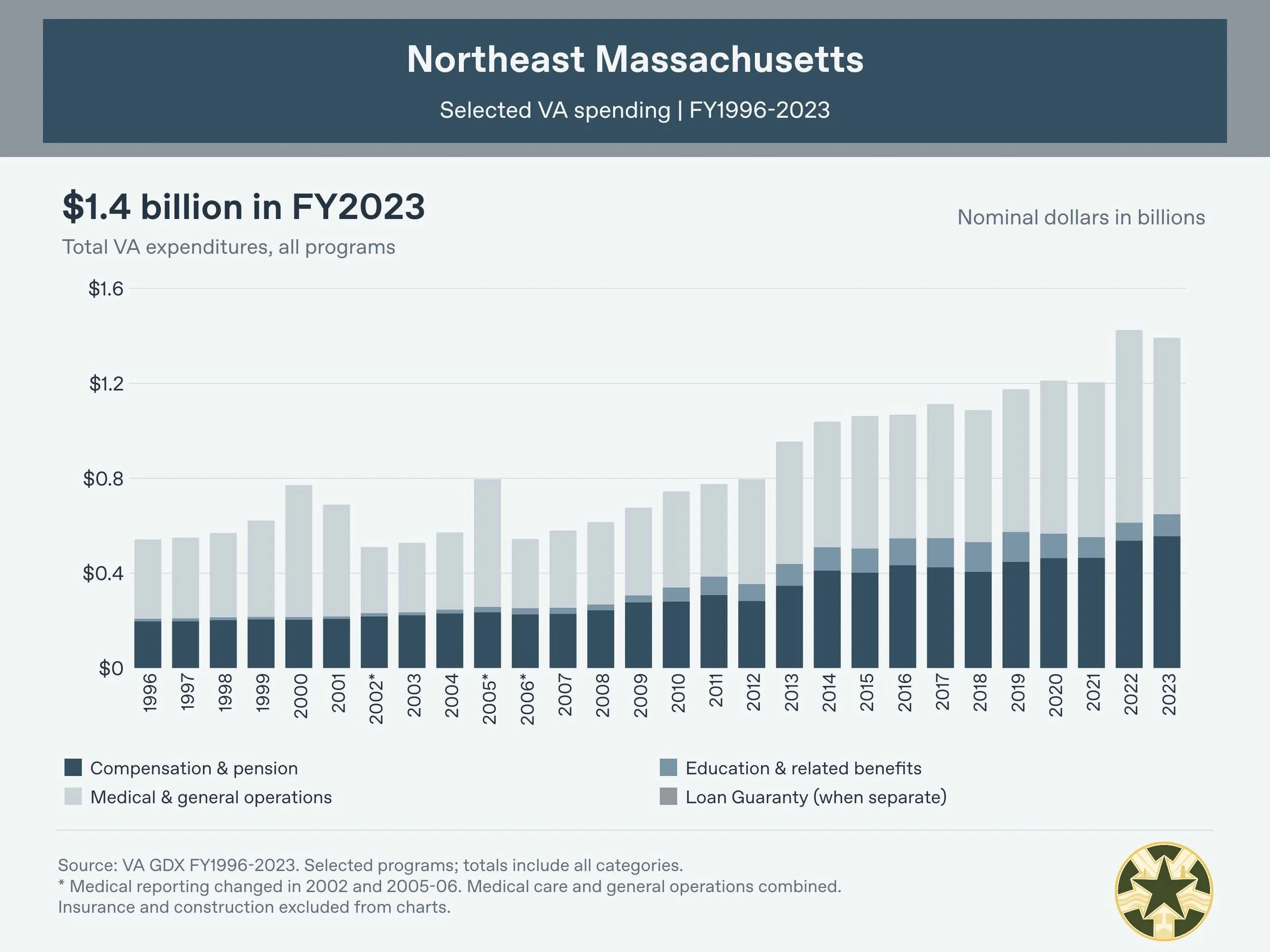
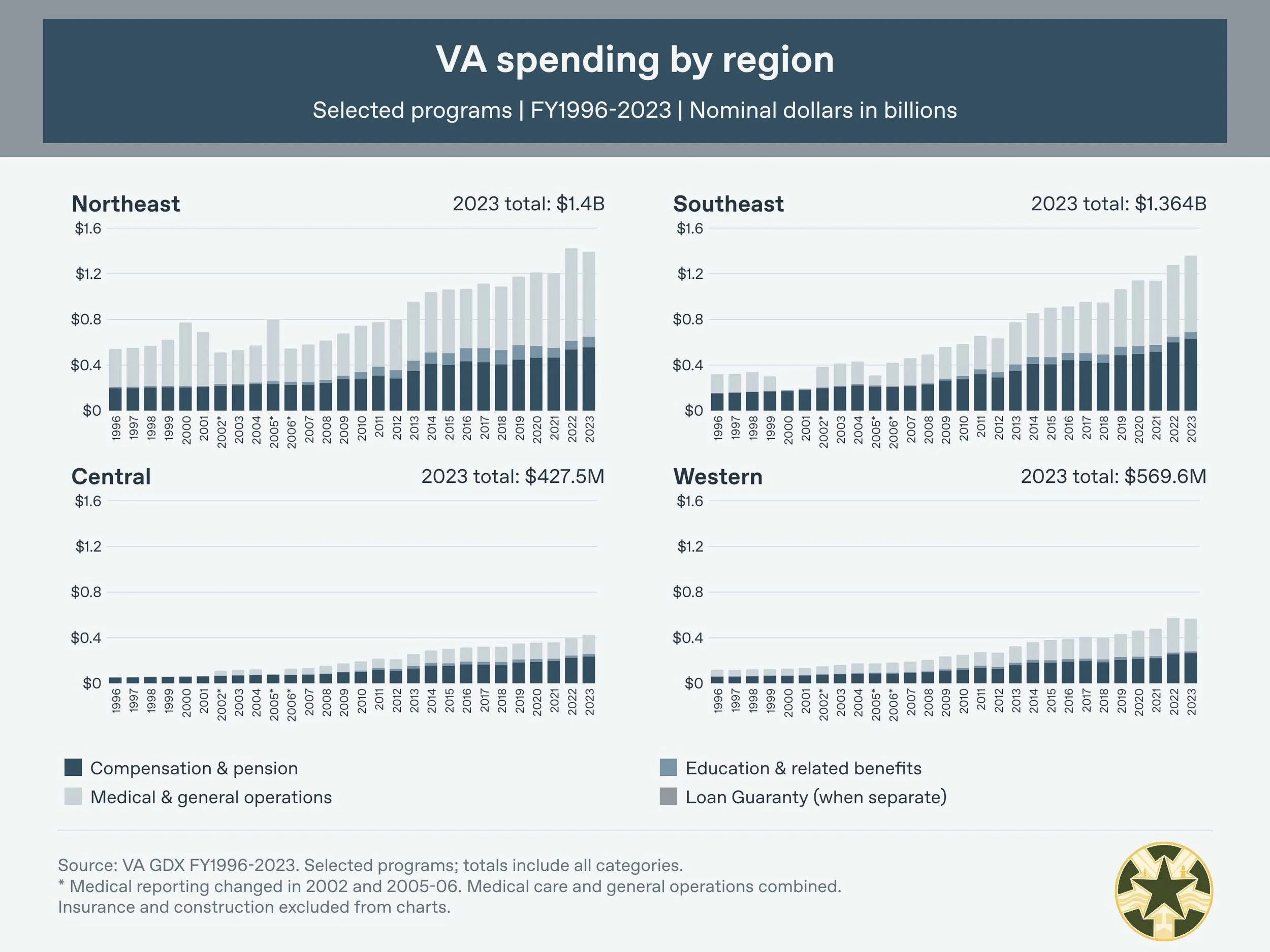
VA changed the GDX reporting methodology in FY2024, moving from financial transaction codes toward individual and program office records, with recipients’ addresses and facility or project locations used to assign spending geographically. Program categories also changed. Compensation and pension previously included Dependency and Indemnity Compensation (DIC) and burial allowances, which now appear in separate categories, affecting where spending appears and what the totals include.
Veteran Homelessness in Northeast Mass
HUD’s Continuum of Care (CoC) Program is designed to promote community-wide commitment to the goal of ending homelessness. Massachusetts has 10 regional CoCs, including the Boston, Cambridge, Lynn, and Massachusetts Balance of State CoCs serving communities in Northeast Massachusetts.
The Balance of State CoC’s full coverage area includes communities in Southeast Mass as well, so its full count cannot be treated as a Northeast-only total. Within Northeast Mass, the Balance of State CoC covers all of Middlesex County except Cambridge; all of Essex County except Lynn; and all of Suffolk County except Boston. In Southeast Mass, it covers most of Norfolk County and, as of 2026, it also covers Fall River in Bristol County.
During the last 10 days of January, CoCs conduct a Point-in-Time Count of people experiencing sheltered and unsheltered homelessness on a single night. In 2024, veterans made up around 1.9 percent of the homeless population counted in Massachusetts, down from 2.8 percent in 2023.
There were 550 Massachusetts veterans experiencing homelessness during the 2024 Point-in-Time Count, including 71 women, who made up 12.9 percent of homeless veterans in the state. The total remained at 550 veterans in 2025. Women veteran homelessness could not be compared in 2025 because HUD did not collect gender data as part of that year’s Point-in-Time submission.
Across these four CoCs, the number of homeless veterans counted decreased by 9.9 percent, from 283 in 2024 to 255 in 2025. Together, they accounted for 46.4 percent of homeless veterans counted in Massachusetts in 2025. The total included 71 veterans in emergency shelter, 143 in transitional housing, 24 in Safe Haven housing, and 17 unsheltered veterans.
The 2025 Point-in-Time Count showed different changes across the CoCs serving Northeast Massachusetts:
Boston: The number of veterans counted decreased from 187 in 2024 to 175 in 2025, a 6.4 percent decrease. The 2025 count included 22 veterans in emergency shelter, 125 in transitional housing, 24 in Safe Haven housing, and 4 unsheltered veterans.
Cambridge: The number decreased from 22 to 14 veterans, a 36.4 percent decrease, including 11 in emergency shelter and 3 unsheltered veterans in 2025.
Lynn: The number increased from 2 to 3 veterans, all in emergency shelter in 2025.
Massachusetts Balance of State: Across its full service area, the number decreased from 72 to 63 veterans, a 12.5 percent decrease, including 35 in emergency shelter, 18 in transitional housing, and 10 unsheltered veterans in 2025.
The number of homeless women veterans counted across these four CoCs decreased by 4.7 percent, from 43 in 2023 to 41 in 2024, accounting for 57.7 percent of homeless women veterans counted in Massachusetts in 2024. The 2024 total included 24 women in emergency shelter, 12 in transitional housing, 3 in Safe Haven housing, and 2 unsheltered women veterans.
In the 2024 Point-in-Time Count, 21 women veterans were counted in Boston, 2 in Cambridge, 1 in Lynn, and 17 across the full Balance of State CoC.
The 89 Northeast Massachusetts communities represented in the Balance of State CoC are home to approximately 69,573 veterans, or around 81.2 percent of the region’s veteran population, based on the 2020–2024 ACS 5-year estimates. The Balance of State chart includes these communities alongside 26 Norfolk County communities in Southeast Massachusetts. Its homelessness counts therefore describe the full CoC, not Northeast Massachusetts alone.
Housing Advisory Council
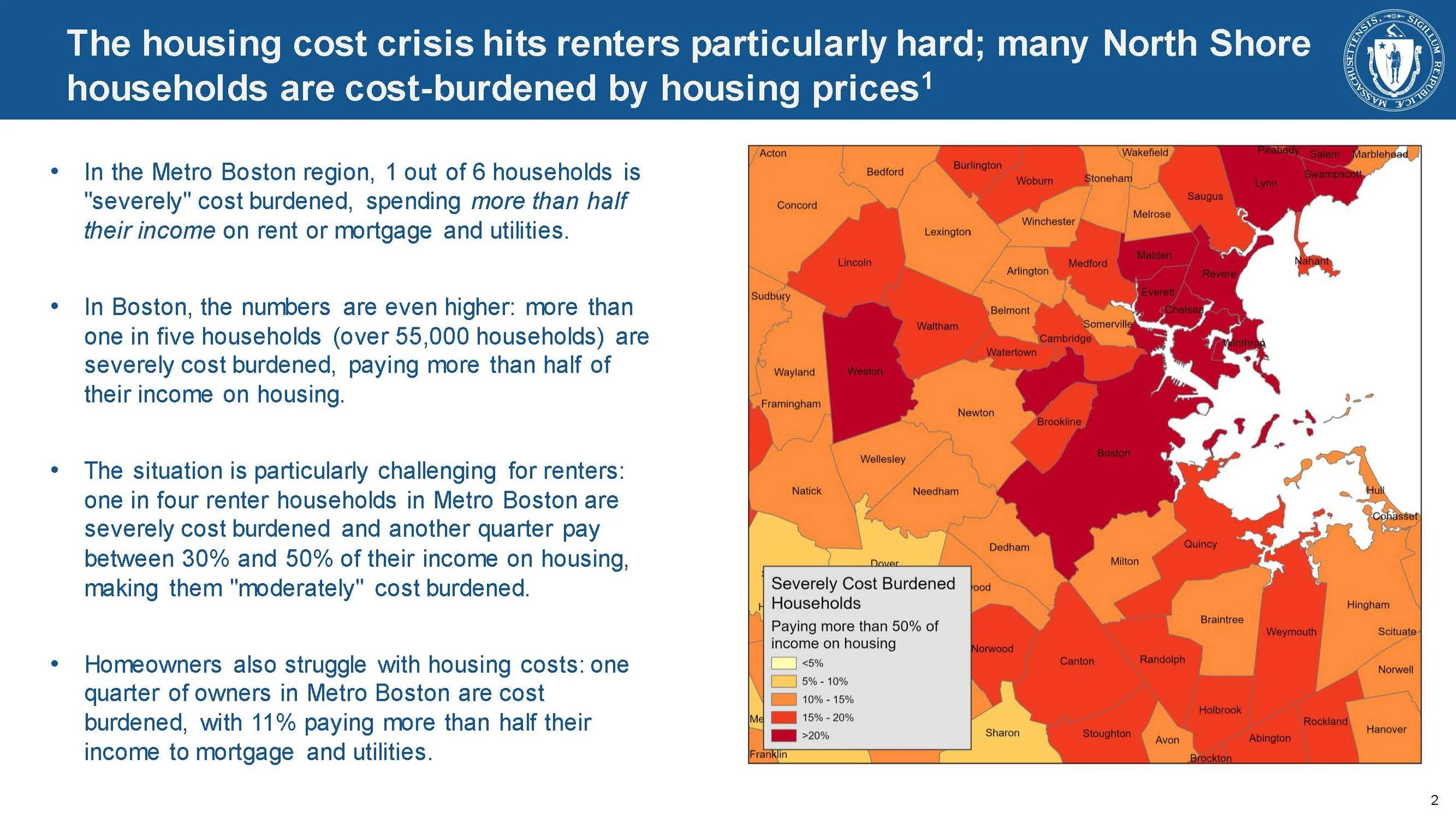
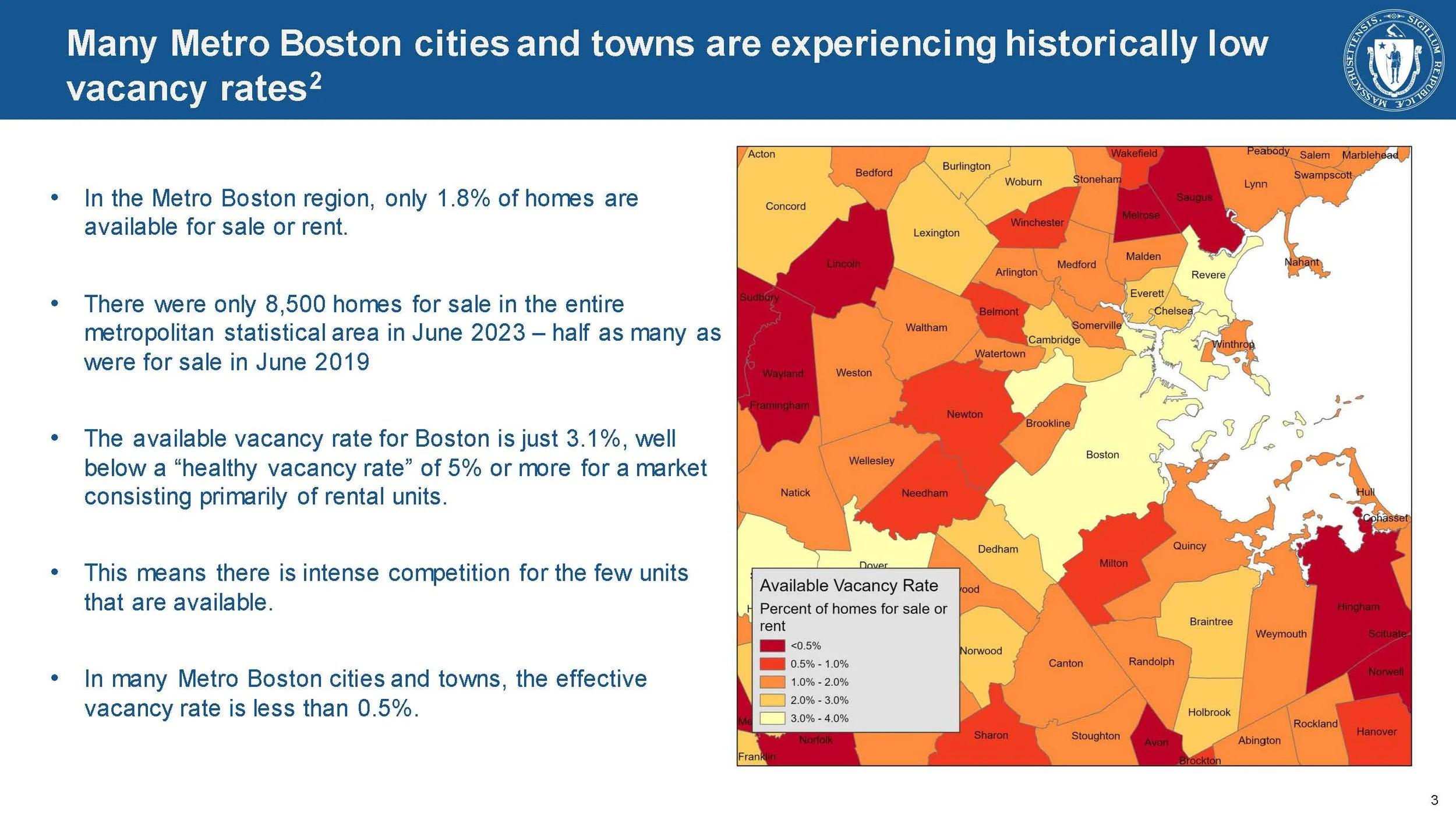
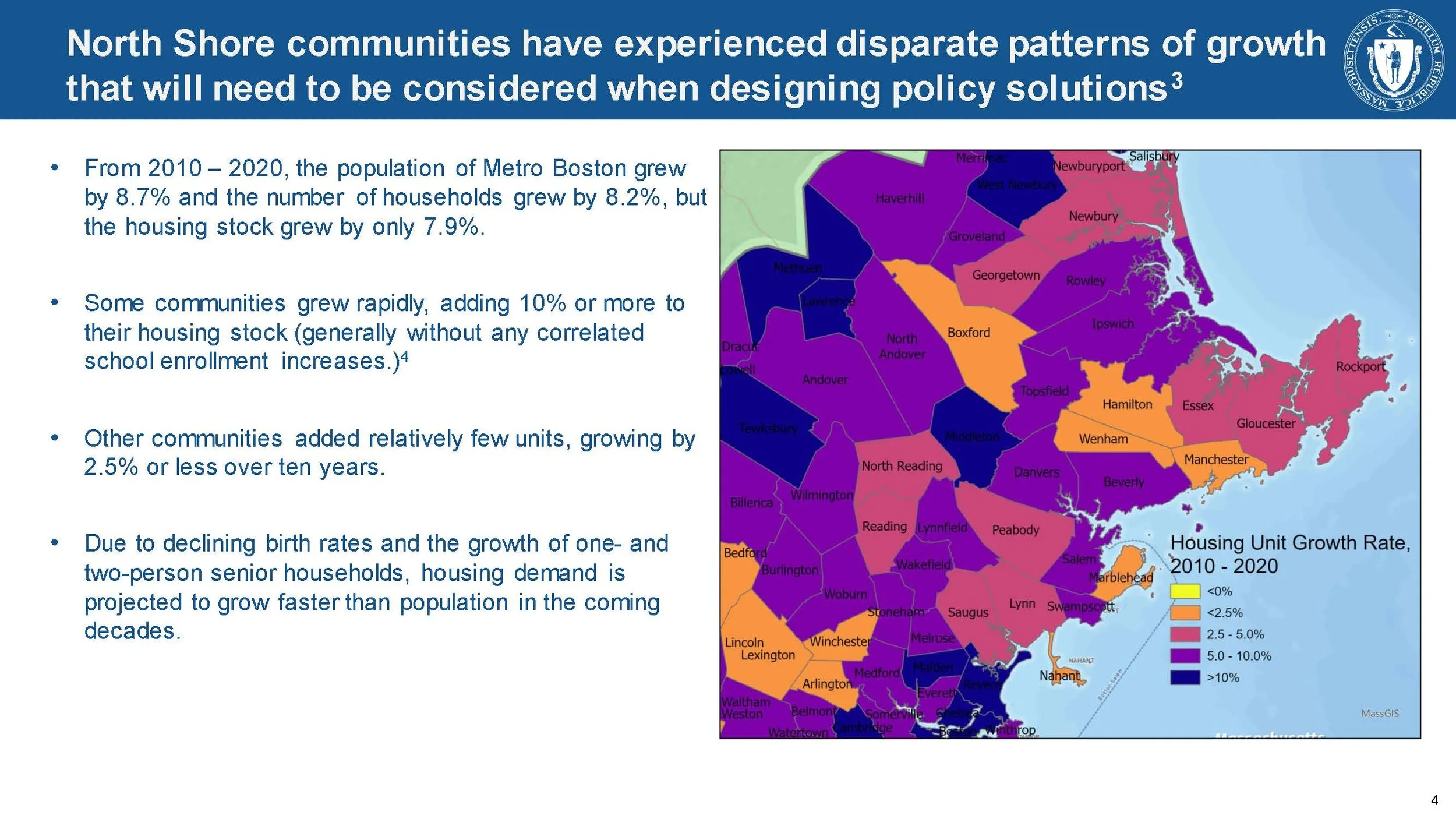
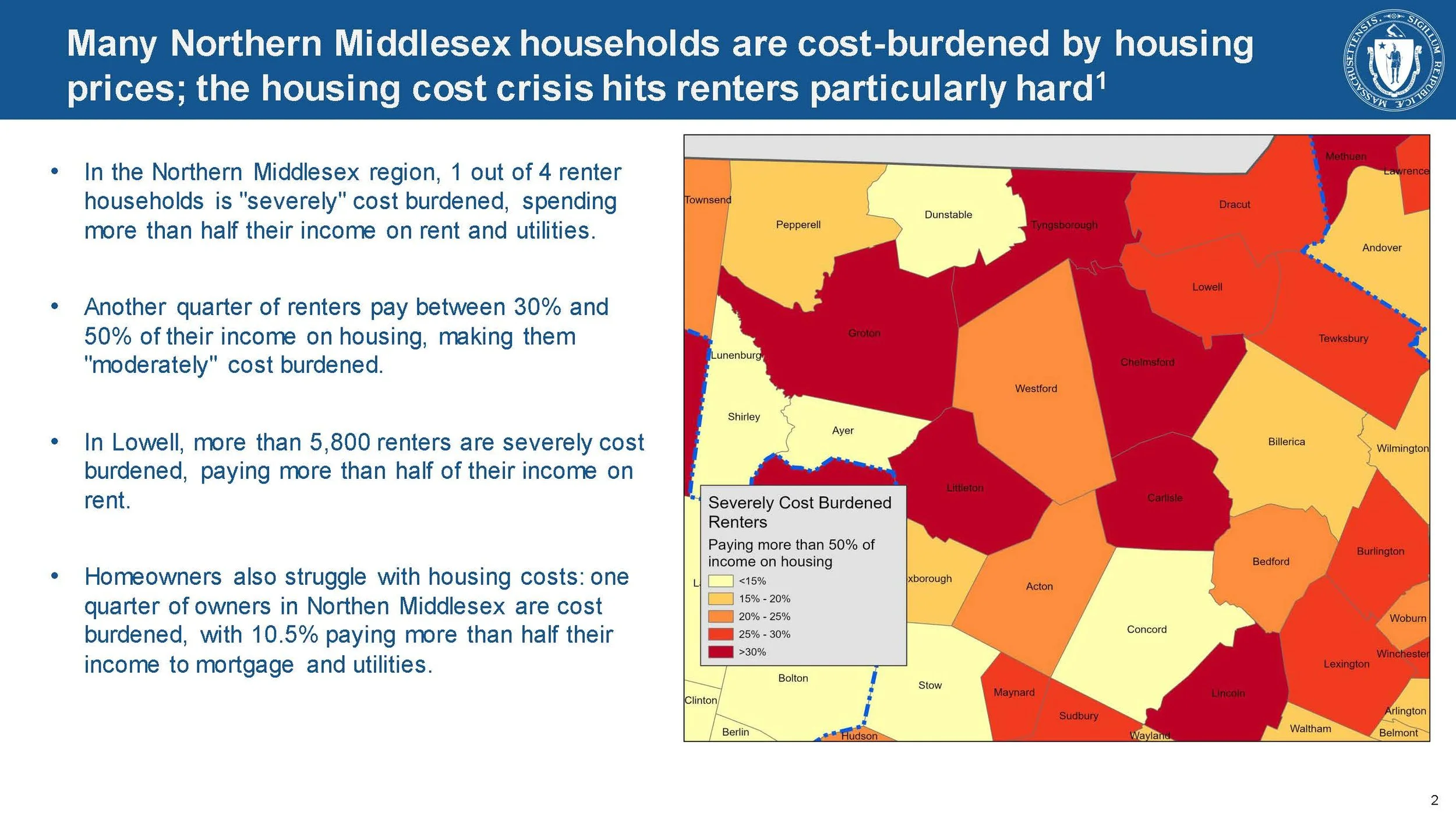
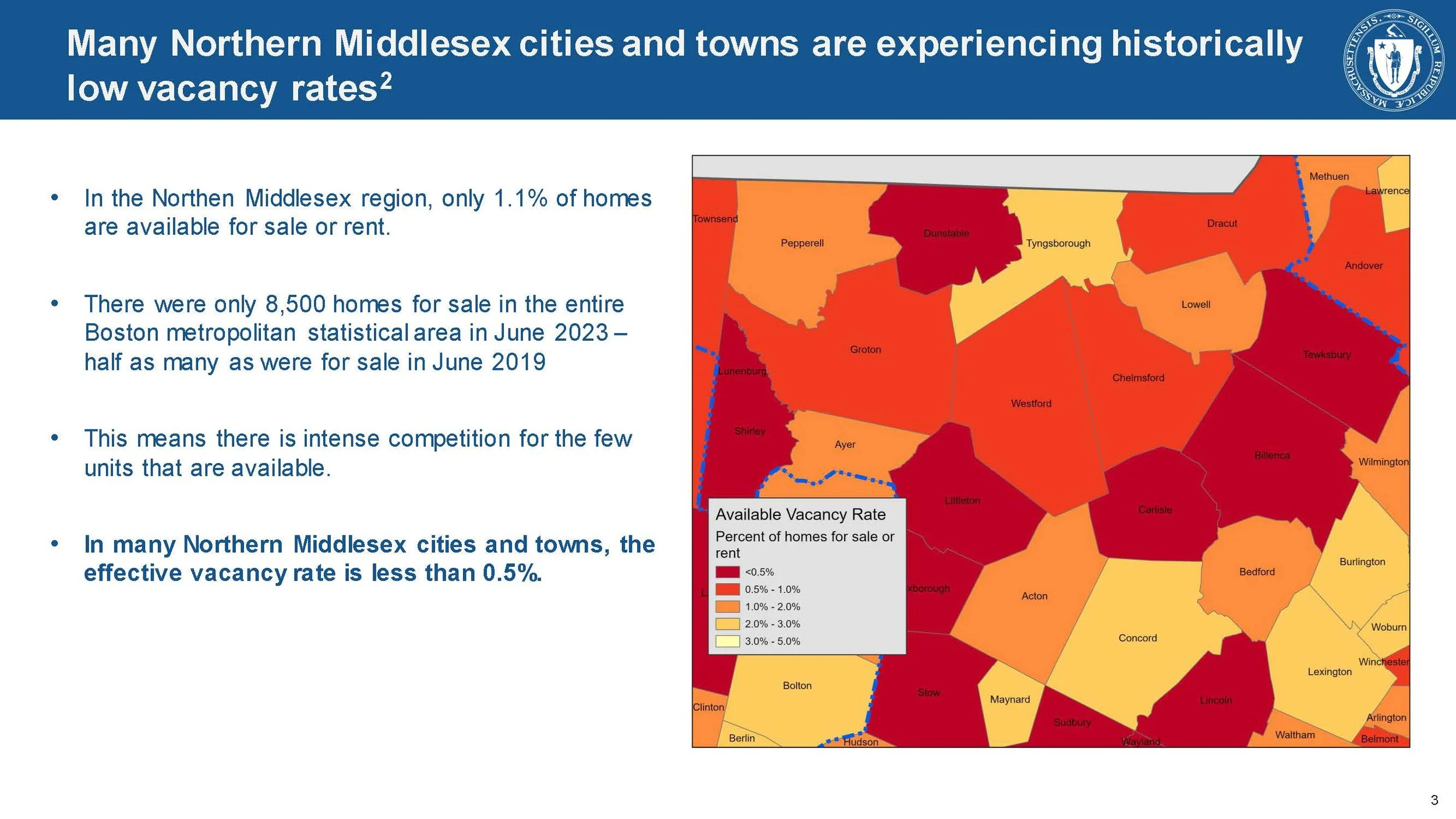
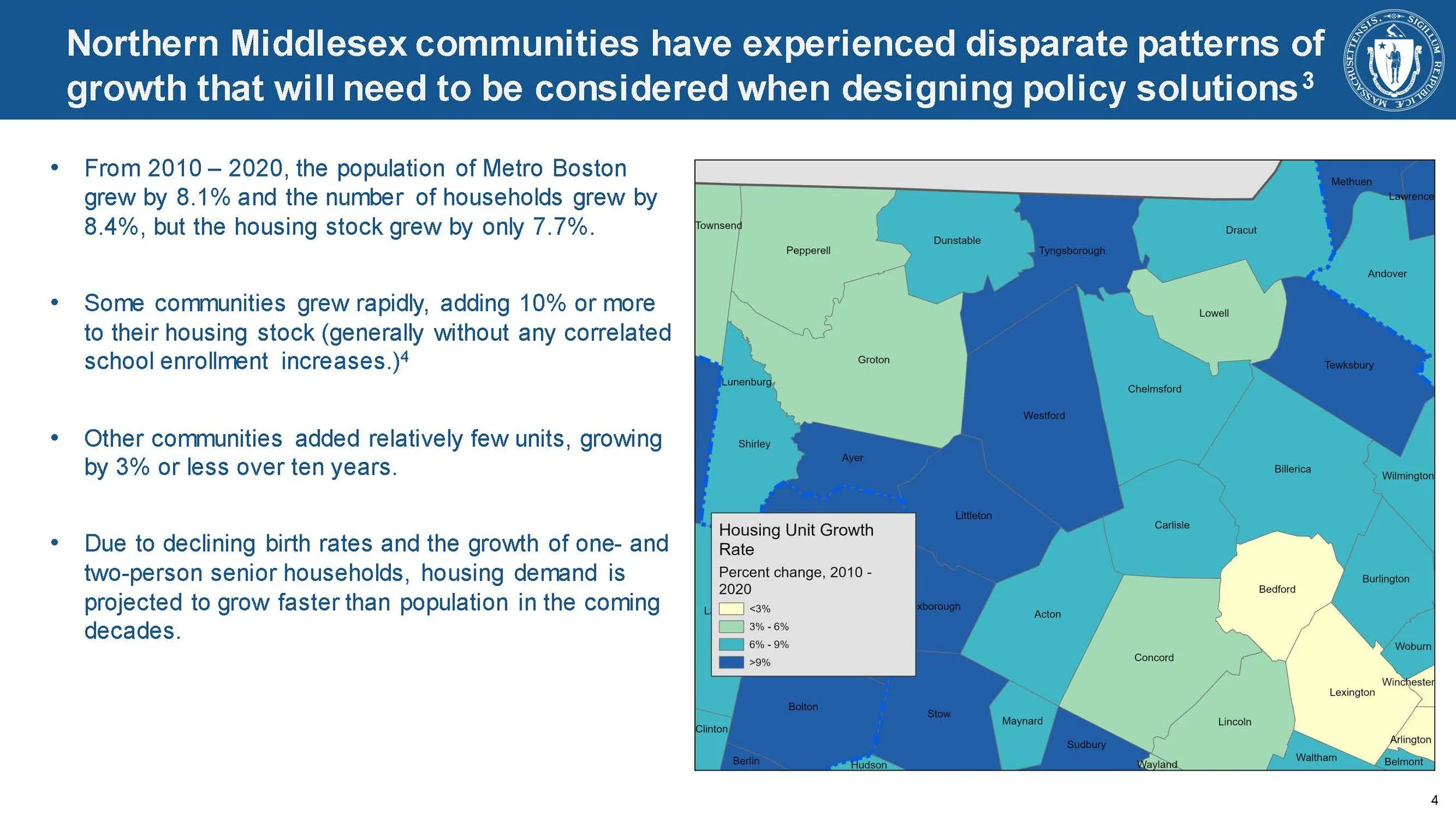
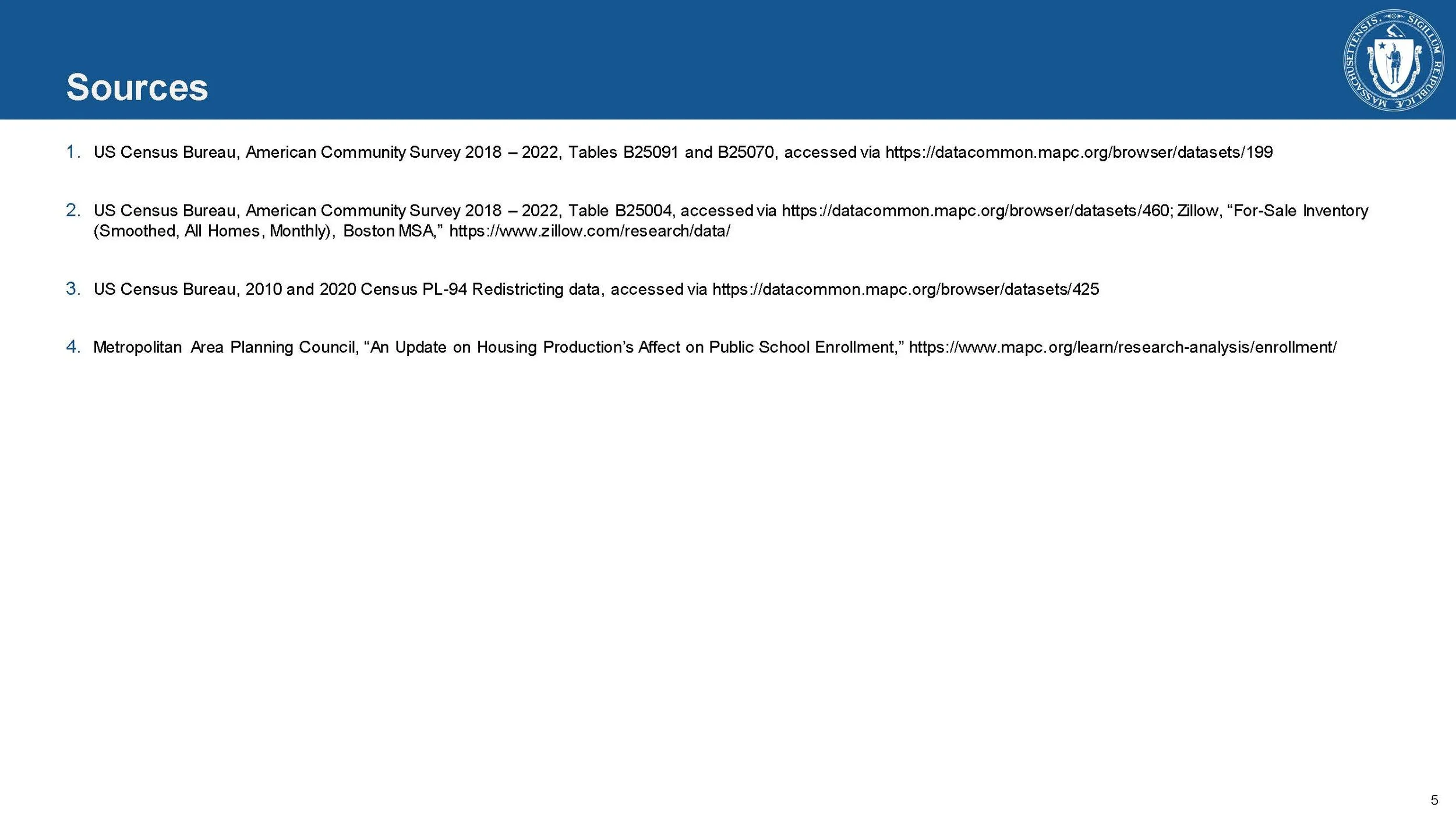
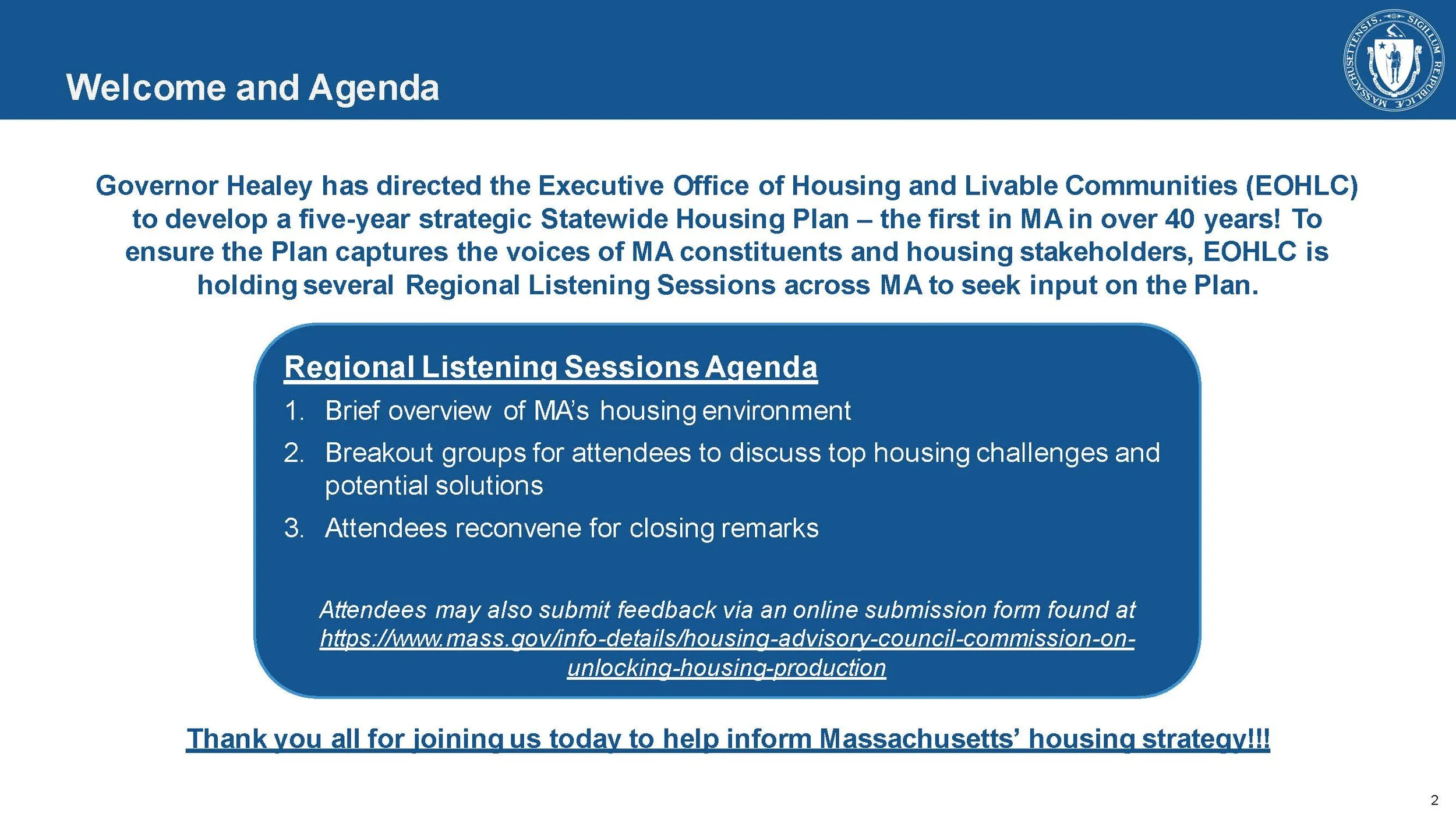
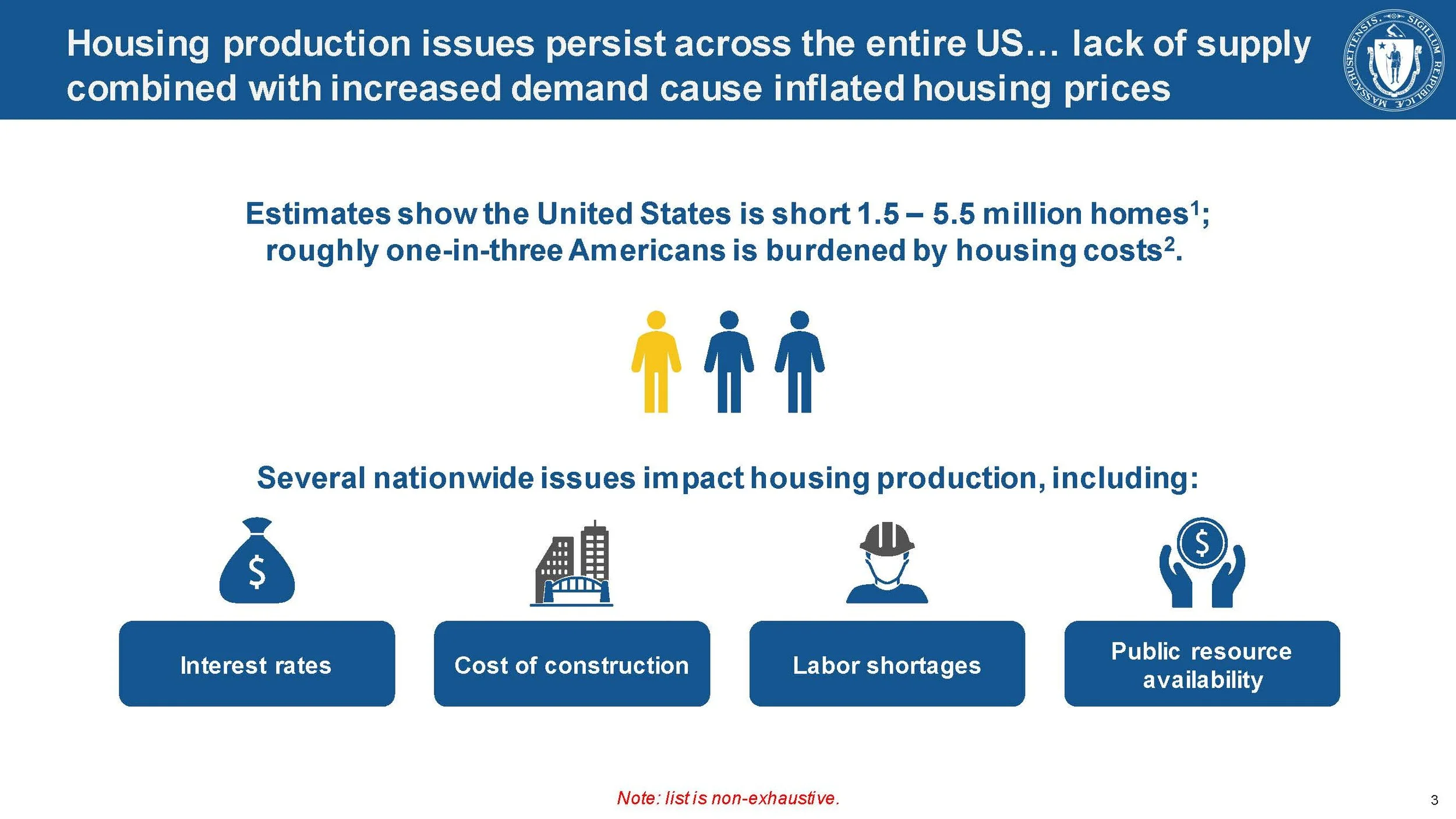
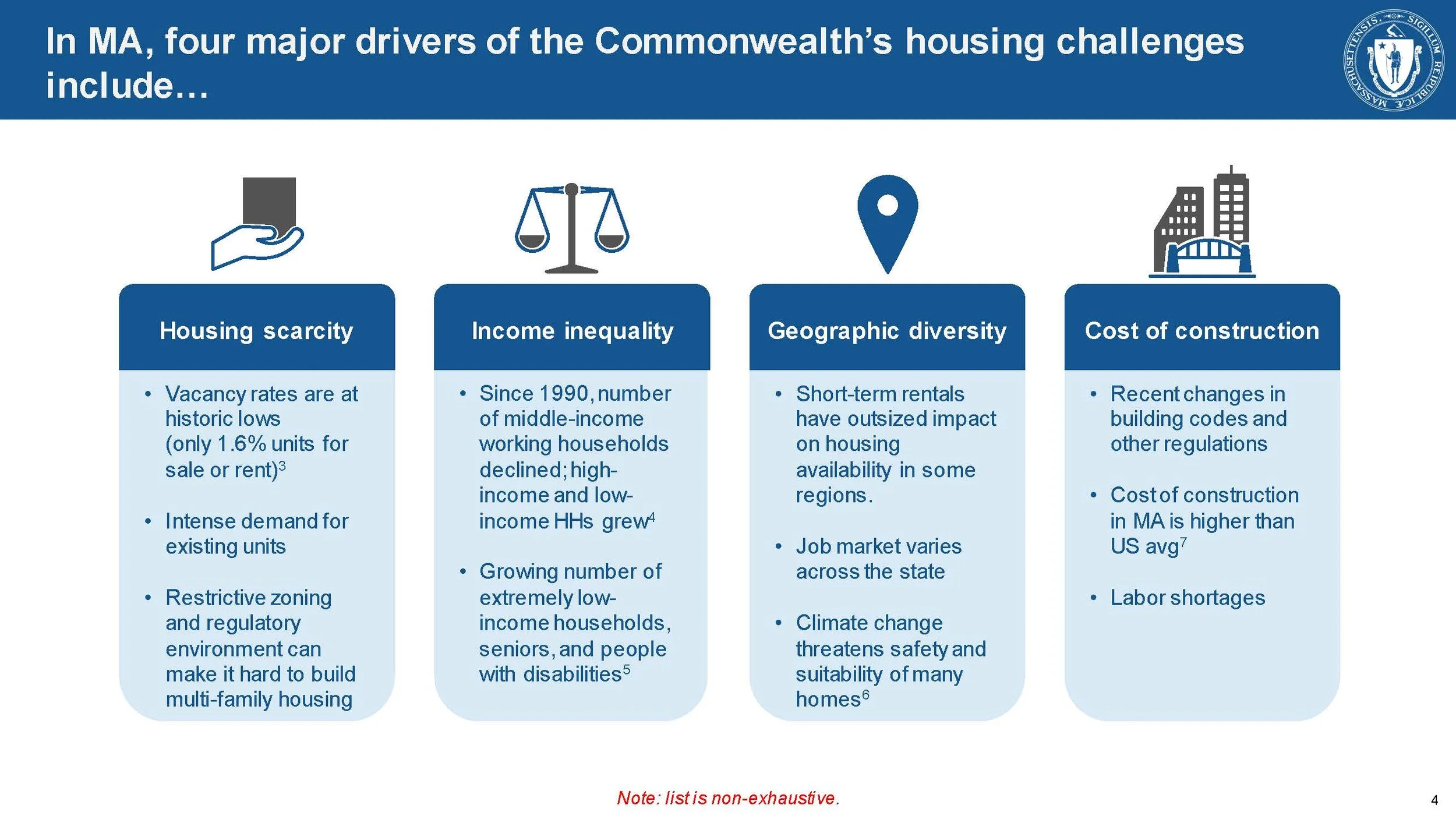
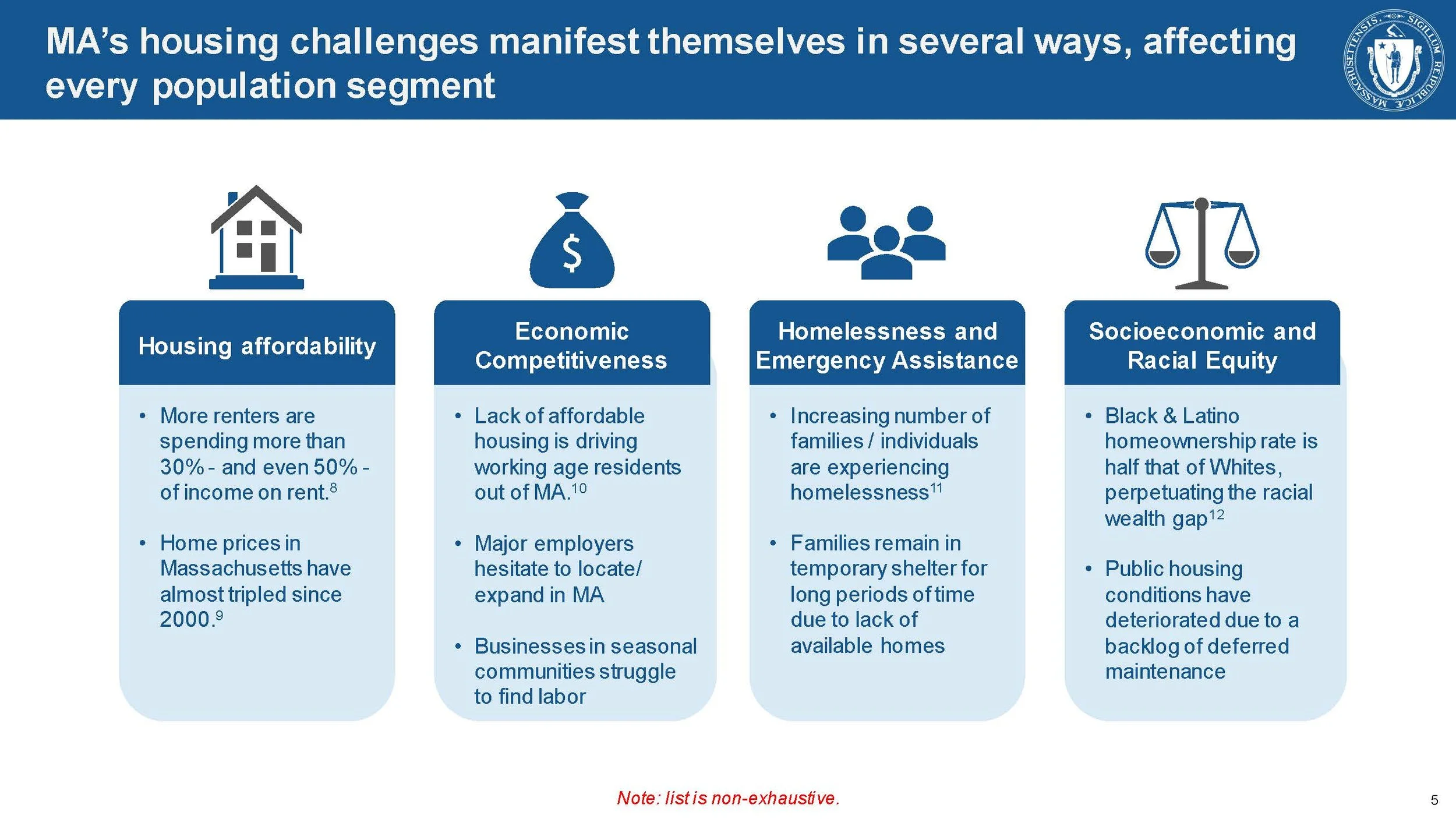
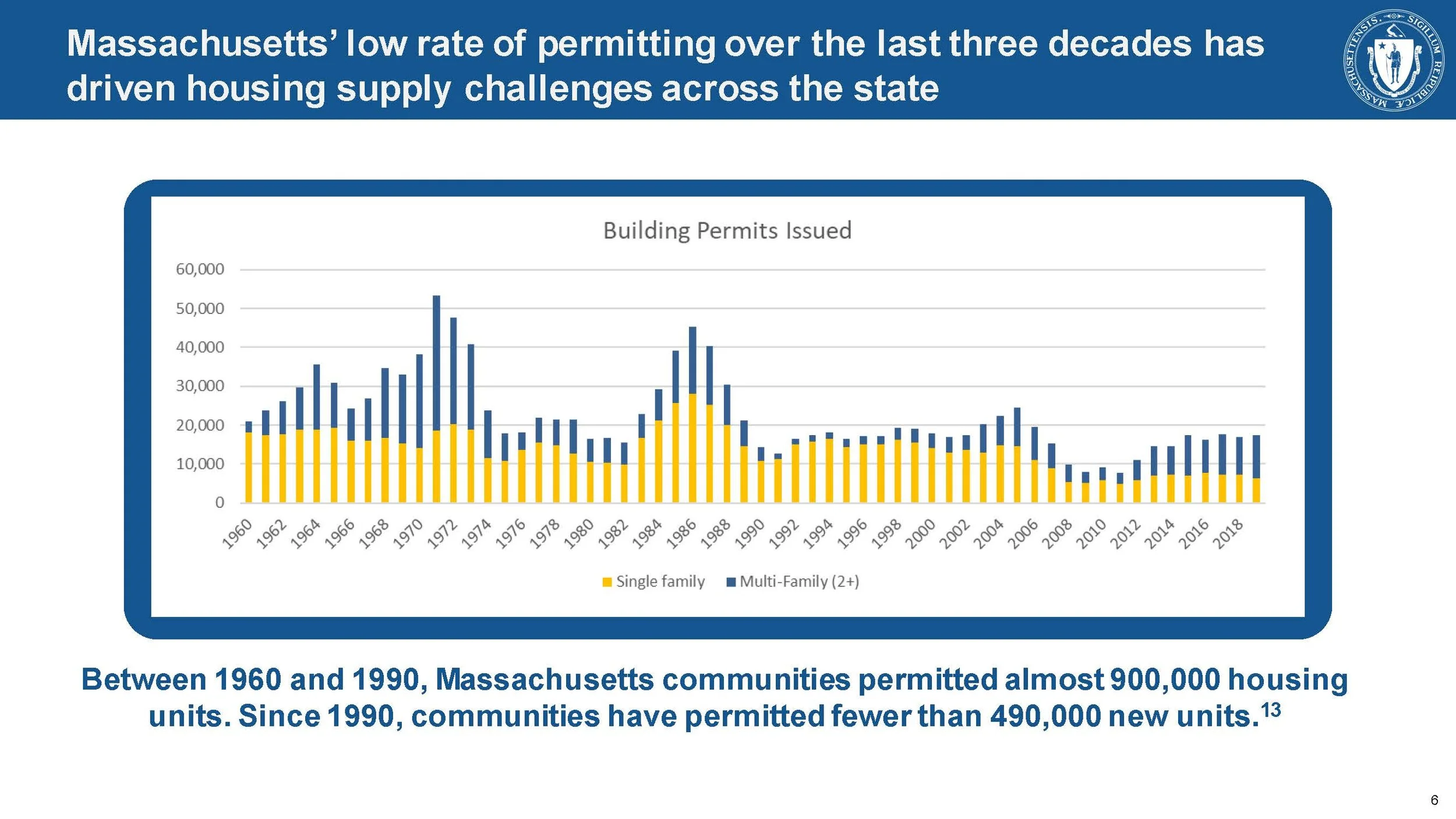
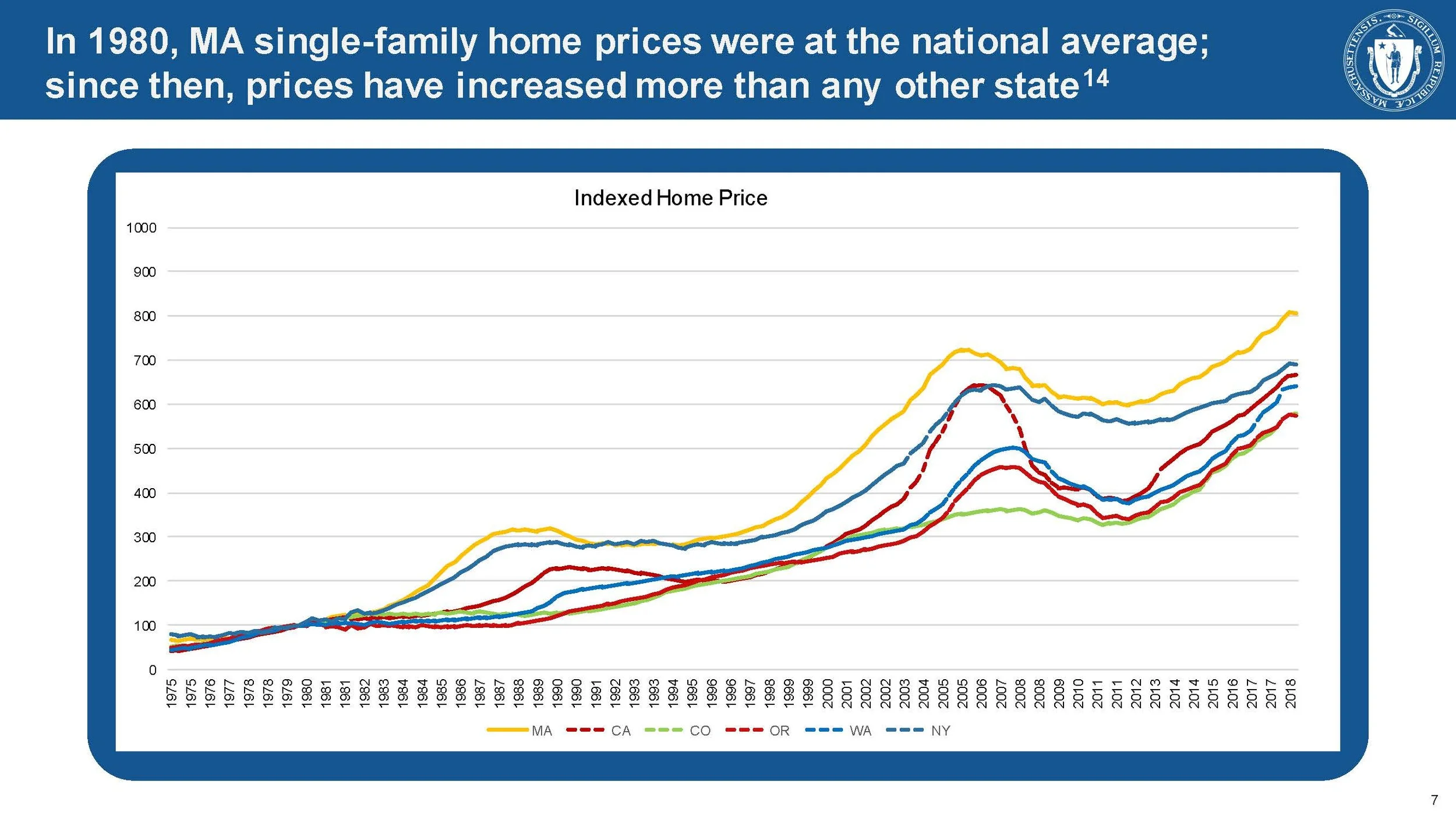
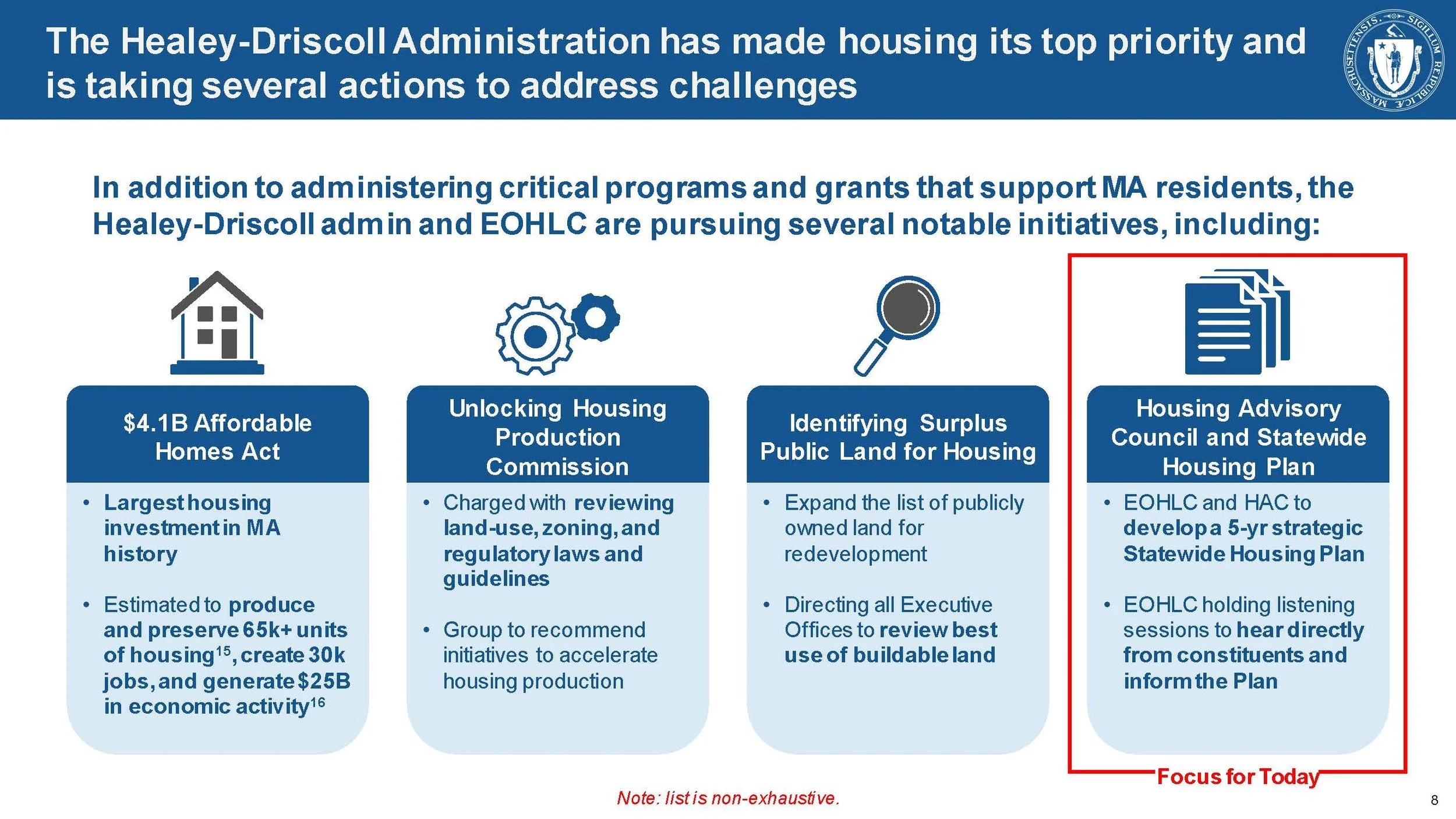
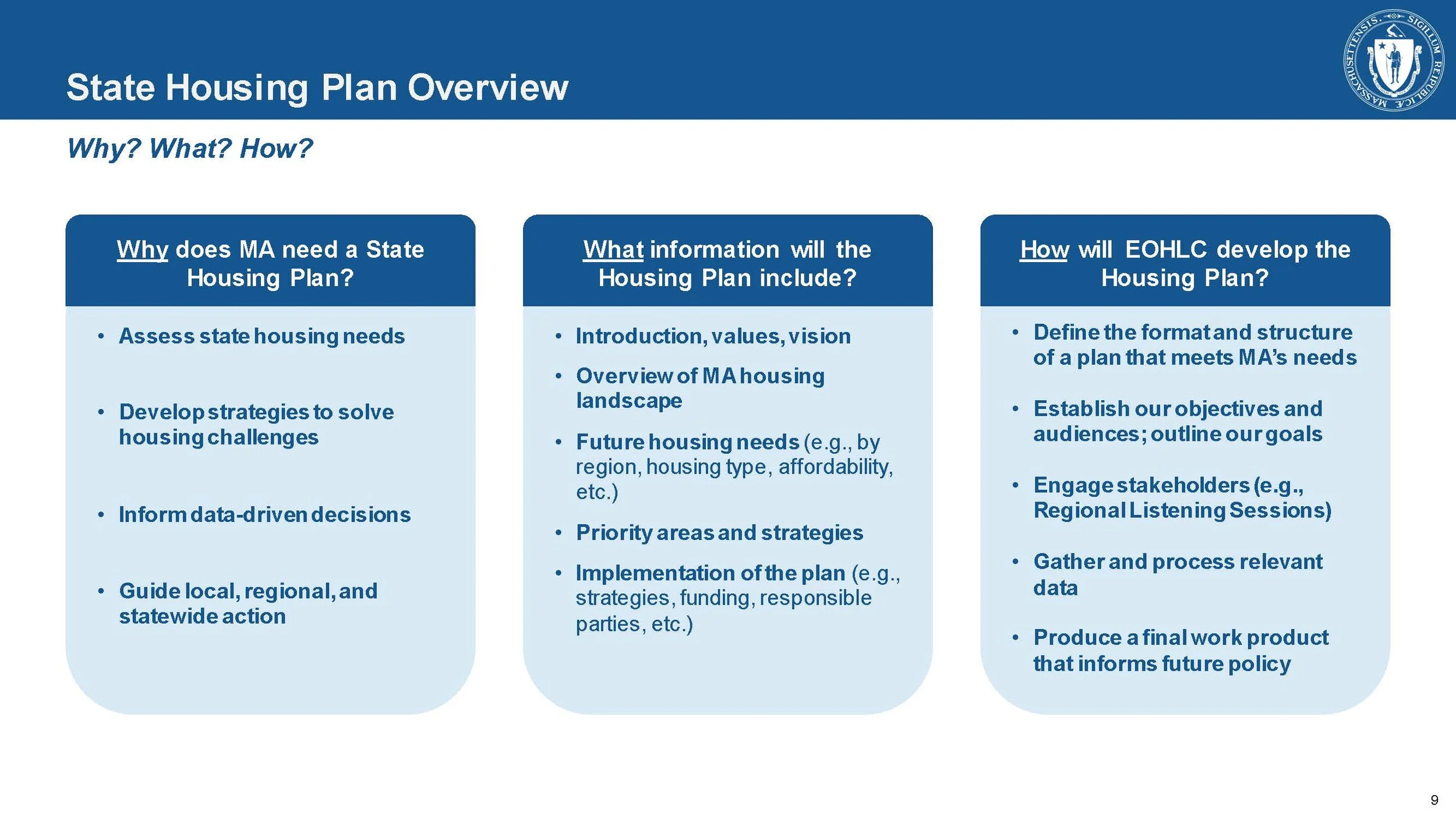
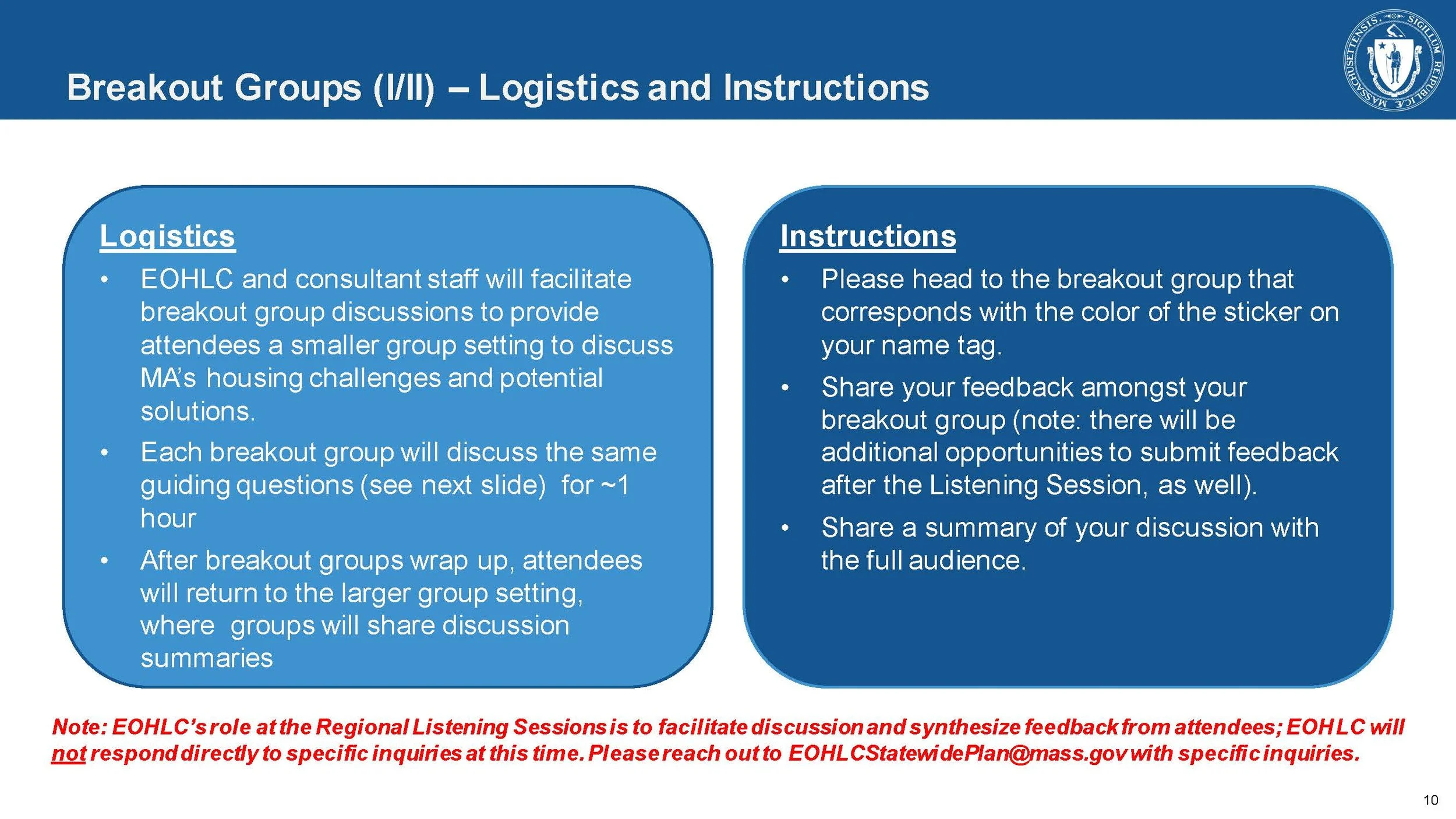
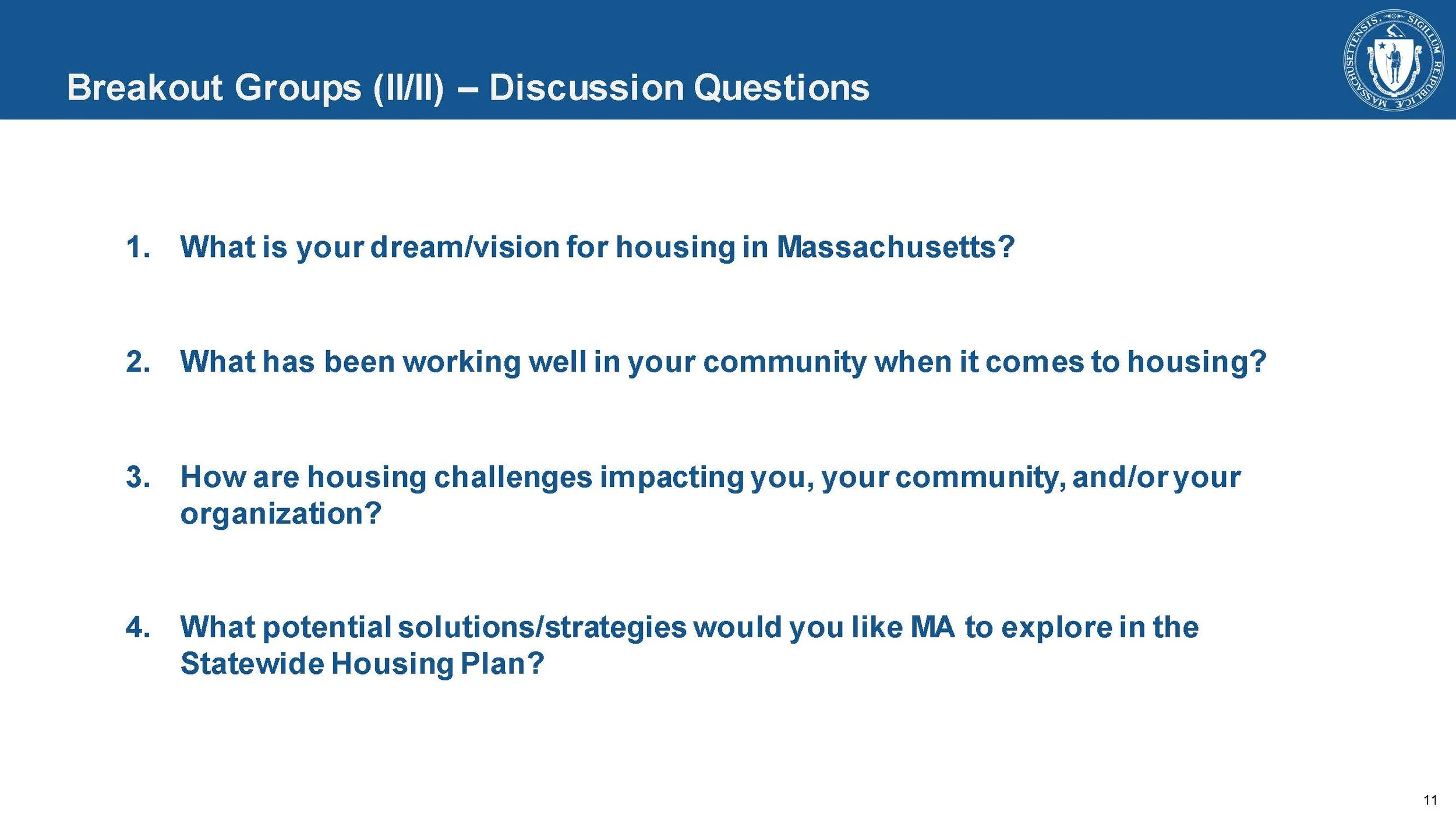
Established through Executive Orders filed in conjunction with the Affordable Homes Act, the Housing Advisory Council and Commission on Unlocking Housing Production is bringing together a broad range of stakeholders from across Massachusetts to advise the Healey-Driscoll administration on strategies to address the state’s housing challenges. A regional listening session was held in May 2024 (see the data below). If you missed them, you can still provide feedback here.
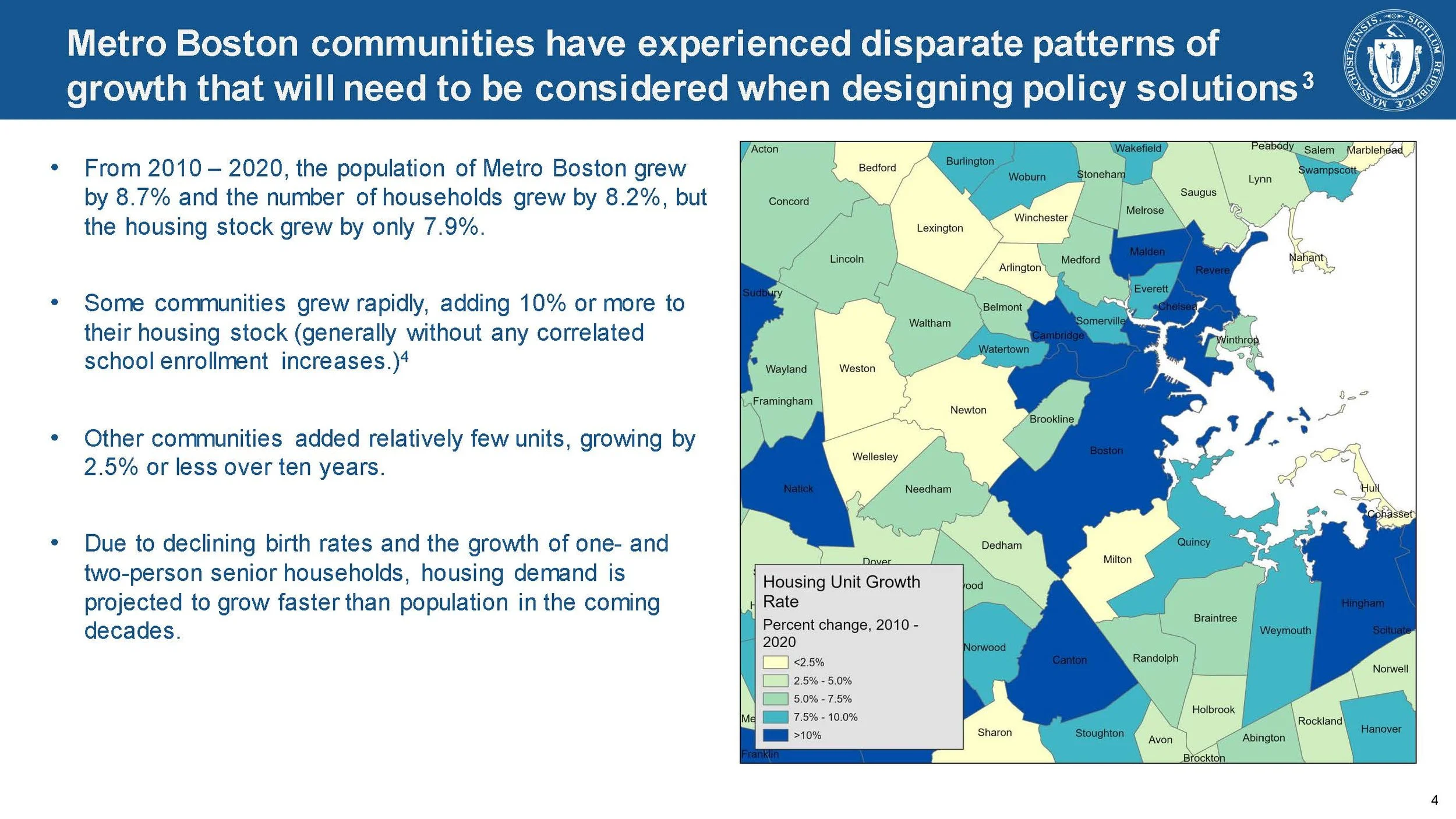
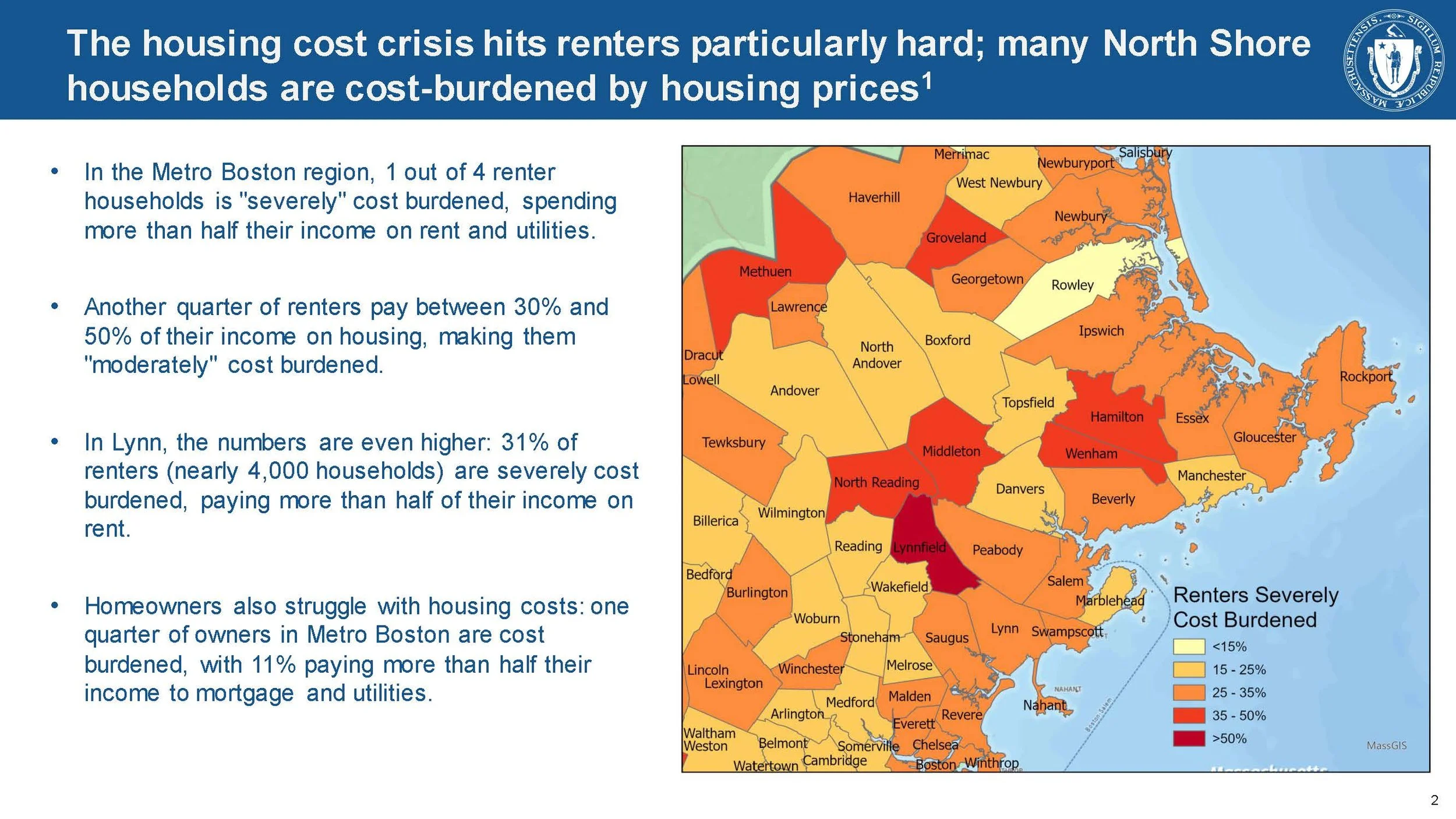
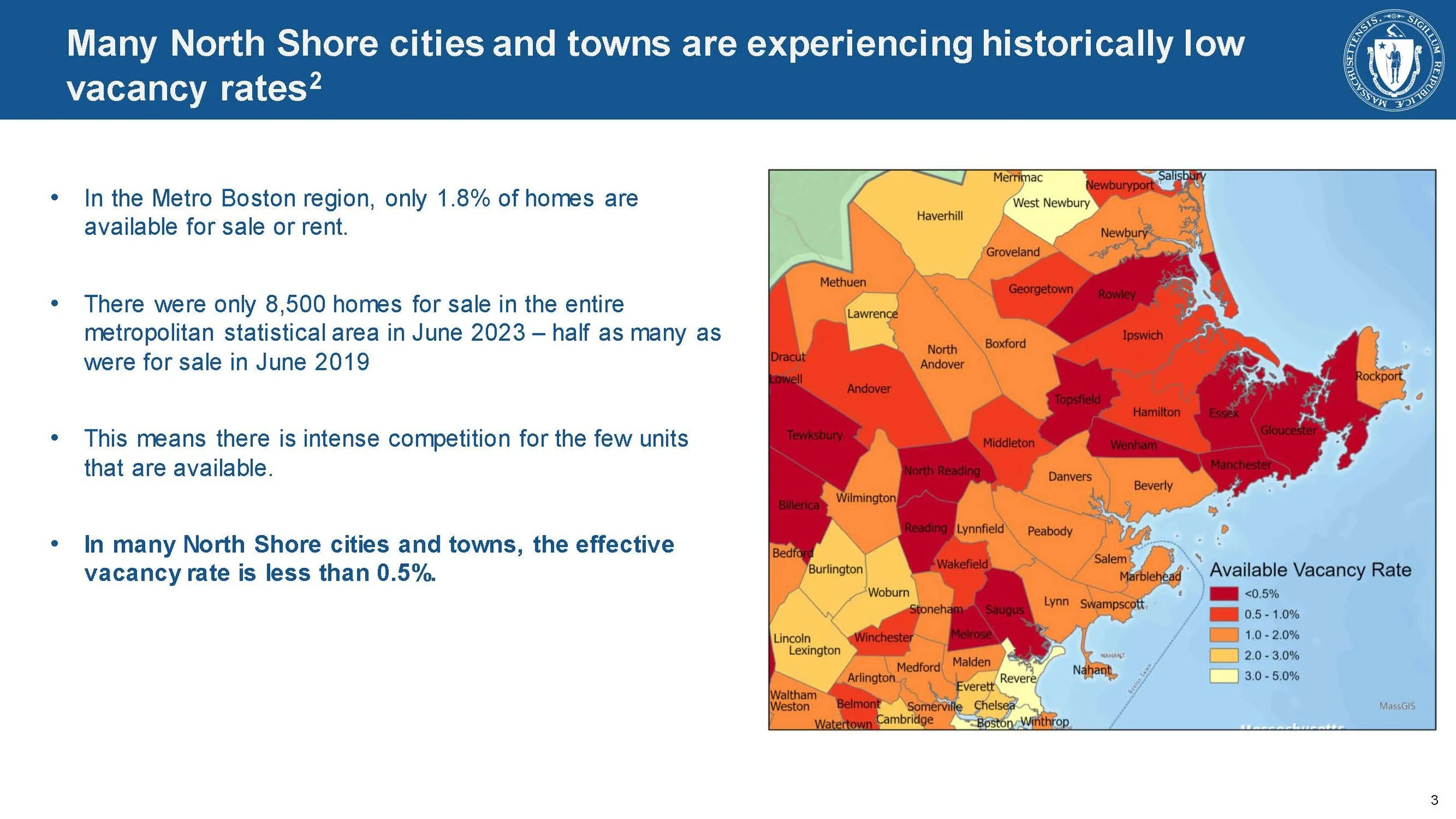
Northeast Region Public Health Data
The U.S. Center for Disease Control’s Suicide Prevention Strategies for Communities support the implementation of a public health approach that uses data to drive decision-making. Massachusetts does not publish comprehensive or local data surrounding the deaths of service members and veterans. The chart below includes data for suicide deaths overall in the Northeast Region.