
Plymouth County
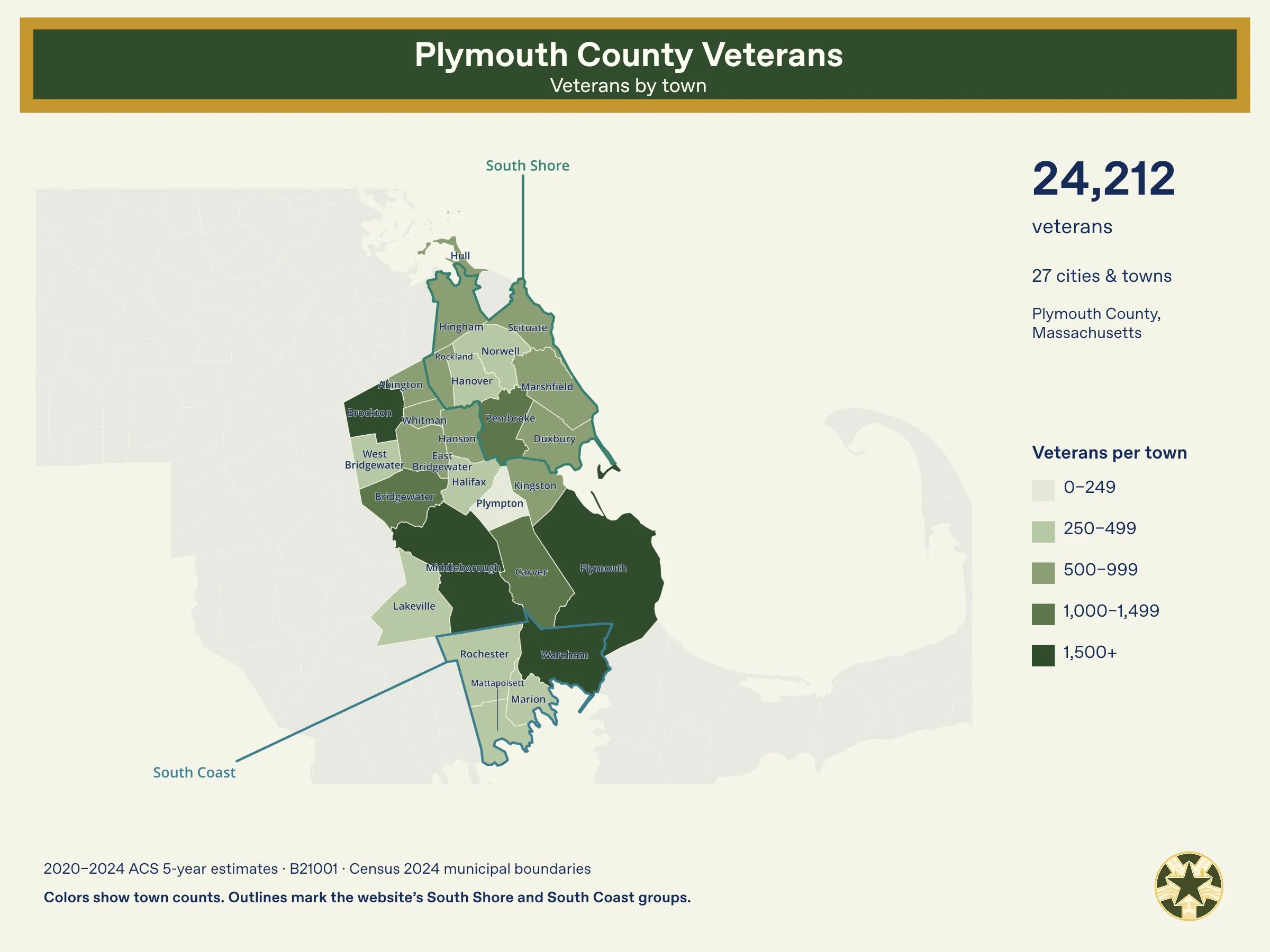
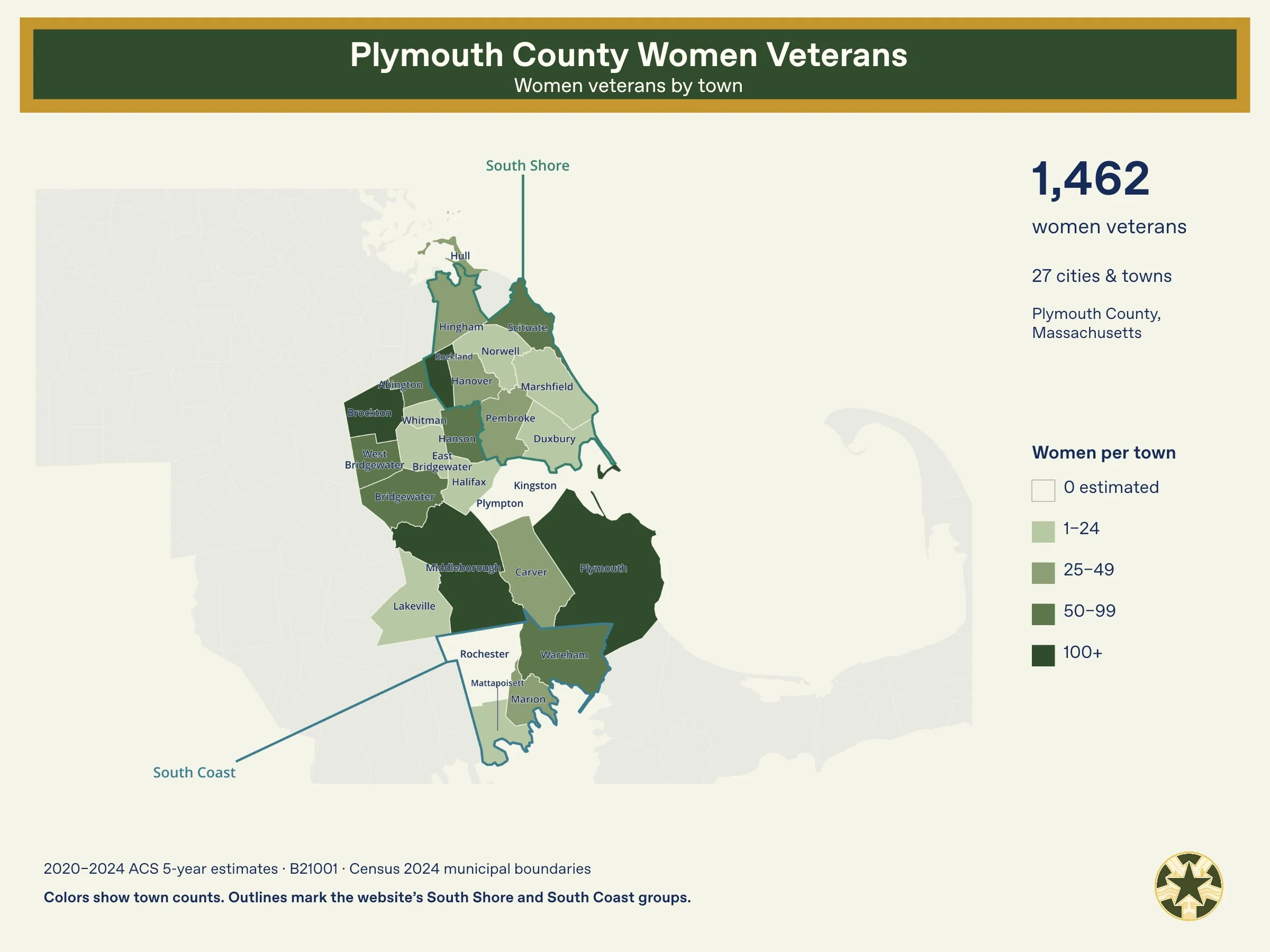
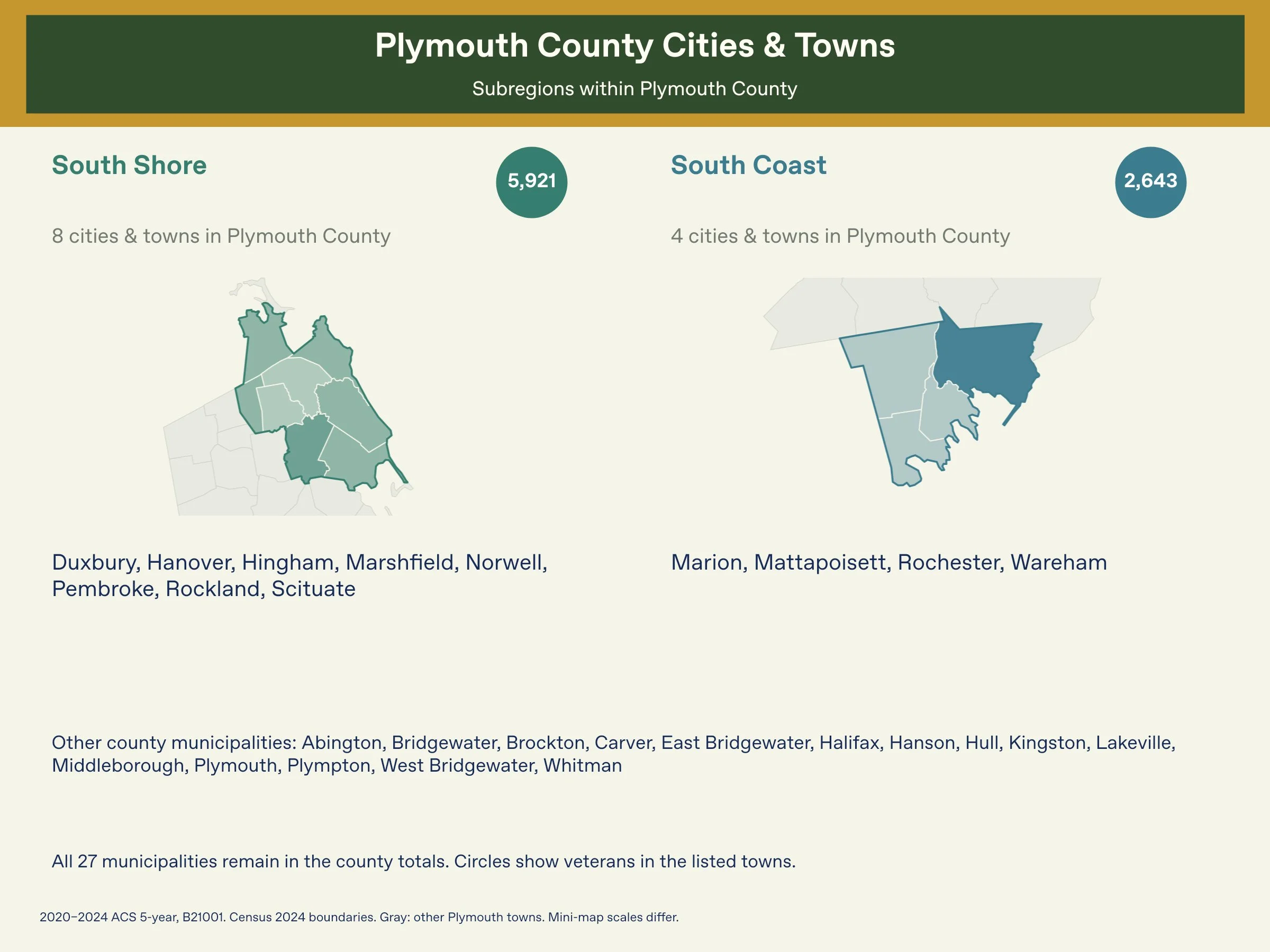
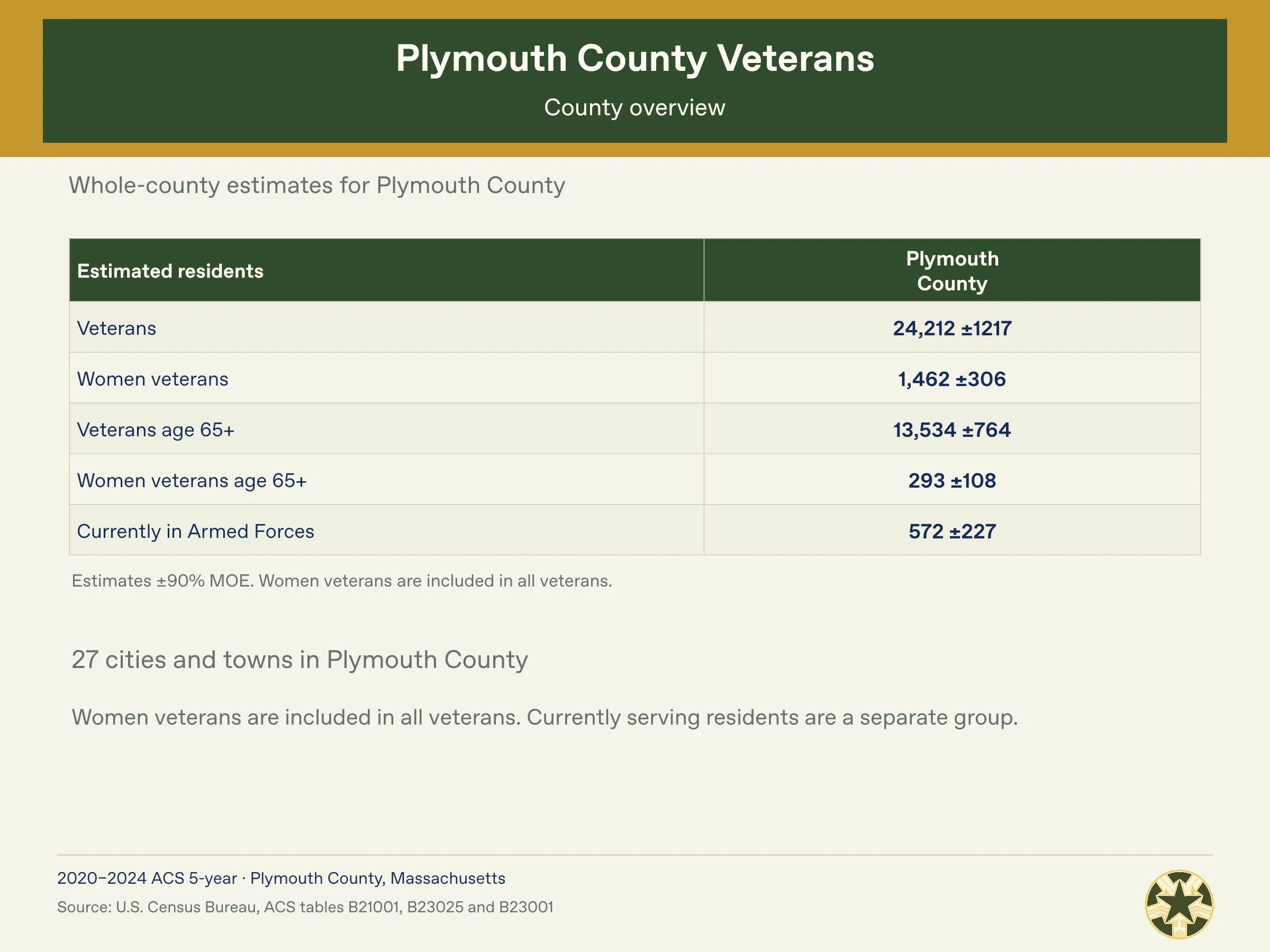
Based on the 2020–2024 ACS 5-year estimates, approximately 24,212 veterans live in Plymouth County, including 1,462 women veterans. This page includes local event listings and directories of veterans’ services; VA-accredited representatives, agents, and attorneys; veteran outreach centers; healthcare facilities; specialty courts; elder services; veterans’ posts and auxiliaries; and veteran owned businesses, along with veterans census, VA spending, veteran homelessness, and public health data.
Local Event Listings
Local Recovery Meetings
The mission of the Massachusetts Executive Office of Veterans’ Services (EOVS) is to act as the primary advocate on behalf of all the Commonwealth’s veterans. The Office provides outreach and support through various programs. EOVS offers assistance to eligible veterans and their surviving spouses through the MassVets Financial Benefits Program, administered by local veterans’ services.
Local Veterans’ Services
District Veterans’ Services
Veterans may use the Mass Vet Benefit Calculator to see what they may qualify for and contact their local veterans’ services office to apply. MGL Chapter 115 requires each town/city have a veterans’ agent to administer these benefits, but two or more contiguous towns can also appoint someone to serve as veterans’ agent and form Veterans’ Services Districts. Many municipal veterans’ services office also have VA-accredited staff to assist with federal benefit claims.
VA-Accredited Representatives, Agents & Attorneys
The directory below includes VA-accredited representatives, agents, and attorneys based in cities and towns in Plymouth County from the VA Office of the General Counsel (OGC) Accreditation Search Tool, updated on a weekly basis. Accreditation ensures VA claimants receive qualified assistance aligned with VA Standards of Conduct. Attorney listings also include available official state bar data, license status, registration dates, and disciplinary history, updated on a monthly basis.
Veteran Outreach Centers
Plymouth Area Veterans Center
The Plymouth Area Veterans Center (PAVC) is a one-stop shop for veteran services launched by Volunteers of America Massachusetts with the support of EOVS to serve the South Shore area in October 2024. The center connects South Shore veterans with behavioral health care, VA and other public benefits, housing and employment services, peer support, and social and educational activities. Veterans seeking assistance or opportunities to connect can visit 20 North Park Avenue in Plymouth, call (617) 390-0280, or email the center.
Healthcare Facilities in Plymouth County
VA Healthcare System
Plymouth County veterans are served by the VA Boston and VA Providence Healthcare Systems with the Brockton VA Medical Center; Plymouth outpatient clinic; and Brockton Vet Center located within the county. Anyone who has served in the military is encouraged to apply to determine their eligibility and Priority Group. Some veterans are exempt from co-pays due to their VA rating, income, or special eligibility factors.
Community Behavioral Health Centers
Community Behavioral Health Centers (CBHCs) are one-stop shops for mental health and substance use services and treatment. CBHCs are open daily for walk-ins, routine appointments, and crisis care, including Mobile Crisis Intervention.
CBHCs are closely connected to the Massachusetts Behavioral Health Help Line (BHHL). The BHHL is a 24/7 clinical hotline staffed by trained behavioral health providers and peer coaches who offer clinical assessment, treatment referrals, and crisis triage services. Staff directly connect callers with the nearest CBHC when appropriate. Call or text (833) 773-2445.
Peer Recovery Support Centers
Peer Recovery Support Centers (PRSC) in Massachusetts are free accessible peer-led spaces that provide individuals in recovery from substance use, as well as their family members and loved ones, an opportunity to offer and receive human connection, community inclusion, peer support, and access to non-clinical resources.
The Massachusetts Overdose Prevention Helpline is staffed by a dedicated team of harm reductionists and people with lived and living experience with overdose. The hotline is not a recovery or treatment helpline; it connects people using drugs with trained operators who can call for help in case of overdose. It is available to anyone at risk of overdose. Call (800) 972-0590.
Plymouth County Specialty Courts

The Massachusetts Center of Excellence for Specialty Courts, an initiative of the Executive Office of the Massachusetts Trial Court, brings innovative, evidence-based, and equitable interventions to Specialty Courts.
-
Veterans’ Treatment Courts are court-supervised, treatment-focused collaboratives designed to handle criminal cases involving defendants with a history of military service through a coordinated effort among the veterans services delivery system, community-based providers, and the court.
Veterans’ treatment court sessions aim to improve public safety while dealing with underlying issues of PTSD, TBI, and MST. Abstinence from drugs/alcohol, mandated treatment, swift accountability, and weekly interaction with the court is required. The Brockton District Court holds Veterans’ Treatment Court sessions in Plymouth County.
-
Mental Health Courts, also referred to as Recovery Courts and Recovery with Justice, address the behavioral health and social support needs of adults involved with the criminal-legal system. Mental Health Courts are designed to increase access to mental health treatment for court-involved people and assist them in their path away from unlawful behavior. The Plymouth District Court operates Mental Health Court sessions in Plymouth County.
-
Recovery Courts, also referred to as Drug Treatment Courts and Drug Courts, address the behavioral health and social support needs of adults involved with the criminal-legal system. Recovery Courts are designed to assist court-involved people in their path toward recovery from substance use and away from unlawful behavior. The Brockton, Hingham, Plymouth, and Wareham District Courts operate Recovery Court sessions in Plymouth County.
Elder Services in Plymouth County
Aging Services Access Points (ASAPs) are private, non-profit agencies established under MGL Chapter 19A. ASAPs provide direct and protective services, including information and referrals; interdisciplinary case management; intake and assessment; developing, implementing, and monitoring service plans; reassessing needs; and investigating reports of elder abuse and neglect.
Aging Services Access Points
Councils on Aging
Councils on Aging (COAs) are municipal agencies that provide local outreach, social and health services, advocacy, information and referral for older adults, their families, and caregivers. COAs and Senior Centers serve as advocates and links to support services for elders, families, and caregivers. They offer outreach, transportation, meals, health screenings, health insurance counseling, and life-long learning, social, fitness, wellness, and recreation activities.
MassOptions is a service of the Executive Office of Health & Human Services (EOHHS) that can also help older adults, people with disabilities, and family members or caregivers identify aging and disability services and connect to those that can meet their needs. Call (800) 243-4636 or click here to complete a referral.

Veterans Posts & Auxiliaries in Plymouth County
The Veterans Posts and Auxiliaries directory includes information about the VFW and American Legion Posts, Marine Corps League Detachments, and DAV Chapters based in cities and towns in Plymouth County, as well as information about their auxiliaries and other affiliates.
Posts
Auxiliaries
Veteran Owned Businesses in Plymouth County
The Veteran Owned Businesses directory is based on publicly available information and listings of veteran owned businesses based in Massachusetts. The listing below includes businesses in Plymouth County. Follow the link below to update information or submit a new business.
Veteran Owned Business Estimates
The Annual Business Survey and Nonemployer Statistics by Demographics provide estimates of veteran-owned businesses in Plymouth County in 2023, including businesses with paid employees and businesses without paid employees.
Plymouth County had an estimated 542 veteran-owned employer firms and approximately 2,100 non-employer businesses, compared with 548 employer firms and 2,100 non-employers in 2022.
Plymouth had the largest published non-employer count among the six counties in the Southeast Massachusetts region.
Explore the 2023 business ownership tables and 2022 comparison tables for firm counts, receipts, employment, and payroll. Select Veteran under veteran status and Total for All Sectors for the figures above. County employer counts should not be added together as a regional total because a firm operating in multiple counties can appear in each county. Non-employer counts are rounded.
Plymouth County Veterans Census Data
Based on the 2020–2024 ACS 5-year estimates, approximately 24,212 veterans live in Plymouth County. Veterans make up about 6 percent of civilian adults age 18 and older, or 5 percent of the total population.
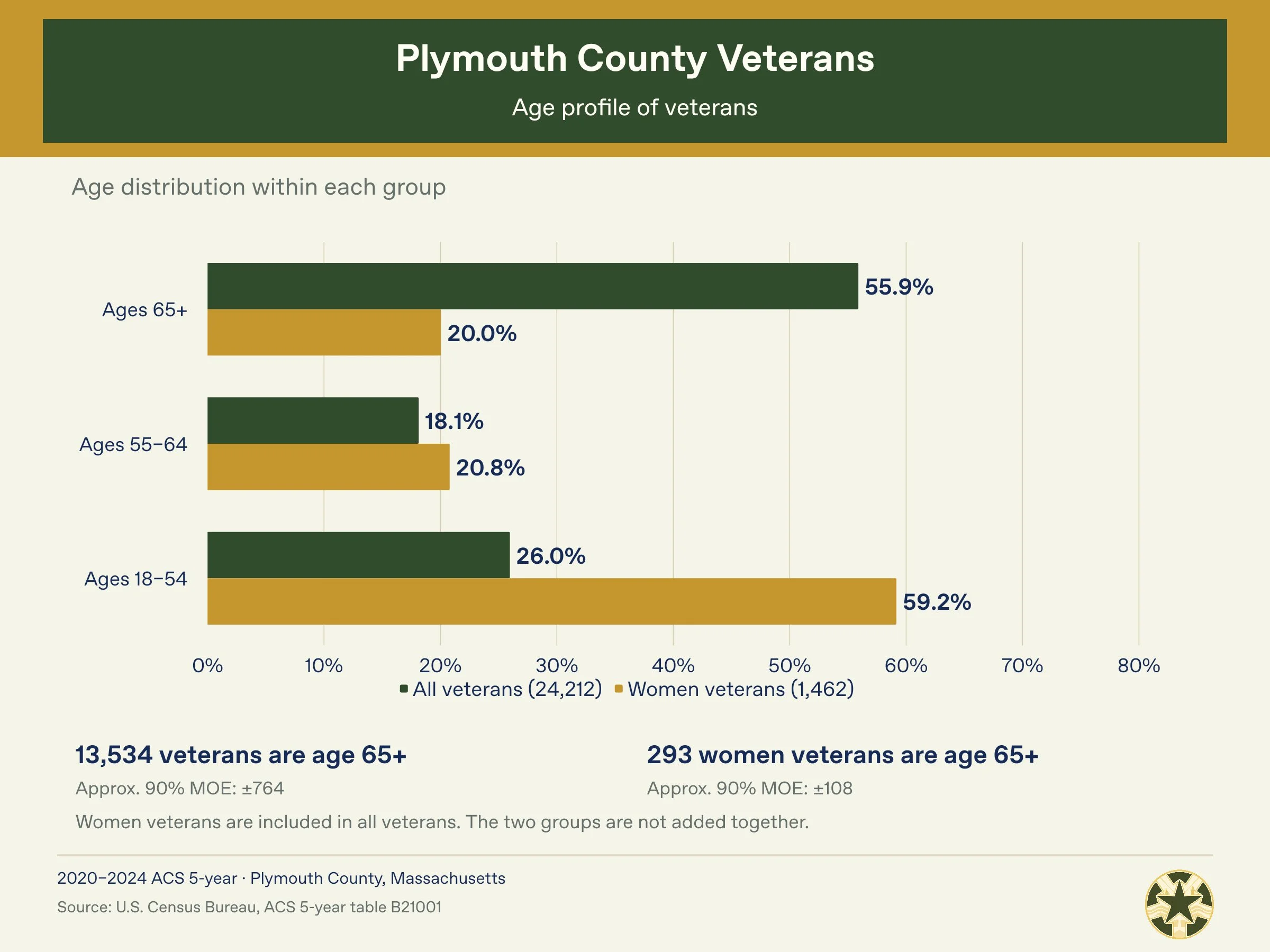
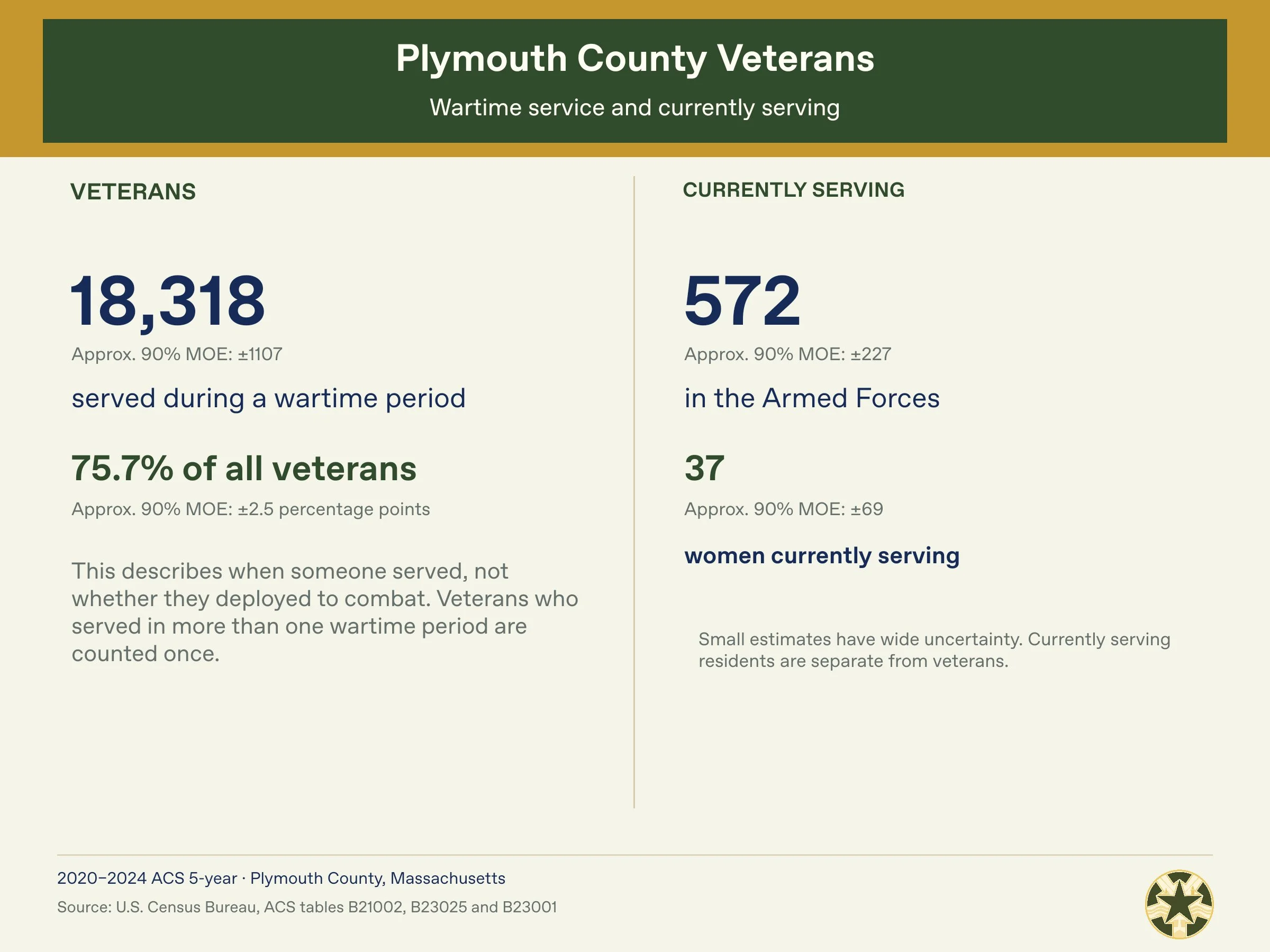
Women account for approximately 6.0 percent of veterans (1,462). Around 56 percent of veterans are age 65 or older (13,534), compared with 20 percent of women veterans (293). Approximately 76 percent of veterans served during a wartime period (18,318). An estimated 572 people are currently serving in the Armed Forces, including 37 women. These small currently-serving estimates have substantial sampling uncertainty.
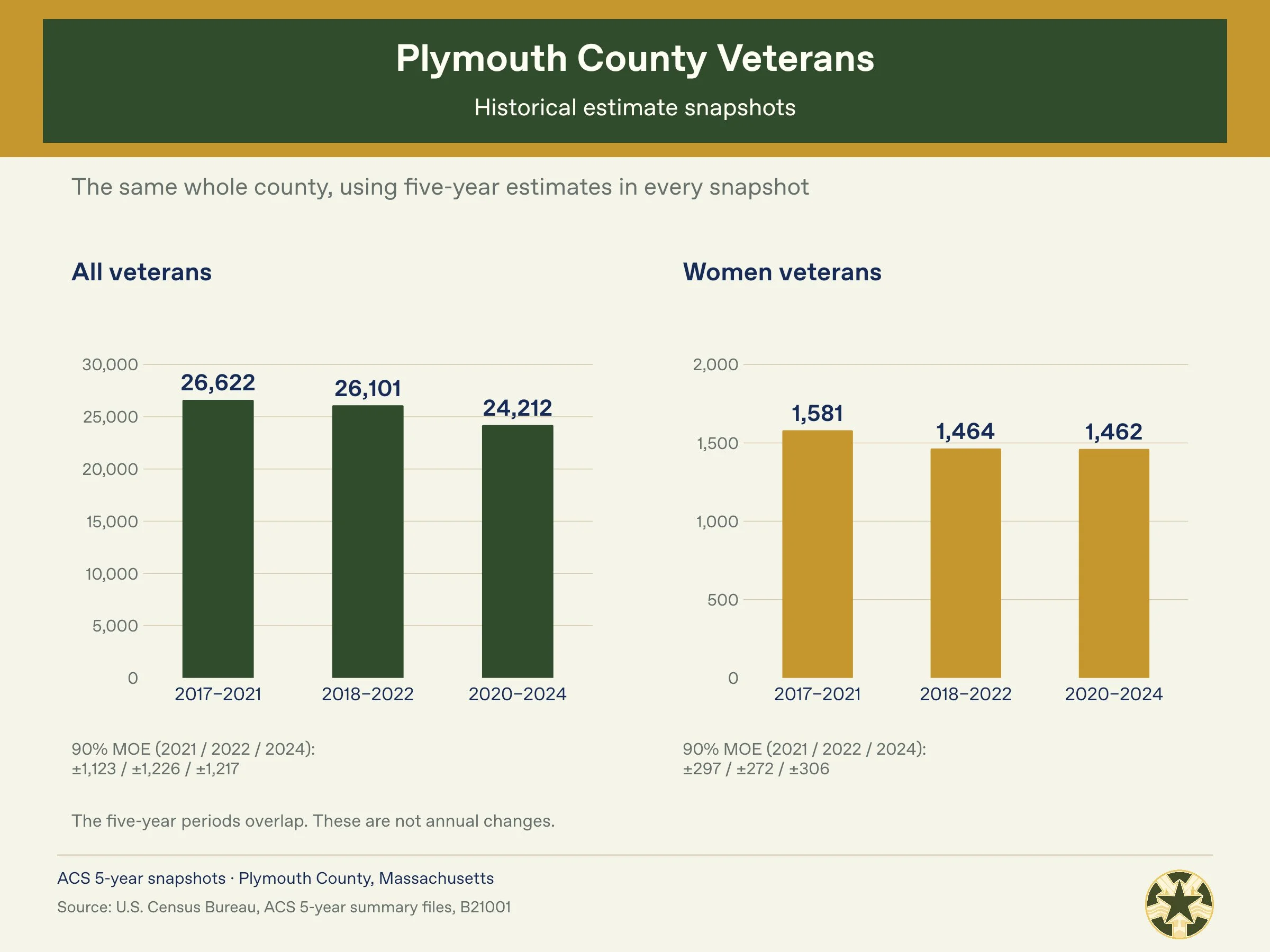
Between the 2021 and 2024 ACS 5-year estimates, the estimated veteran population decreased by 9.1 percent, from 26,622 to 24,212. The estimated number of women veterans decreased by 7.5 percent, from 1,581 to 1,462. These five-year periods overlap, so the differences should not be read as annual changes. Estimates also carry sampling error.
If you serve veterans and are trying to learn more about their demographics, explore the most recent ACS 5-year estimates from Census Reporter for cities and towns in Plymouth County below.
-
Age, gender, and veteran status, median income, educational attainment, employment status, service-connected disability status, service era is available with 5-year estimates (most accurate).
Age, sex, and veteran status, median income, educational attainment, employment status, service-connected disability, service era, and age, disability, and poverty status are available at the city/town and county levels with 1-year estimates (most current).
Age by veteran by disability and poverty status is available at the county level with 1-year estimates.
Labor Force and employment status by industry break out Armed Forces as a separate column: Marital Status by sex and labor force participation; Presence of Own Children by age of children and by family type and employment status; Educational Attainment by employment status; Poverty Status by disability and employment status with 1-year estimates.
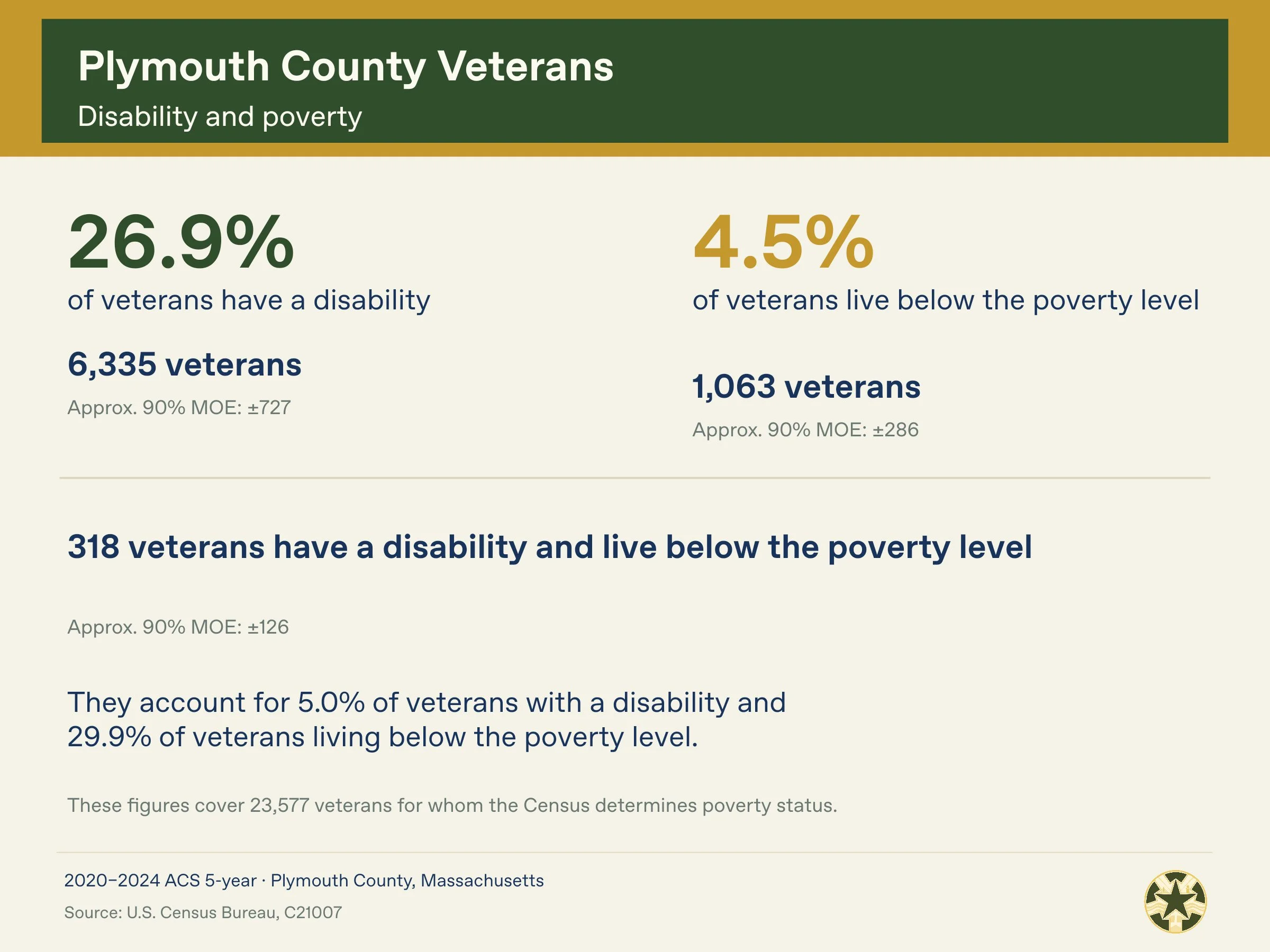
Based on the 2020–2024 ACS 5-year estimates, disability and poverty data cover 23,577 veterans in Plymouth County. Around 27 percent reported a disability (6,335), and 4.5 percent had incomes below the poverty level (1,063).
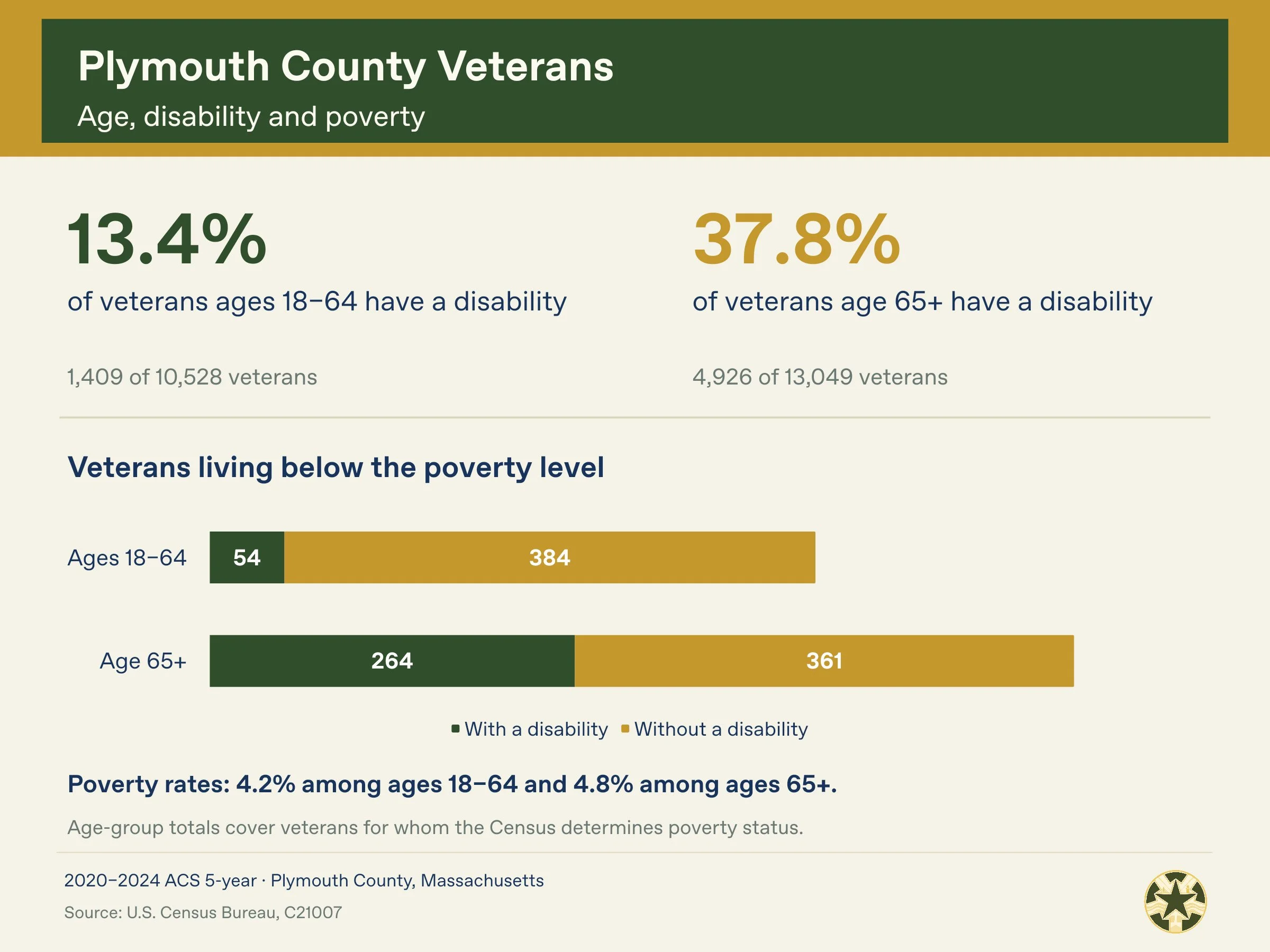
Among veterans age 65 or older for whom poverty status is determined, approximately 38 percent reported a disability (4,926), and 4.8 percent had incomes below the poverty level (625). Around 78 percent of veterans with disabilities were age 65 or older.
An estimated 318 veterans had both a disability and incomes below the poverty level. They made up about 5 percent of veterans with disabilities and 30 percent of veterans with incomes below the poverty level.
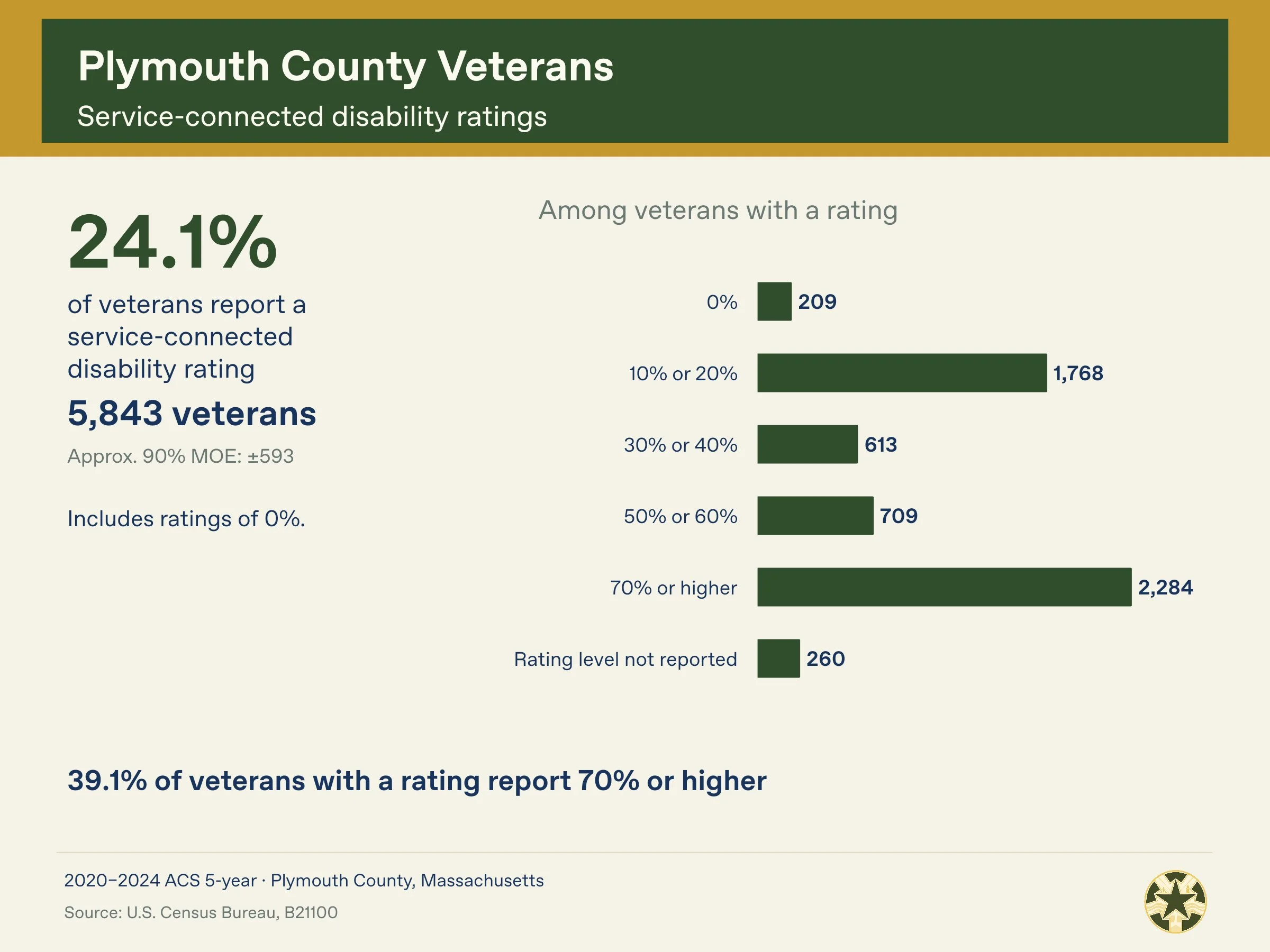
Approximately 24.1 percent of veterans reported a service-connected disability rating (5,843), including ratings of 0 percent. Among veterans with a rating, around 39 percent reported a rating of 70 percent or higher (2,284). Rating level was not reported for 260 veterans. These figures measure reported ratings rather than receipt of compensation payments.
Qualifying wartime service is one of the requirements for a VA Pension, along with income, net worth, and other eligibility requirements. Veterans age 65 or older may qualify without meeting a disability requirement.
Approximately 76 percent of Plymouth County veterans served during a wartime period (18,318). The remaining 24 percent served only during peacetime (5,894). These estimates describe periods of service and do not establish eligibility for VA benefits.
Education, Employment & Median Annual Income
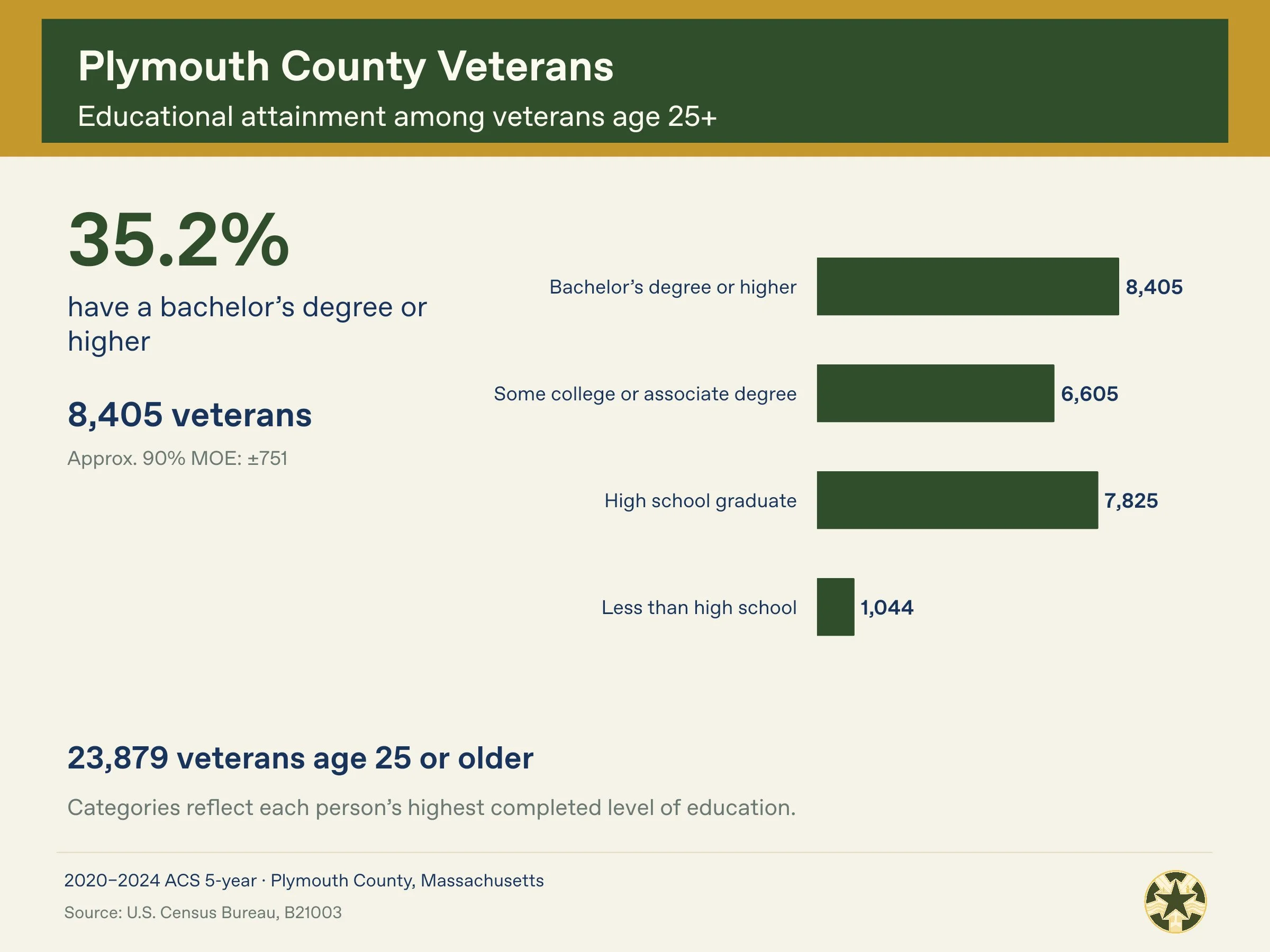
Among veterans age 25 or older, approximately 35 percent had a bachelor’s degree or higher (8,405). Around 28 percent had some college or an associate degree (6,605), 33 percent had a high school diploma or equivalent (7,825), and 4 percent had not completed high school (1,044).
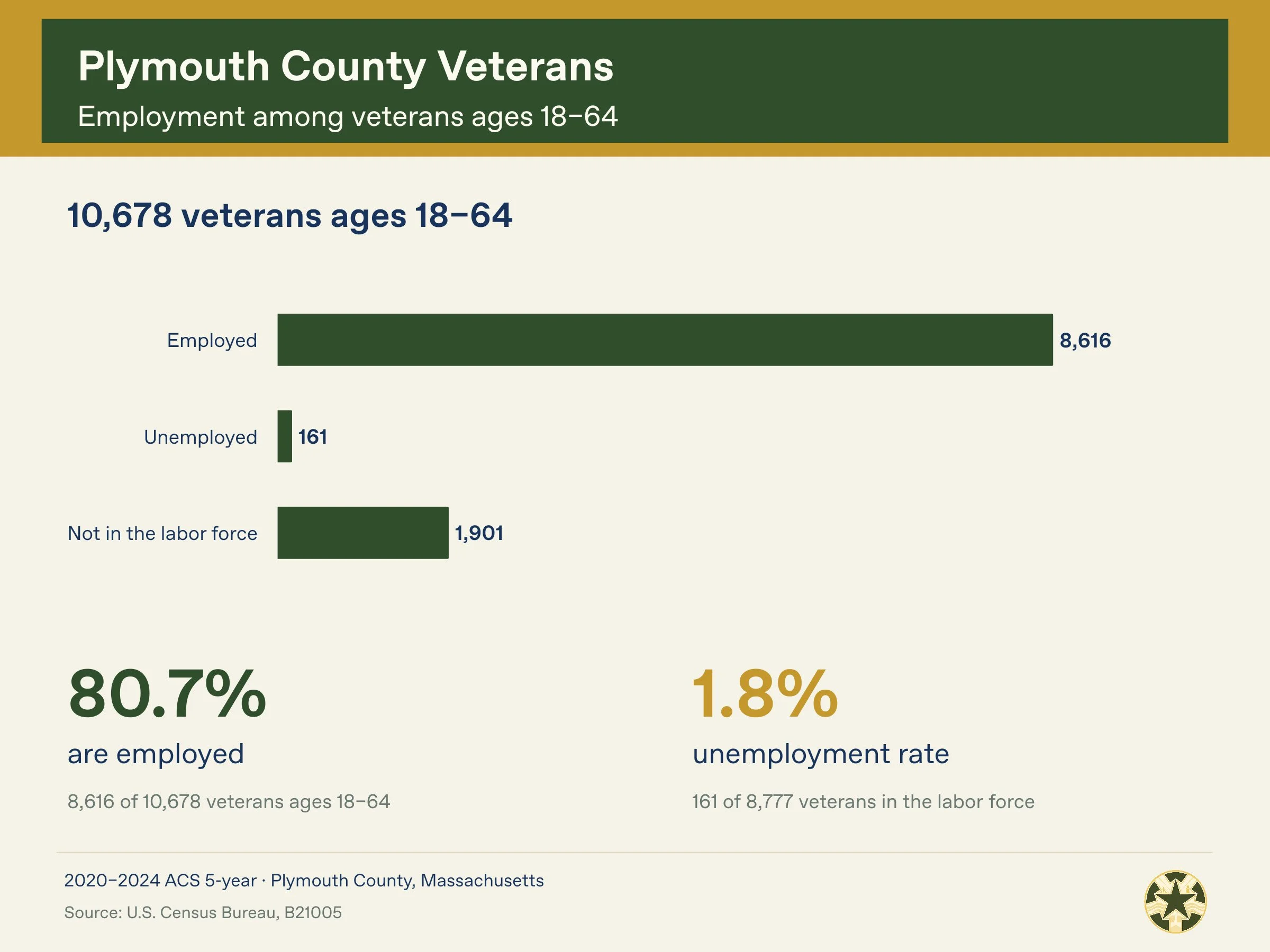
Among veterans ages 18–64, approximately 81 percent were employed (8,616), and 18 percent were outside the labor force (1,901). The unemployment rate was 1.8 percent, representing 161 unemployed veterans among the 8,777 in the labor force.
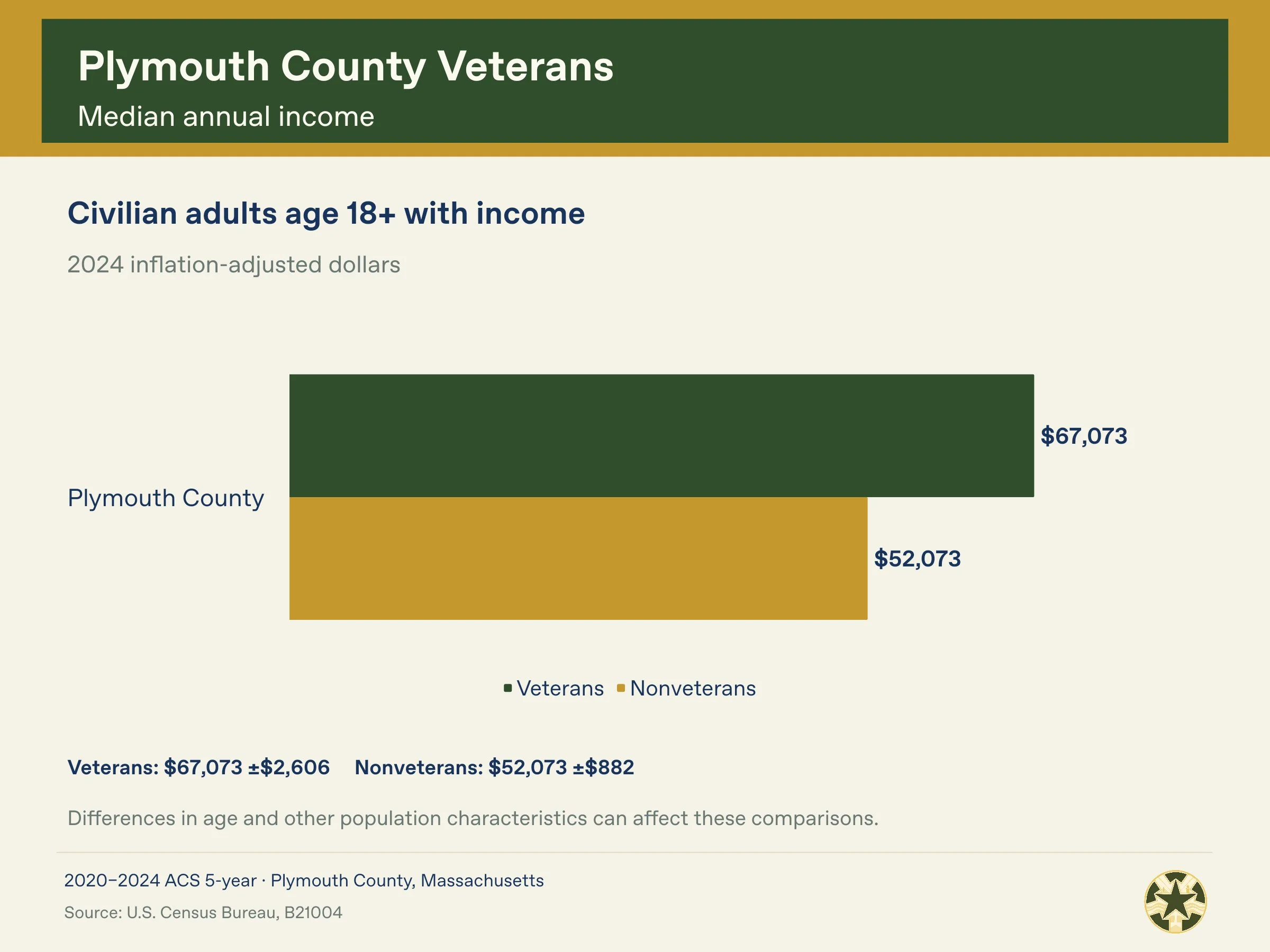
Median annual income among civilian adults age 18 or older with income in Plymouth County was $67,073 for veterans, compared with $52,073 for nonveterans.
These amounts are expressed in 2024 dollars. Differences in age and other population characteristics can affect these comparisons.
VA Spending in Plymouth County
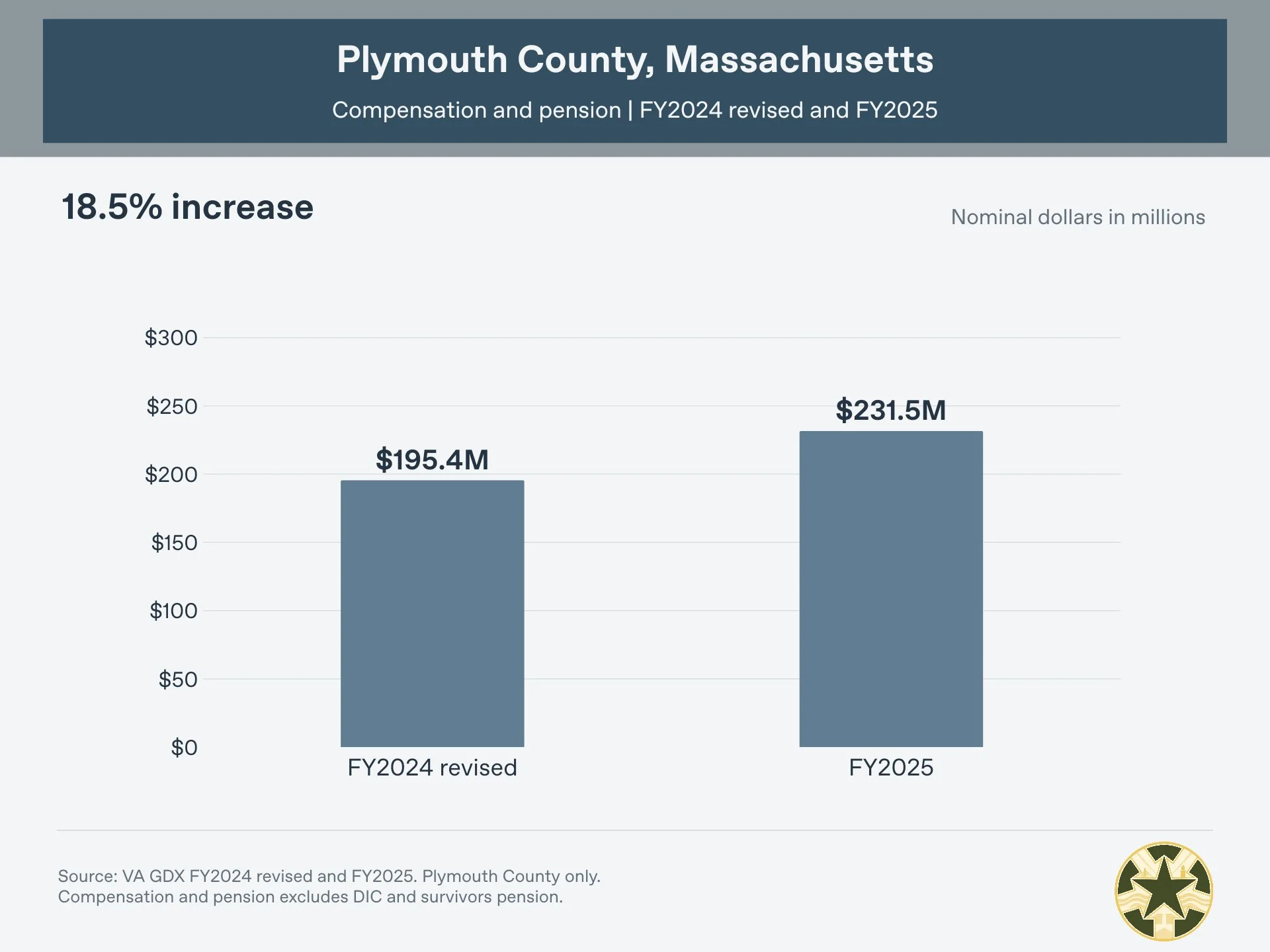
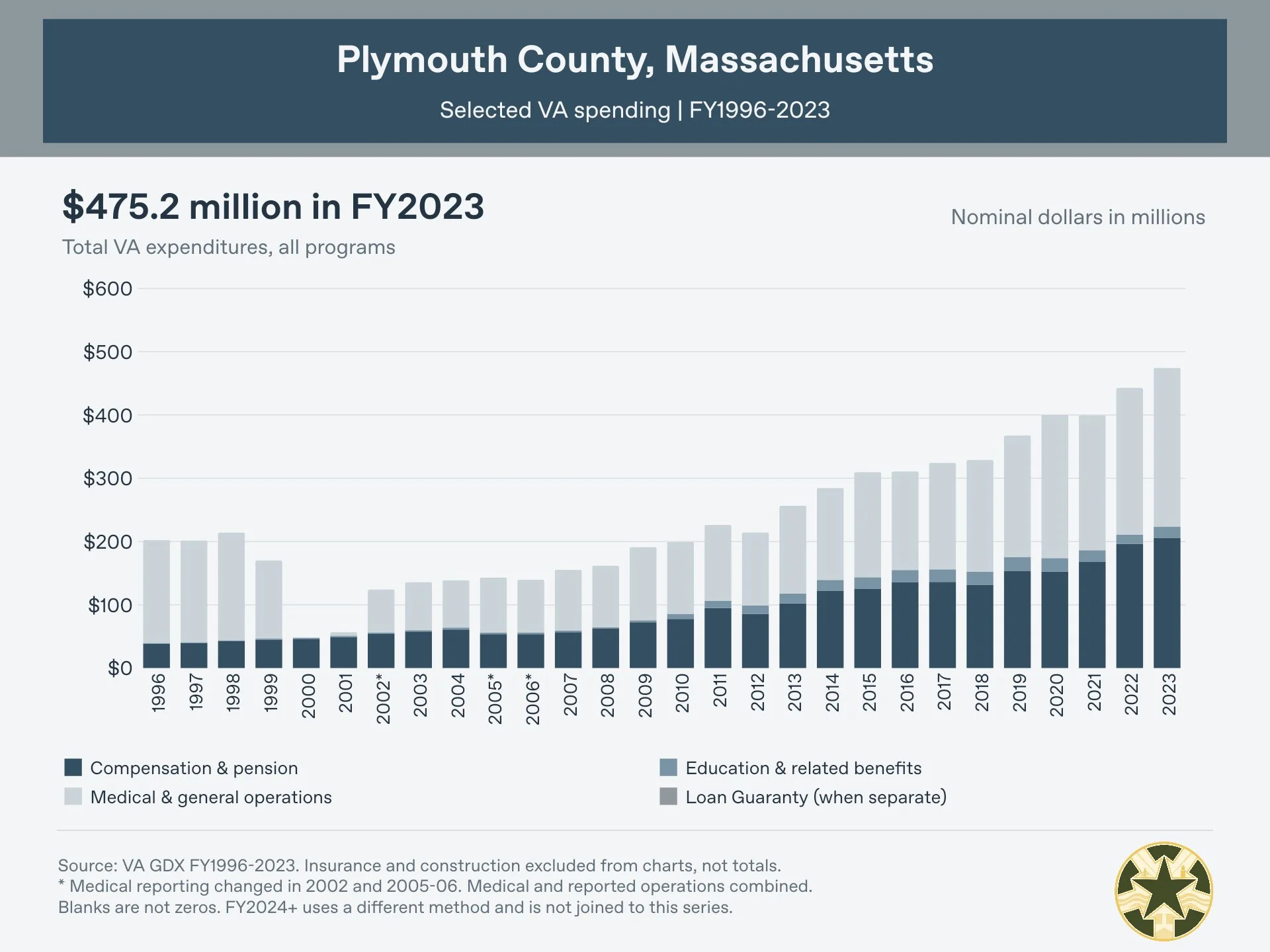
According to the latest VA Geographic Distribution of VA Expenditures (GDX) reports, VA compensation and pension spending in Plymouth County increased by 18.5 percent, from $195.4 million in FY2024 to $231.5 million in FY2025.
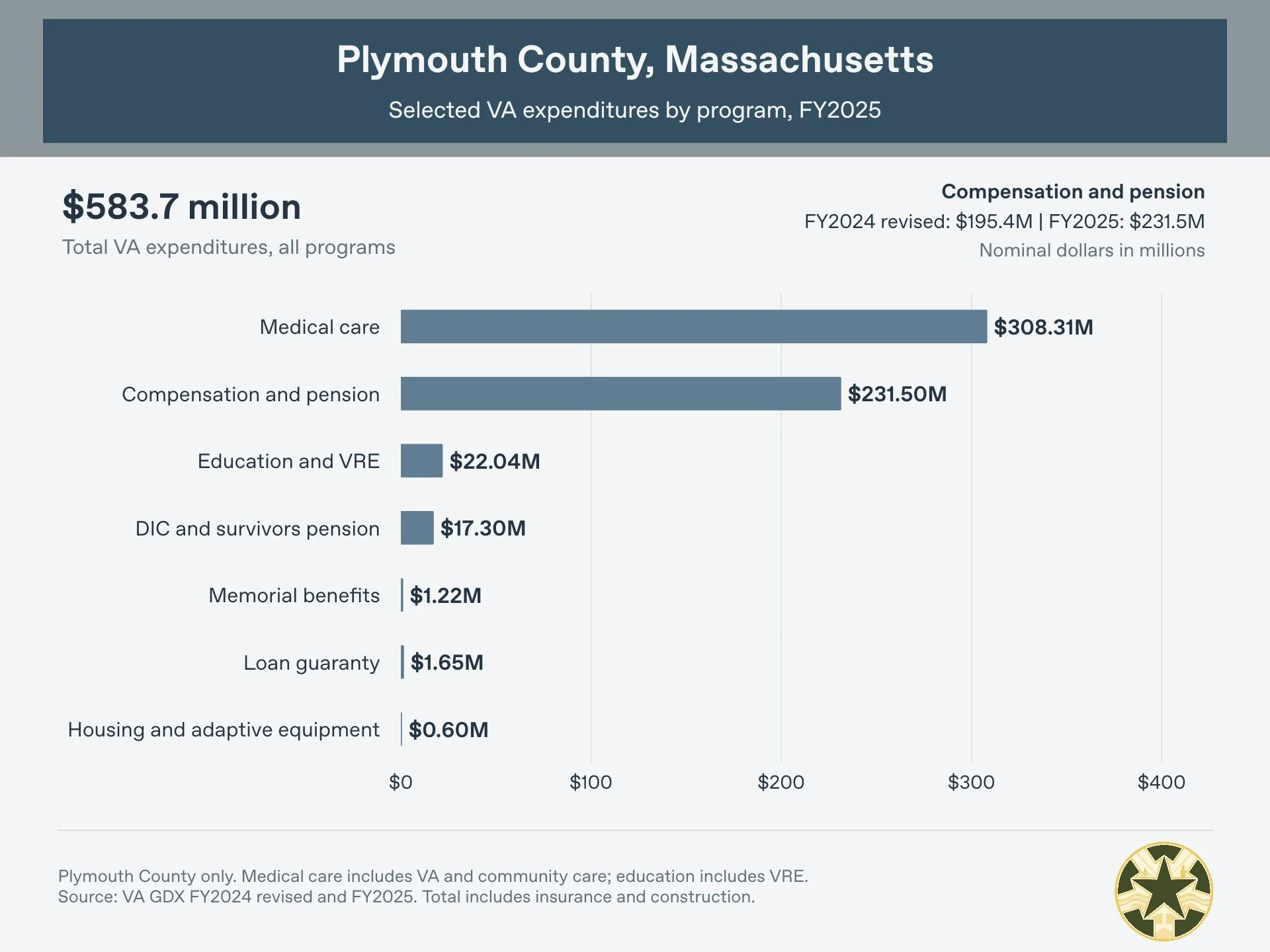
In FY2025, VA reported $583.7 million in total spending in Plymouth County, including:
$308.3 million for medical care;
$231.5 million for compensation and pension; and
$22.0 million for education and employment programs.
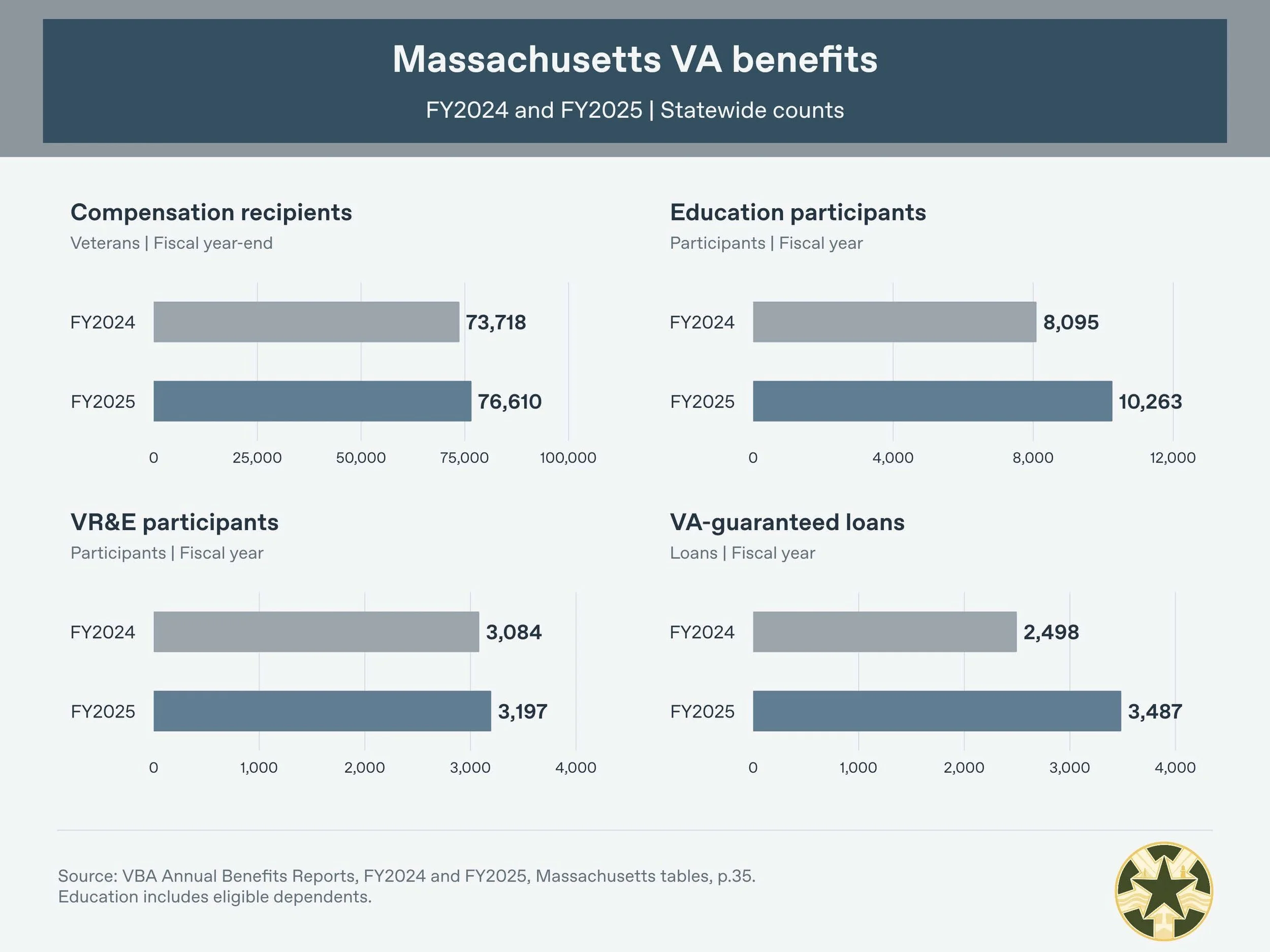
VA Annual Benefits Reports provide additional information about benefit programs, including the number of recipients, their characteristics, and program activity. In FY2025, Massachusetts had 76,610 disability compensation recipients, 10,263 education participants, 3,197 Veteran Readiness and Employment participants, and 3,487 VA-guaranteed loans.
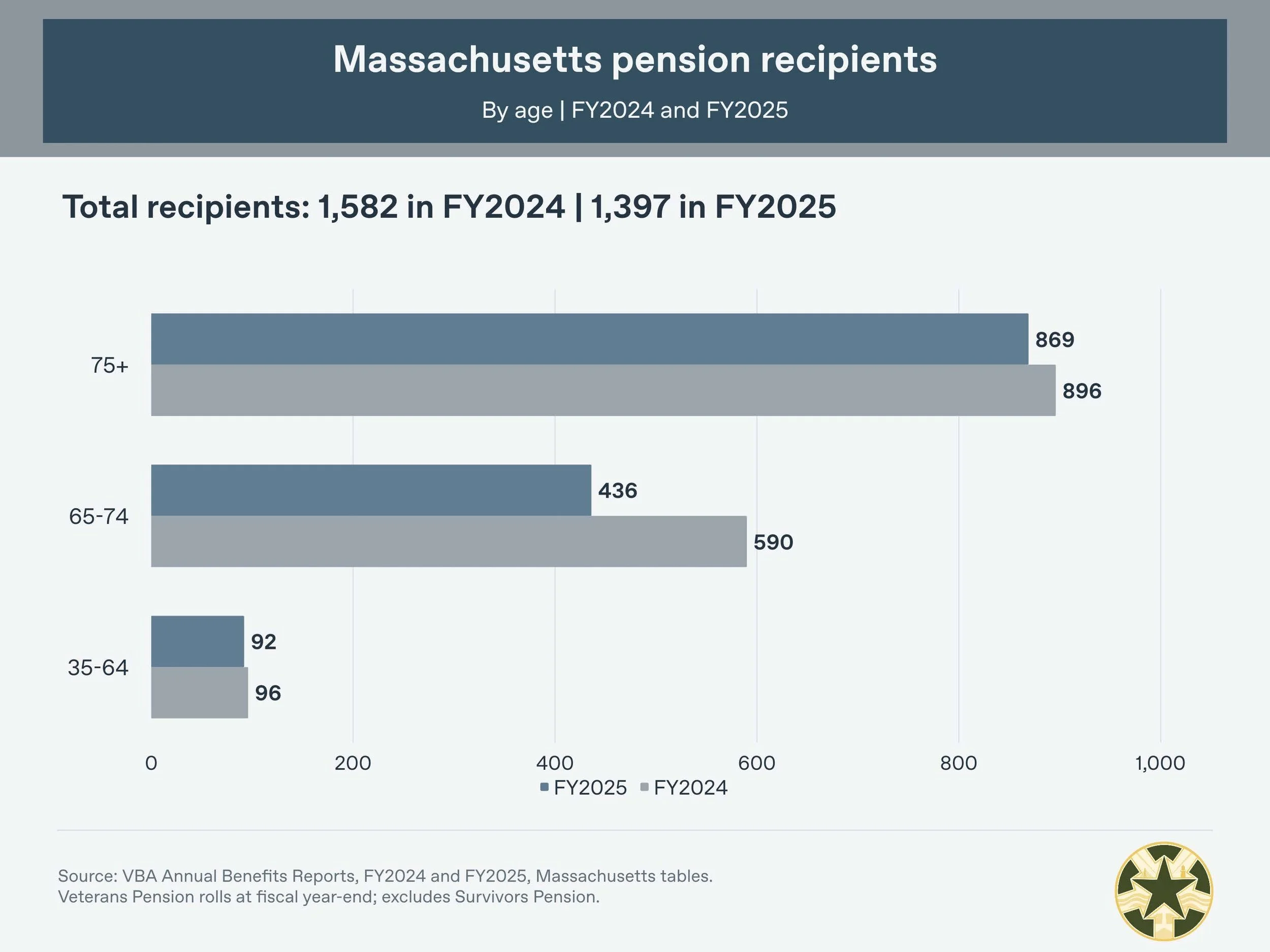
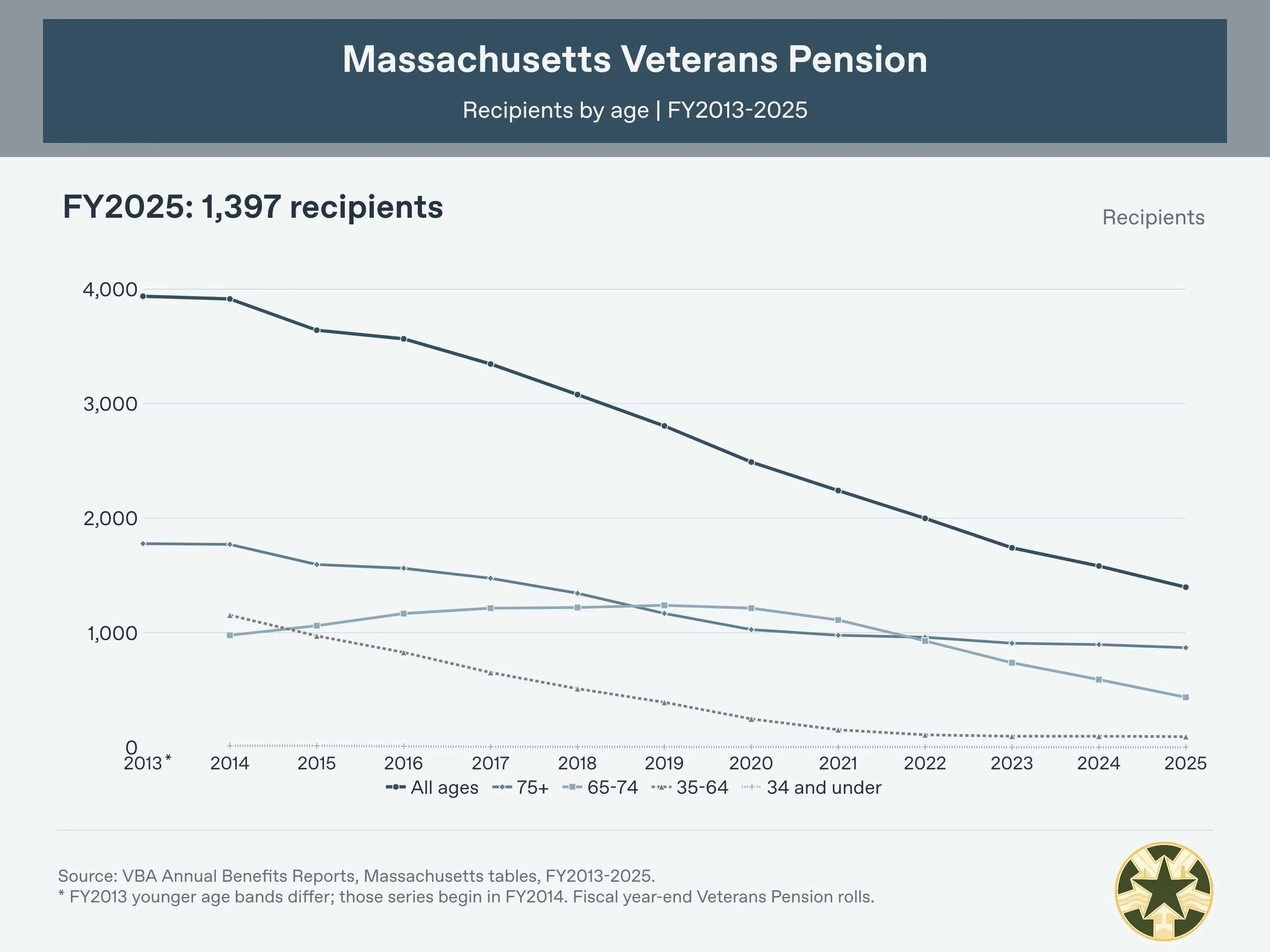
At the end of FY2025, 1,397 veterans were receiving VA pension in Massachusetts, with $18.6 million in estimated annual payments. Approximately 93.4 percent were age 65 or older (1,305). The number of Massachusetts wartime veterans receiving VA pension benefits has continued to decline from 1,582 veterans receiving $21.3 million in payments in FY2024, 1,998 veterans receiving $25.2 million in payments in FY2022, and 3,937 veterans receiving $43.1 million in payments in FY2013.
These figures cover the whole state and are not broken down by county. The chart below shows pension recipients by age through FY2025. The payment estimate is a benefit-program measure rather than a GDX expenditure total.
VA revised its GDX reporting methodology in FY2024, using individual and program-office records to assign spending by recipients’ addresses and facility or project locations rather than relying on financial transaction codes. Program categories also changed. Dependency and Indemnity Compensation (DIC), survivors pension, and burial benefits are now reported separately from compensation and pension. The historical FY1996–FY2023 figures should therefore be read separately from the FY2024–FY2025 figures.
Veteran Homelessness in Plymouth County
HUD’s Continuum of Care (CoC) Program is designed to promote community-wide commitment to the goal of ending homelessness. The Massachusetts CoC includes 12 regional CoCs, including the South Shore CoC covering Plymouth County and Quincy/Weymouth in Norfolk County.
During the last week of January, CoC’s count all of the homeless people reported by service providers and counted by local police and volunteer groups on the streets. In 2023, veterans made up 3.4 percent of the homeless population in Massachusetts, up from from 2.2 percent in 2022.
From 2022 to 2023, the number of homeless veterans increased from 534 to 545, including 70 women, who made up 12.8 percent of homeless veterans counted. Veteran homelessness increased by less than 3 percent overall, with a 23 percent increase for women veterans.
Plymouth County Public Health Data
The U.S. Center for Disease Control’s Suicide Prevention Strategies for Communities support the implementation of a public health approach that uses data to drive decision-making. Massachusetts does not publish comprehensive data surrounding the deaths of service members and veterans. The chart below includes toxicology data for suicide deaths overall in Plymouth County.