
Western Massachusetts
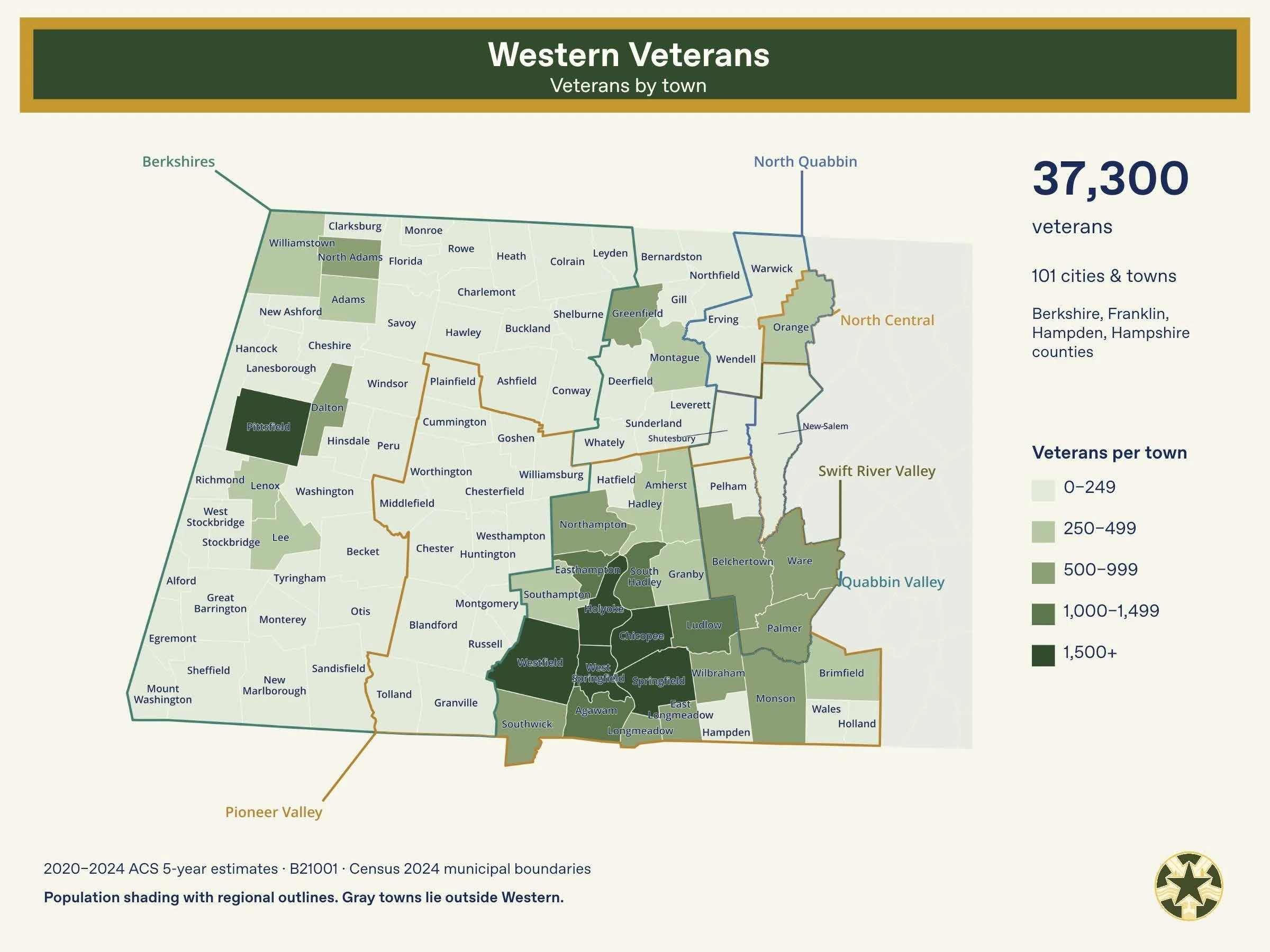
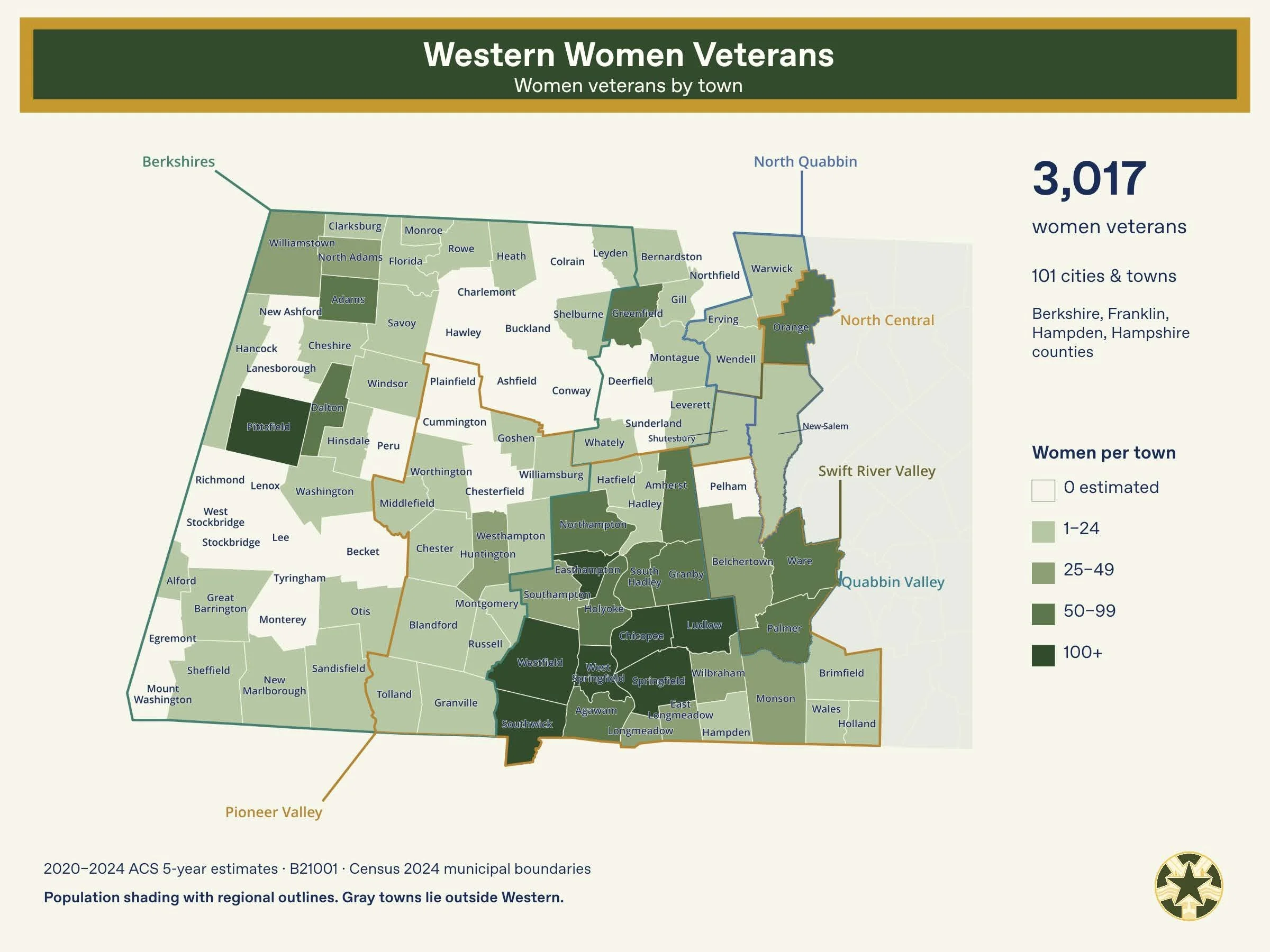
Based on the 2020–2024 ACS 5-year estimates, approximately 37,300 veterans live in Western Massachusetts, including 3,017 women veterans. This page includes local events and directories of veterans’ services; veteran outreach centers; VA healthcare facilities; VA-accredited representatives, agents, and attorneys; elder services; community resources; posts & auxiliaries; and veteran owned businesses, as well as census, veteran homelessness, and public health data for the Western Region.
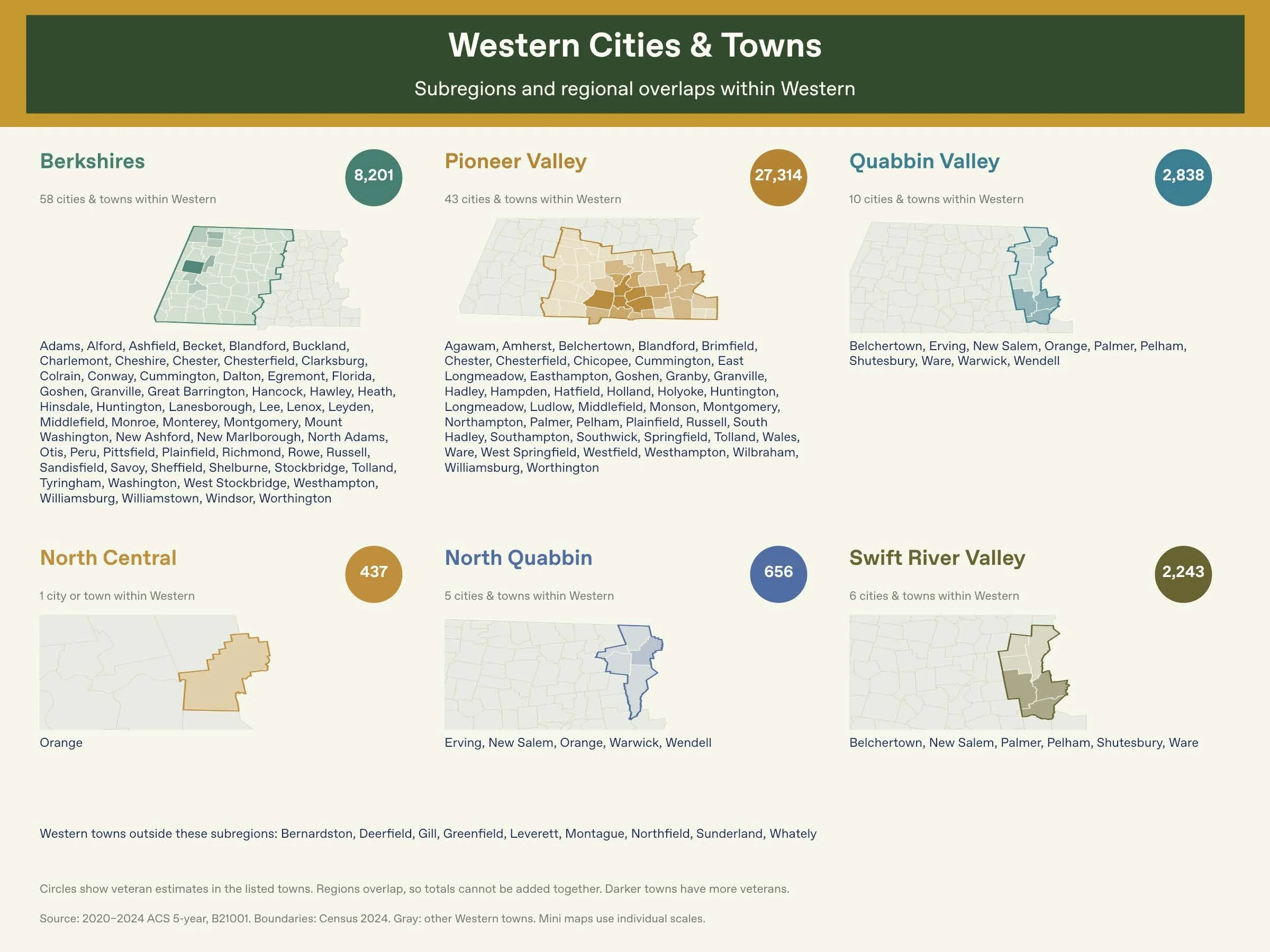
Tag any events you submit with #western-mass so they show up here. Some cities and towns are also in the #berkshires and #pioneer-valley. Use the listing below to search for events by city or town. As long as you include the name of the city or town in an event, it will show up in the relevant local event listings below.
Executive Office of Veterans’ Services
The mission of the Massachusetts Executive Office of Veterans’ Services (EOVS) is to act as the primary advocate on behalf of all the Commonwealth’s veterans. The Office provides outreach and support through various programs. EOVS offers assistance to eligible veterans and their surviving spouses through the MassVets Financial Benefits Program.

Veterans may use the Mass Vet Benefit Calculator to see what they may qualify for and contact their local veterans’ services office below to apply.
-
MGL Chapter 115 requires each town/city have a veterans’ agent to administer these benefits, but two or more contiguous towns can also appoint someone to serve as veterans’ agent and form Veterans’ Services Districts. Most cities and towns in Western Mass share a veterans’ agent or are served by a Veterans’ Services District listed below.
Veteran Outreach Centers in Western Mass
The Berkshire Veterans Outreach Center in Pittsfield is committed to helping veterans and their families in the Berkshires any way they can. They know the challenges that can come with paperwork and red tape and will help with anything from VA disability and pension claims to VA healthcare applications and Veteran ID cards. Call (413) 448-6052 or email the BVOC directly.
The Bilingual Veterans Outreach Center of Massachusetts is located in Springfield and is open to all veterans. For more information or assistance, call (413) 731-0194.
VA Healthcare in Western Mass
Western Region veterans are served by the VA Central Western Massachusetts Healthcare System with a hospital, three clinics, and the Springfield Vet Center in Western Mass. Anyone who has served in the military is encouraged to apply to determine their eligibility and Priority Group. Some veterans are exempt from co-pays due to their VA rating, income, or special eligibility factors.
The VA’s Access to Care website includes a directory of primary licensed independent practice providers who may be lead, ongoing members of the healthcare system’s treatment teams (physicians, PAs, NPs, psychologists, dentists, nurse specialists, RN anesthetists, chiropractors, optometrists, and podiatrists) at VA Central Western Mass. It also includes wait times for new patients.
-
The directory below includes VA-accredited representatives, agents, and attorneys based in Berkshires area cities and towns from the VA Office of the General Counsel’s Accreditation Search Tool as of July 2024. The VA provides accreditation to ensure VA claimants receive qualified assistance preparing and presenting their claims in accordance with VA Standards of Conduct.
-
Aging Services Access Points (ASAPs) are private, non-profit agencies established under MGL Chapter 19A to provide direct and protective services, including information and referrals; interdisciplinary case management; intake and assessment; developing, implementing, and monitoring service plans; reassessing needs; and investigating reports of elder abuse and neglect.
-
Councils on Aging (COAs) are municipal agencies that provide local outreach, social and health services, advocacy, information and referral for older adults, their families, and caregivers. COAs and Senior Centers serve as advocates and links to support services for elders, families, and caregivers. They offer outreach, transportation, meals, health screenings, health insurance counseling, and life-long learning, social, fitness, wellness, and recreation activities.

MassOptions is a service of the Executive Office of Health & Human Services (EOHHS) that can also help older adults, people with disabilities, and family members or caregivers identify aging and disability services and connect to those that can meet their needs. Call 800-243-4636 or click here to complete a referral.
Western Mass Resource Network
The Veterans Collaborative Network Directory is a shared resource that includes the various organizations and programs participants are affiliated with, as long as they’ve signed in or otherwise participated in our summits to help us map the landscape. This is not an exhaustive list of programs serving the Southeast Region, but you’ll find many here along with their websites and event listings.
-
The Veterans Posts and Auxiliaries directory includes information about the VFW and American Legion Posts, Marine Corps League Detachments, and DAV Chapters based in cities and towns in Western Massachusetts.
Veteran Owned Businesses in Western Mass
The Veteran Owned Businesses directory is based on publicly available information and listings of veteran owned businesses based in Massachusetts. The listing below includes businesses in Southeastern Massachusetts. Follow the link below to update information or submit a new business.
-
In October 2023, the US Census Bureau released the most recent 2022 data from the Annual Business Survey, which includes information at the state level on veteran-owned businesses within:
Company Summaries and Characteristics of Businesses tables by industry, sex, ethnicity, race, and veteran status and Characteristics of Business Owners tables by Service-Disabled and Other Veteran Characteristics
Module Business Characteristics tables by industry, sex, ethnicity, race, and veteran status, including Effect of Coronavirus on Business Sales, Level of Operations During Coronavirus Pandemic, Level of Operations During Coronavirus Pandemic, and Outstanding Debt
Western Mass Veterans Census Data
Based on the 2020–2024 ACS 5-year estimates, approximately 37,300 veterans live in Berkshire, Franklin, Hampden, and Hampshire Counties. Veterans make up about 5.5 percent of civilian adults age 18 and older, or 4.5 percent of the total population.
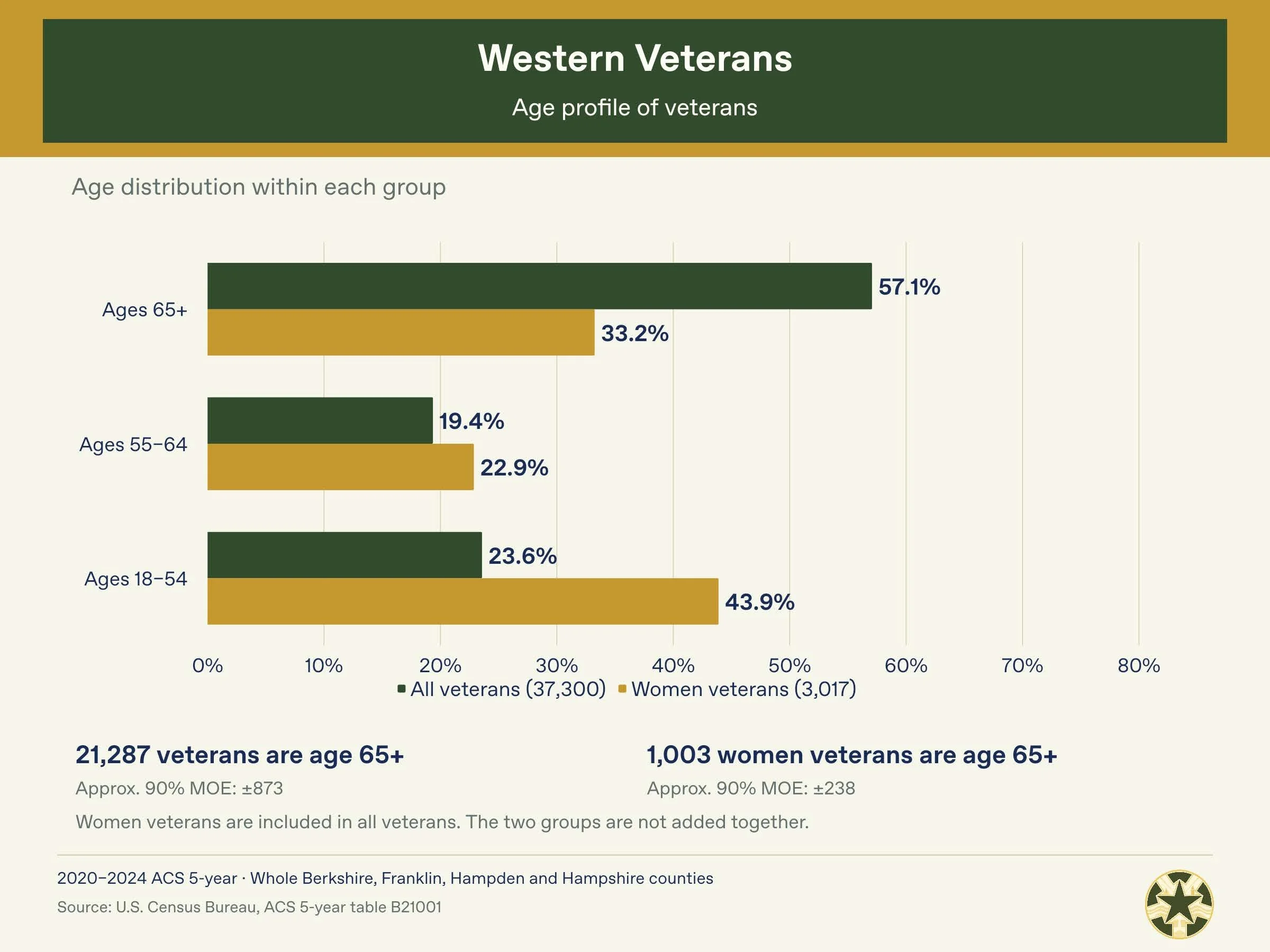
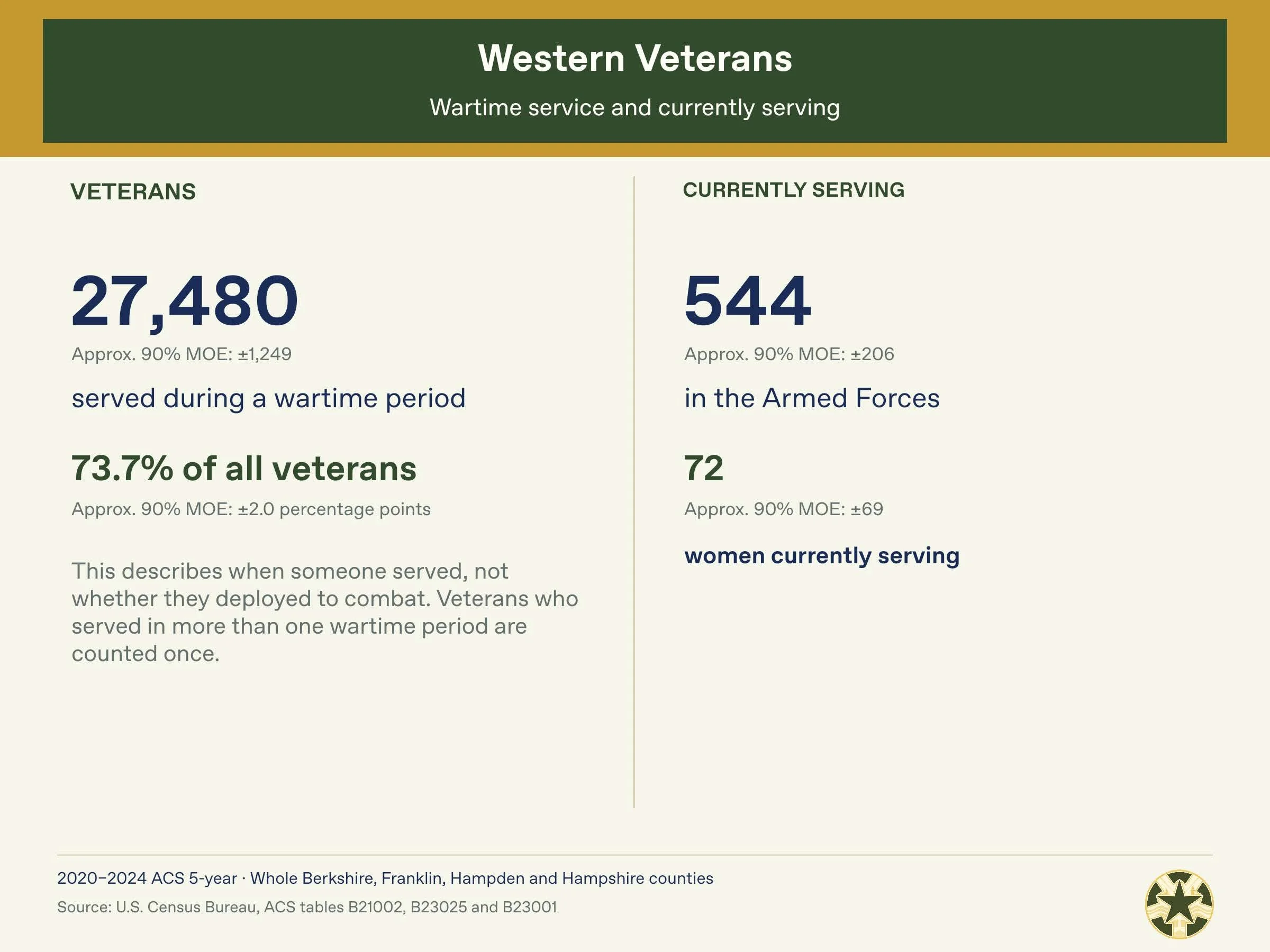
Women account for approximately 8.1 percent of veterans (3,017). Around 57 percent of veterans are age 65 or older (21,287), compared with 33.2 percent of women veterans (1,003). Approximately 74 percent of veterans served during a wartime period (27,480). An estimated 544 people are currently serving in the Armed Forces, including 72 women, or about 13 percent.
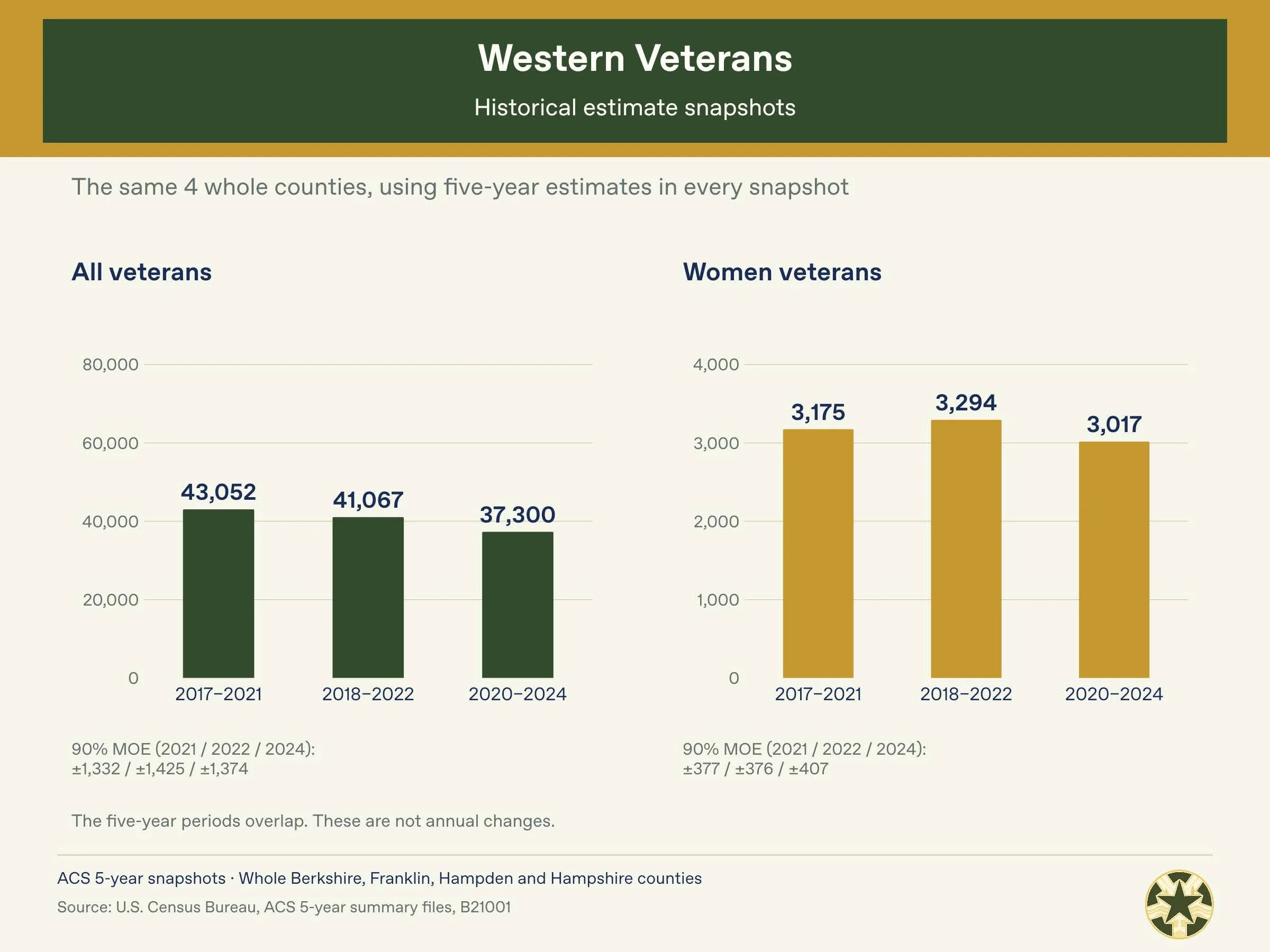
Between the 2021 and 2024 ACS 5-year estimates, the estimated veteran population decreased by 13.4 percent, from 43,052 to 37,300. The estimated number of women veterans decreased by 5 percent, from 3,175 to 3,017. These five-year periods overlap, so the differences should not be read as annual changes. Estimates also carry sampling error.
If you serve veterans and are trying to learn more about their demographics, explore the most recent ACS 5-year estimates from Census Reporter for cities and towns in Western Massachusetts below.
-
Age by gender and veteran status, service era, service-connected disability, veteran status by educational attainment, age by veteran status and employment, median income by gender and veteran status, and sex by age by employment status with Armed Forces are available at the city and town level with 5-year estimates.
Age by disability by veteran and poverty status is available with 5-year estimates and is used consistently in the analysis below. The more detailed age breakdown is also available with 1-year estimates for these counties. Check the release shown when comparing tables.
Age, sex, and veteran status data are also available by race and Hispanic origin. The links below cover cities and towns in Berkshire, Franklin, Hampden, and Hampshire Counties, along with whole-county data for the same area. City and town tables use ACS 5-year estimates. Check the release shown when comparing county tables.
White alone: cities and towns · whole-county data
Black or African American alone: cities and towns · whole-county data
American Indian and Alaska Native alone: cities and towns · whole-county data
Asian alone: cities and towns · whole-county data
Native Hawaiian and Other Pacific Islander alone: cities and towns · whole-county data
Some other race alone: cities and towns · whole-county data
Two or more races: cities and towns · whole-county data
White alone, not Hispanic or Latino: cities and towns · whole-county data
Hispanic or Latino: cities and towns · whole-county data
Hispanic or Latino includes people of any race. These categories overlap and should not be added together. Estimates for small groups can have substantial uncertainty. Review the margins of error alongside them.
Age, Disability & Poverty Status
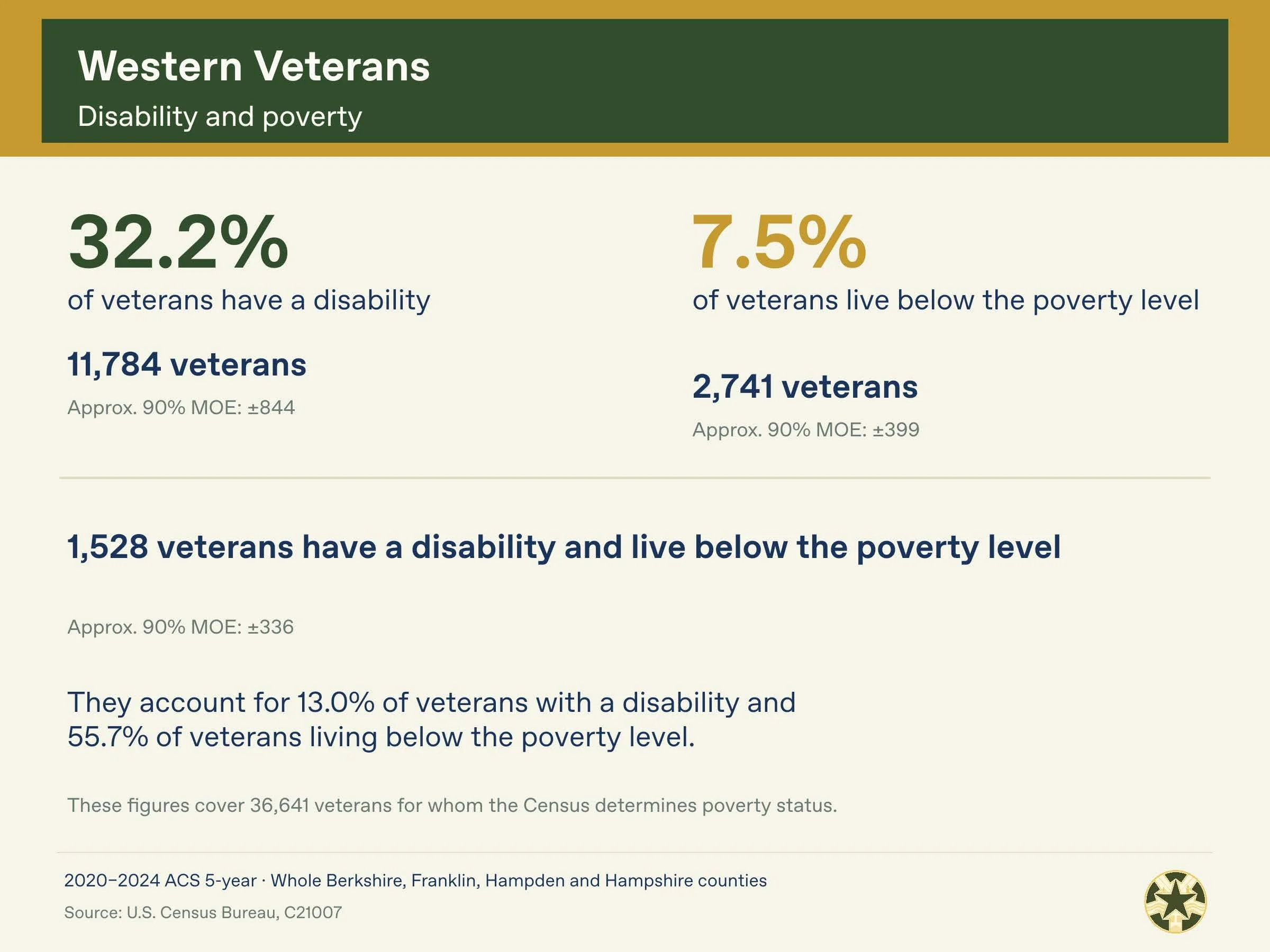
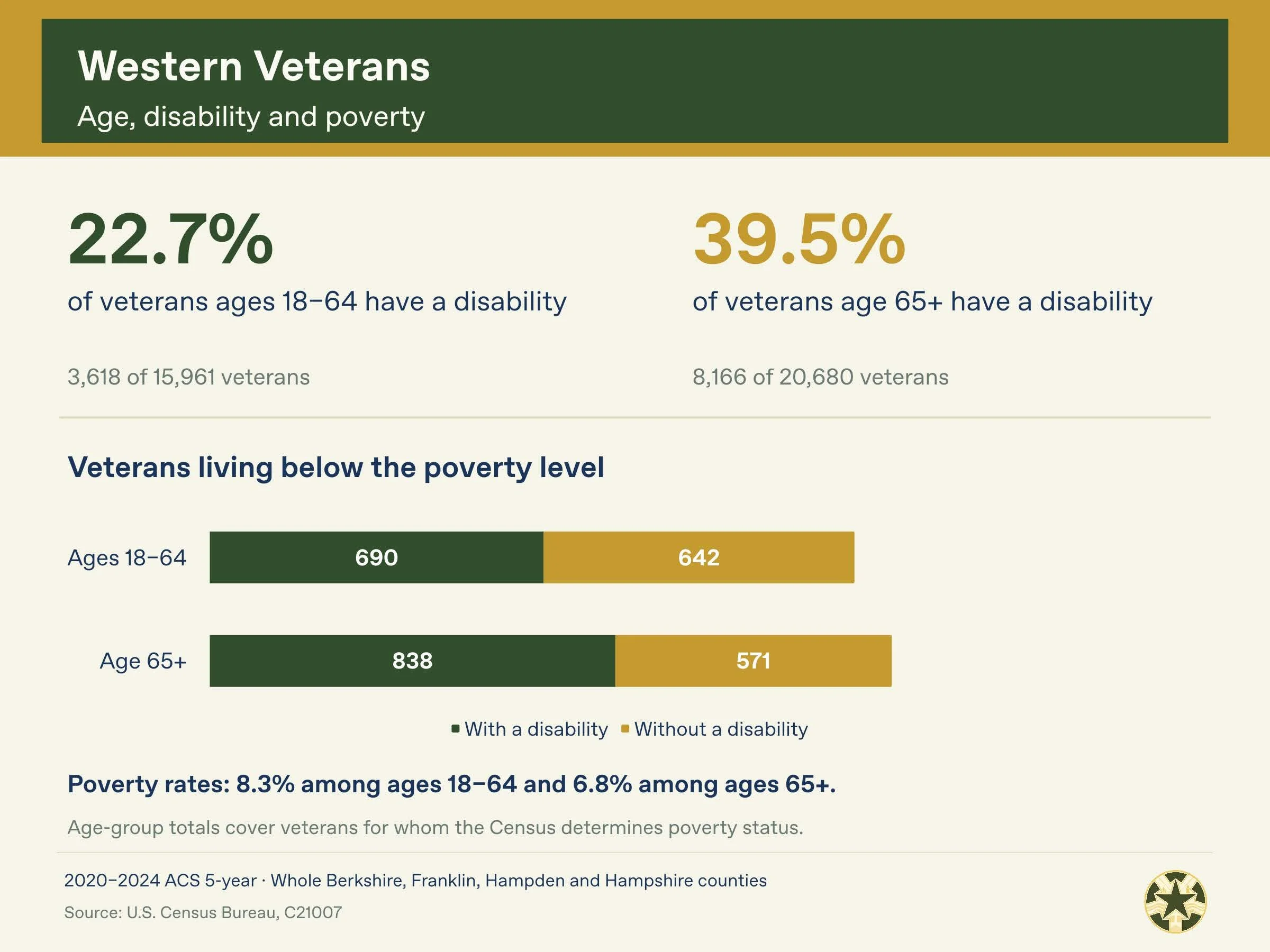
Based on the 2020–2024 ACS 5-year estimates, disability and poverty data cover 36,641 veterans in Western Massachusetts. Around 32 percent reported a disability (11,784), and 7.5 percent had incomes below the poverty level (2,741).
Among veterans age 65 or older for whom poverty status is determined, approximately 39 percent reported a disability (8,166), and 6.8 percent had incomes below the poverty level (1,409). Around 69 percent of veterans with disabilities were age 65 or older.
An estimated 1,528 veterans had both a disability and incomes below the poverty level. They made up about 13 percent of veterans with disabilities and 56 percent of veterans with incomes below the poverty level.
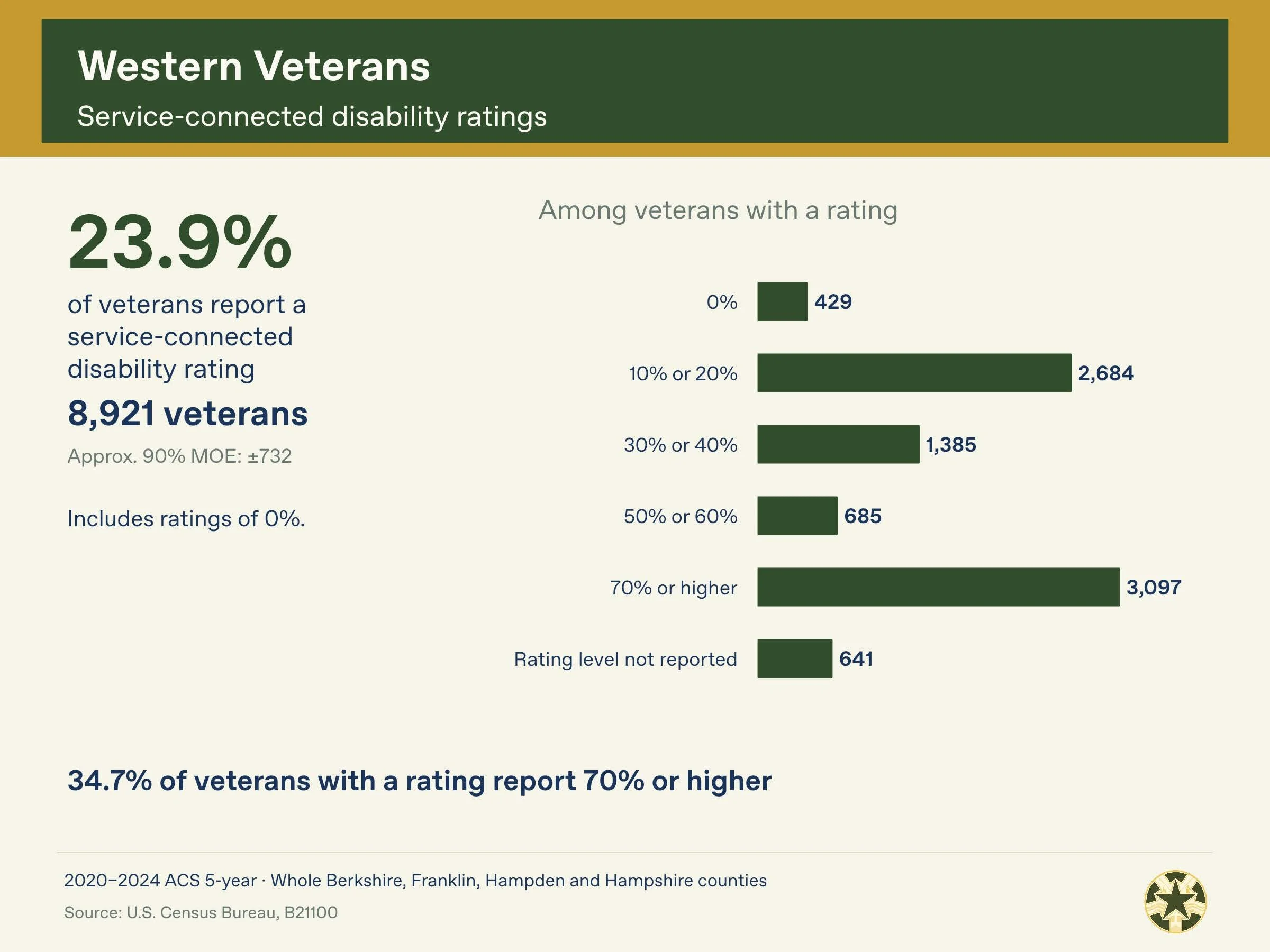
Approximately 23.9 percent of veterans reported a service-connected disability rating (8,921), including ratings of 0 percent. Among veterans with a rating, around 35 percent reported a rating of 70 percent or higher (3,097). Rating level was not reported for 641 veterans. These figures measure reported ratings rather than receipt of compensation payments.
Whether or not a veteran has time during a “wartime” service era determines whether a very low income veteran is potentially eligible for a VA Pension. Eligible veterans over age 65 may qualify for a VA pension whether or not they have a qualifying disability.
Approximately 74 percent of Western Massachusetts veterans served during a wartime period (27,480). The remaining 26 percent served only during peacetime (9,820). These estimates describe periods of service and do not establish eligibility for VA benefits.
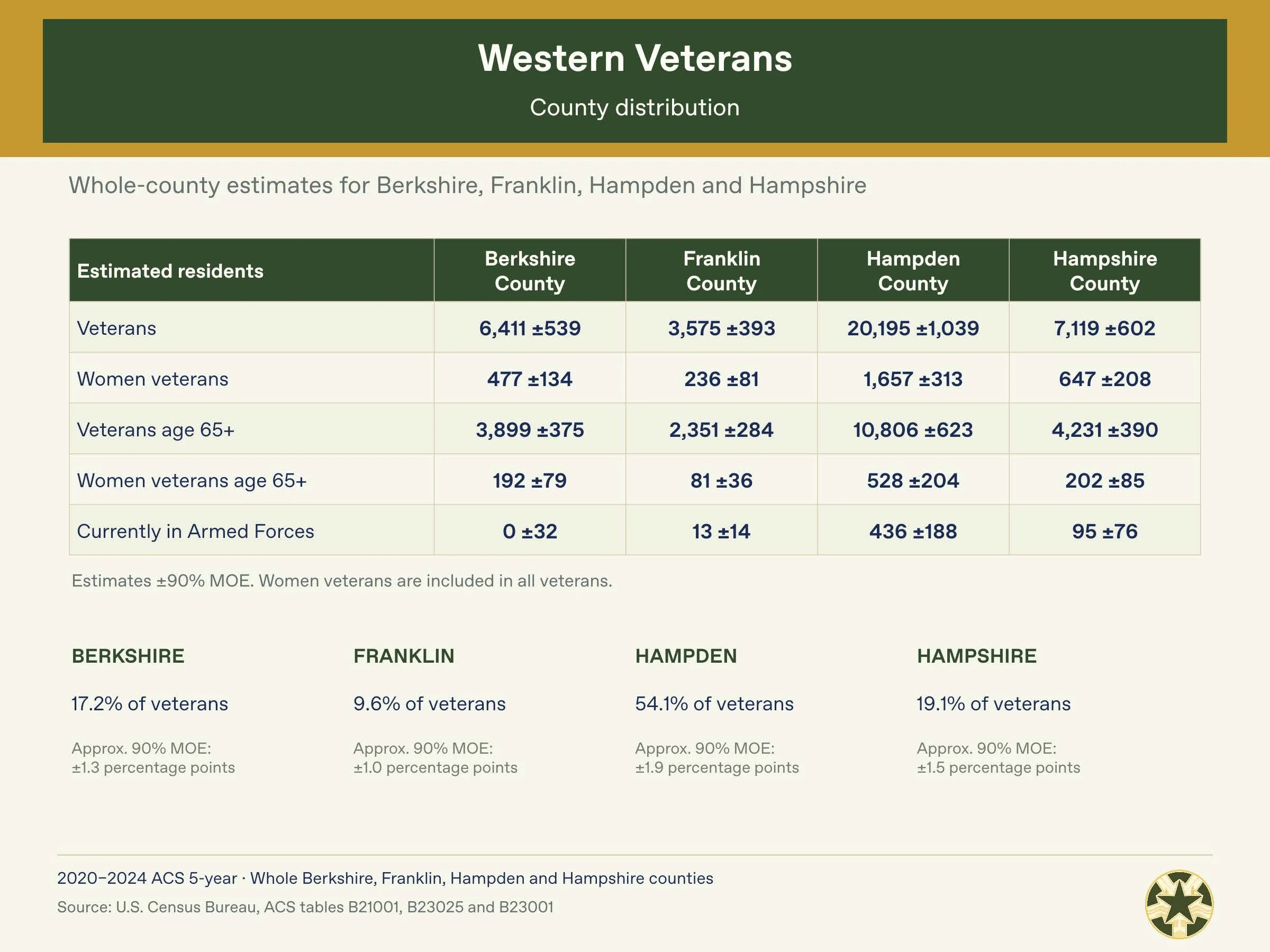
Around 54 percent of Western Massachusetts veterans live in Hampden County (20,195).
Approximately 8.2 percent are women veterans (1,657).
Around 54 percent of veterans are age 65 or older (10,806), including 32 percent of women veterans (528).
Approximately 73 percent served during a wartime period (14,757).
Around 19 percent of Western Massachusetts veterans live in Hampshire County (7,119).
Approximately 9.1 percent are women veterans (647).
Around 59 percent of veterans are age 65 or older (4,231), including 31 percent of women veterans (202).
Approximately 76 percent served during a wartime period (5,405).
Around 17 percent of Western Massachusetts veterans live in Berkshire County (6,411).
Approximately 7.4 percent are women veterans (477).
Around 61 percent of veterans are age 65 or older (3,899), including 40 percent of women veterans (192).
Approximately 73 percent served during a wartime period (4,708).
Around 10 percent of Western Massachusetts veterans live in Franklin County (3,575).
Approximately 6.6 percent are women veterans (236).
Around 66 percent of veterans are age 65 or older (2,351), including 34 percent of women veterans (81).
Approximately 73 percent served during a wartime period (2,610).
Education, Employment & Median Annual Income
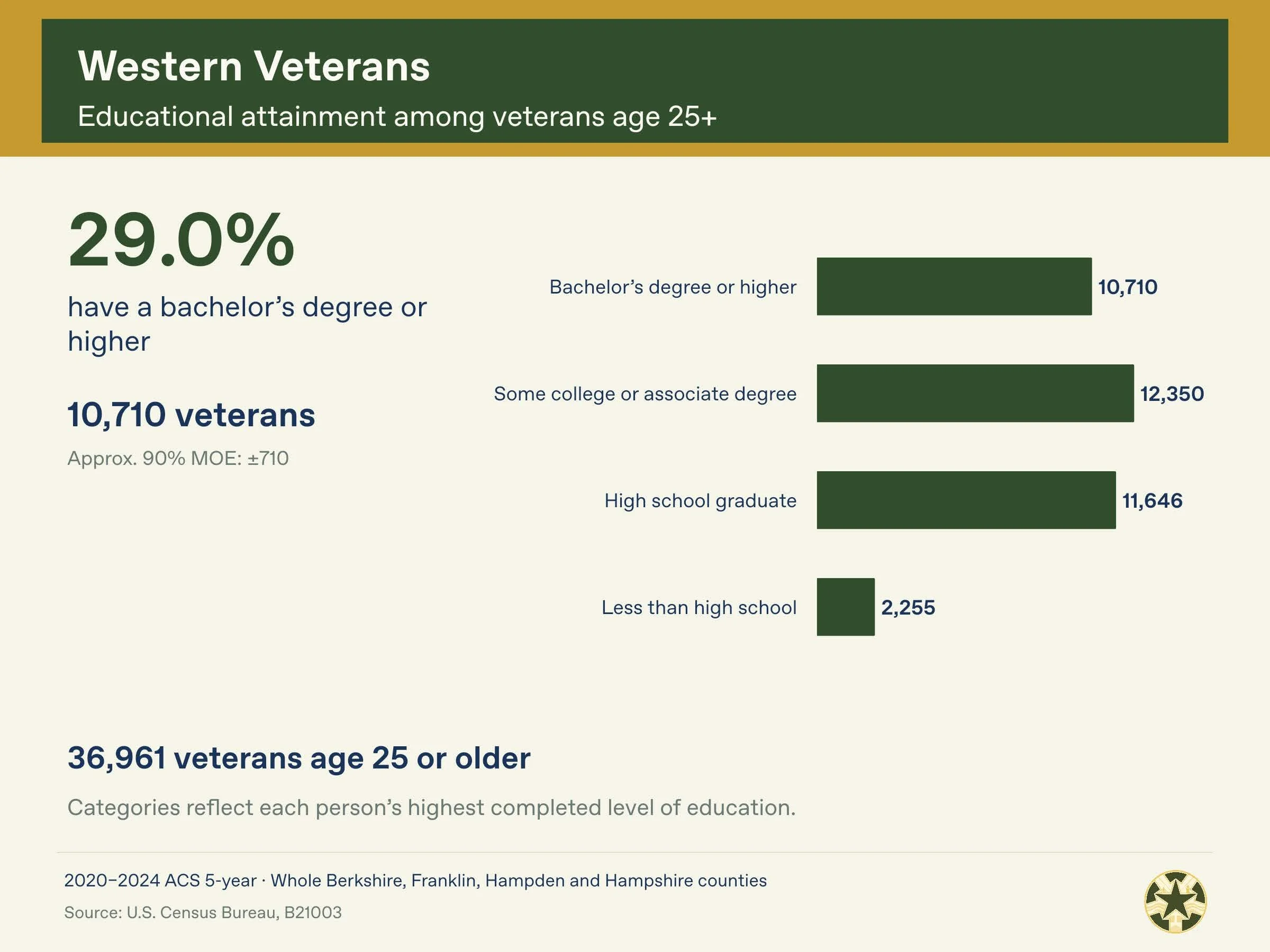
Among veterans age 25 or older, approximately 29 percent had a bachelor’s degree or higher (10,710). Around 33 percent had some college or an associate degree (12,350), 32 percent had a high school diploma or equivalent (11,646), and 6 percent had not completed high school (2,255).
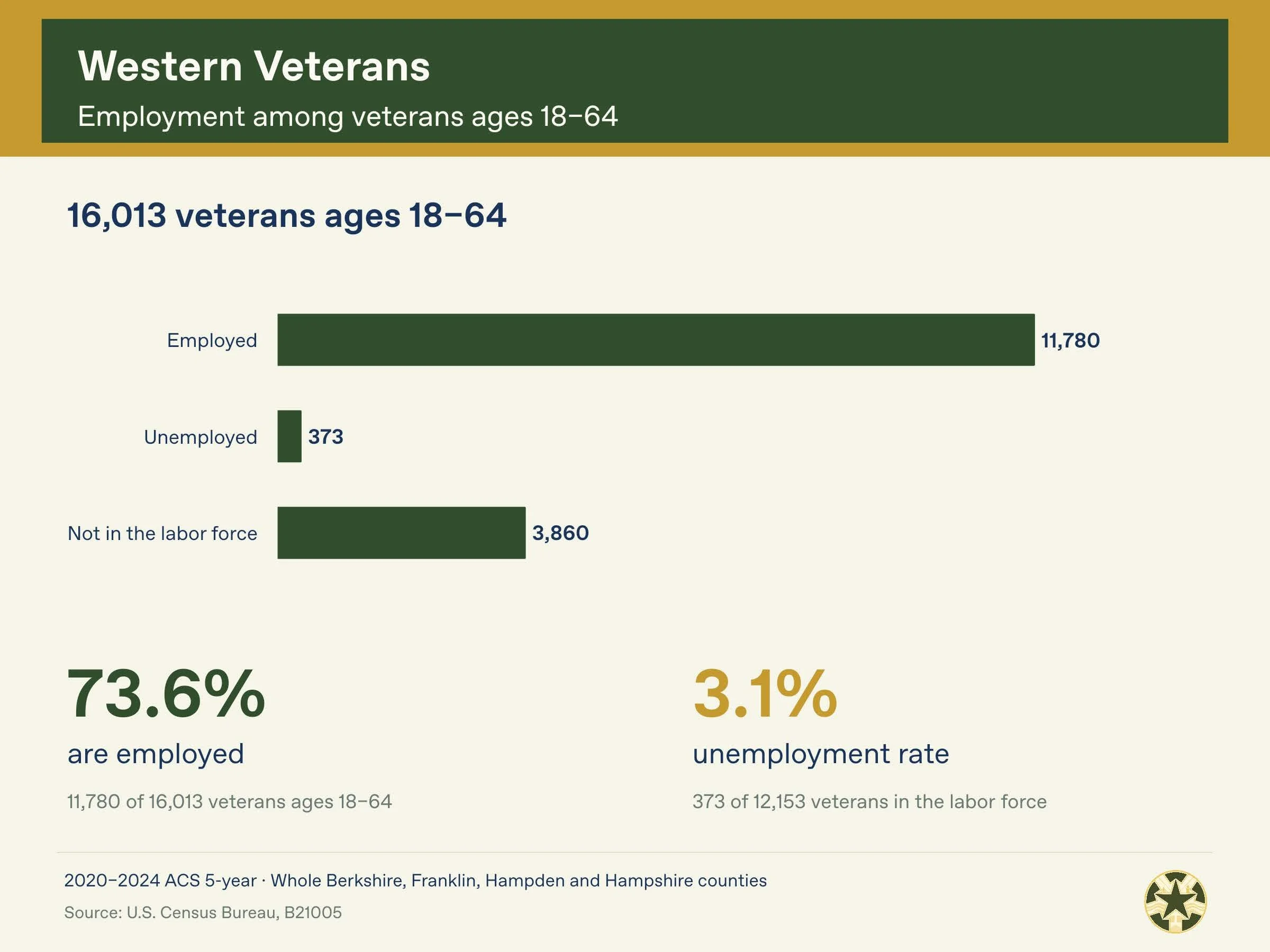
Among veterans ages 18–64, approximately 74 percent were employed (11,780), and 24 percent were outside the labor force (3,860). The unemployment rate was 3.1 percent, representing 373 unemployed veterans among the 12,153 in the labor force.
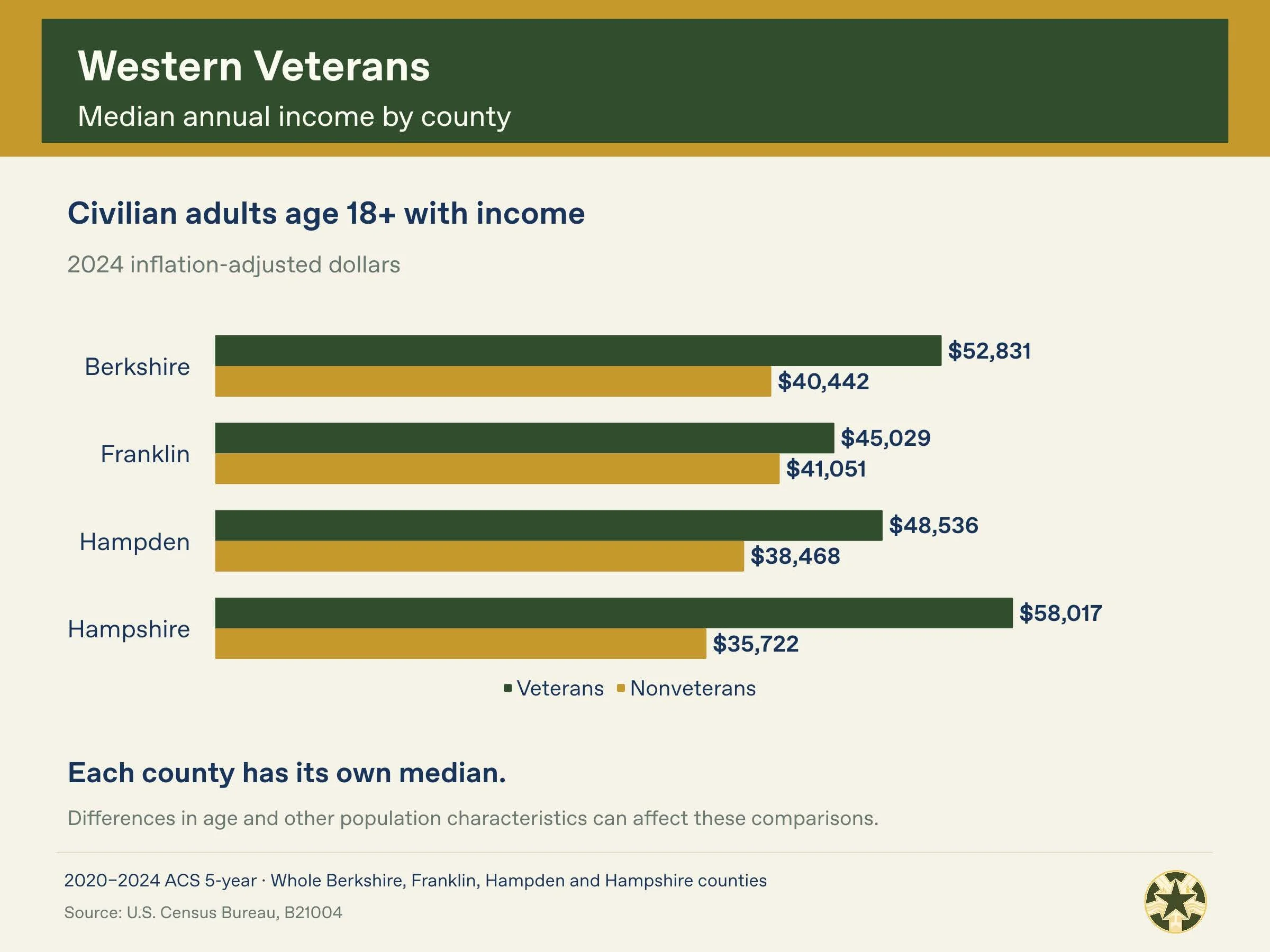
Median annual income among civilian adults age 18 or older with income was:
Berkshire County: $52,831 for veterans, compared with $40,442 for nonveterans.
Franklin County: $45,029 for veterans, compared with $41,051 for nonveterans.
Hampden County: $48,536 for veterans, compared with $38,468 for nonveterans.
Hampshire County: $58,017 for veterans, compared with $35,722 for nonveterans.
These amounts are expressed in 2024 dollars. Each county has its own median. Differences in age and other population characteristics can affect these comparisons.
Veteran Homelessness in Western Mass
HUD’s Continuum of Care (CoC) Program is designed to promote community-wide commitment to the goal of ending homelessness. The Massachusetts CoC includes 12 regional CoCs, including the Three County CoC (covering Berkshire, Franklin, and Hampshire Counties) and the Springfield-Hampden County CoC covering Western Mass.
During the last week of January, CoC’s count all of the homeless people reported by service providers and counted by local police and volunteer groups on the streets. In 2023, veterans made up around 3.4 percent of the homeless population in Massachusetts, up from 2.2 percent in 2022.
From 2022 to 2023, the number of homeless veterans increased from 534 to 545, including 70 women, who made up 12.8 percent of homeless veterans counted. The number of homeless veterans increased by less than 3 percent overall, with a 23 percent increase for women veterans.
The CoCs in Western Massachusetts account for around 23 percent of homeless veterans and 11.4 percent of homeless women veterans in Massachusetts. From 2022 to 2023:
The number of homeless veterans counted increased more than 40 percent from 104 to 127 veterans, including 7 unsheltered, 40 in emergency shelter, and 80 in transitional housing.
The number of homeless women veterans counted decreased over 27 percent from 11 to 8 veterans, including 6 in transitional housing and 2 in emergency shelter.
Housing Advisory Council
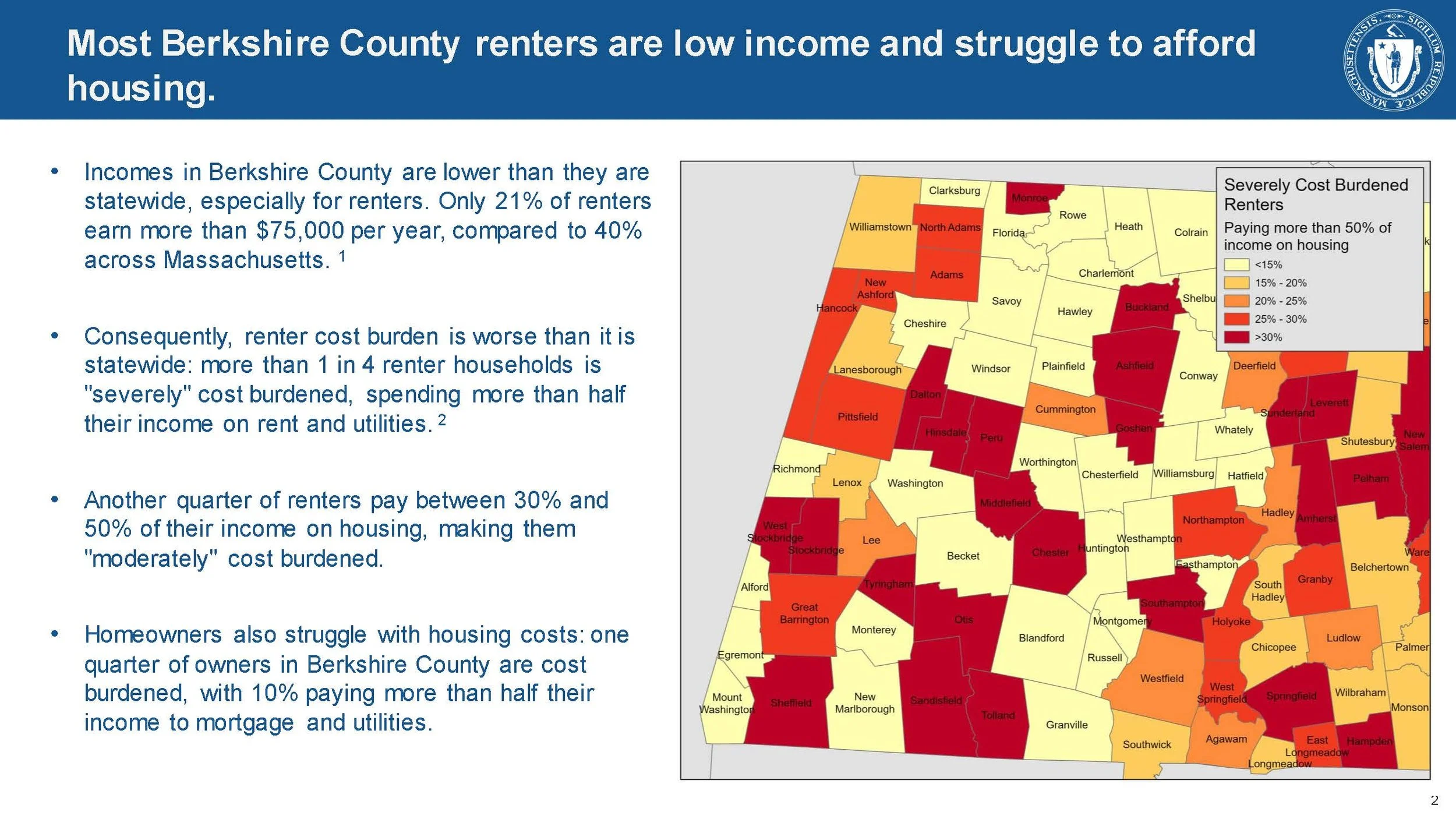
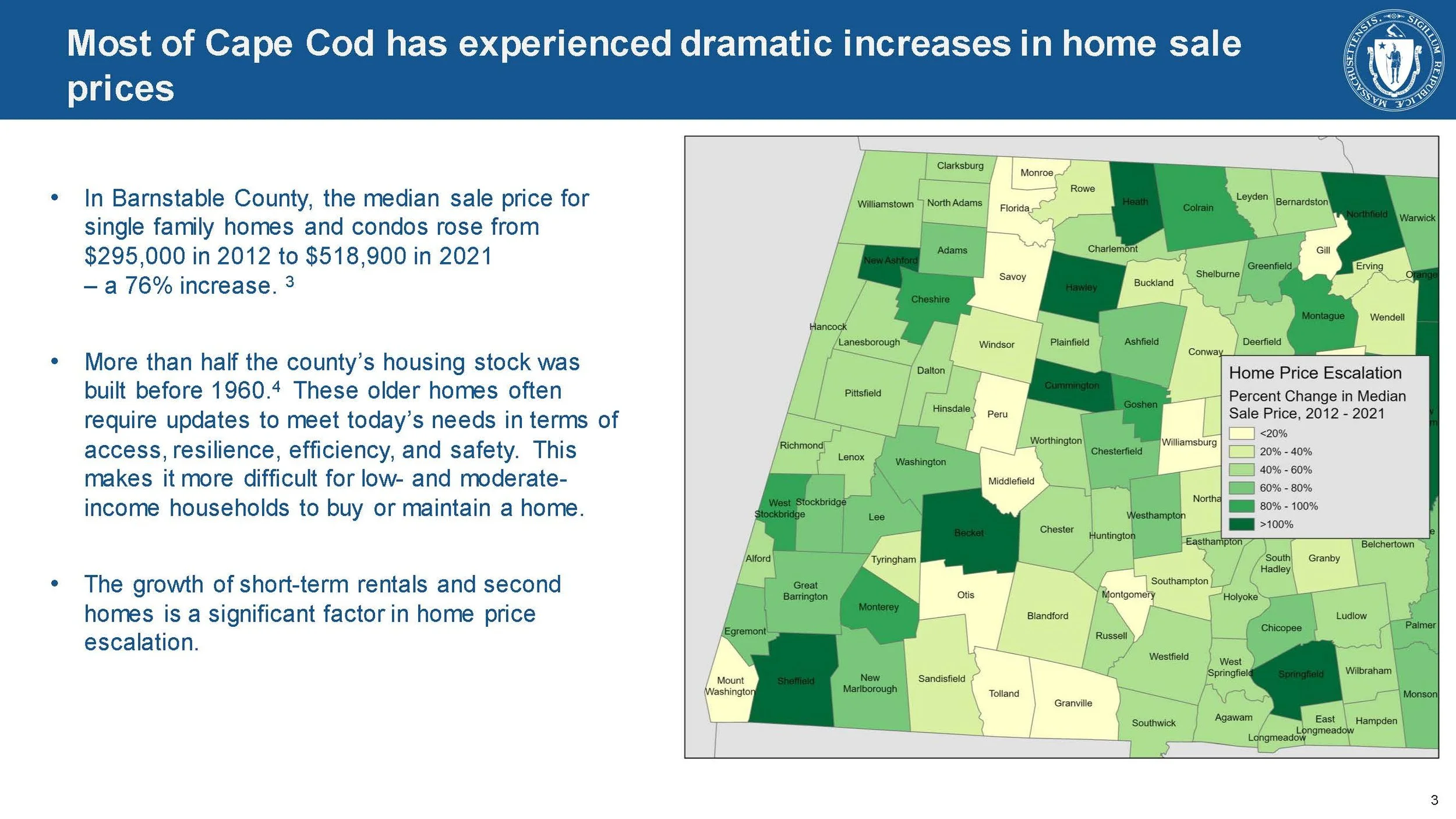
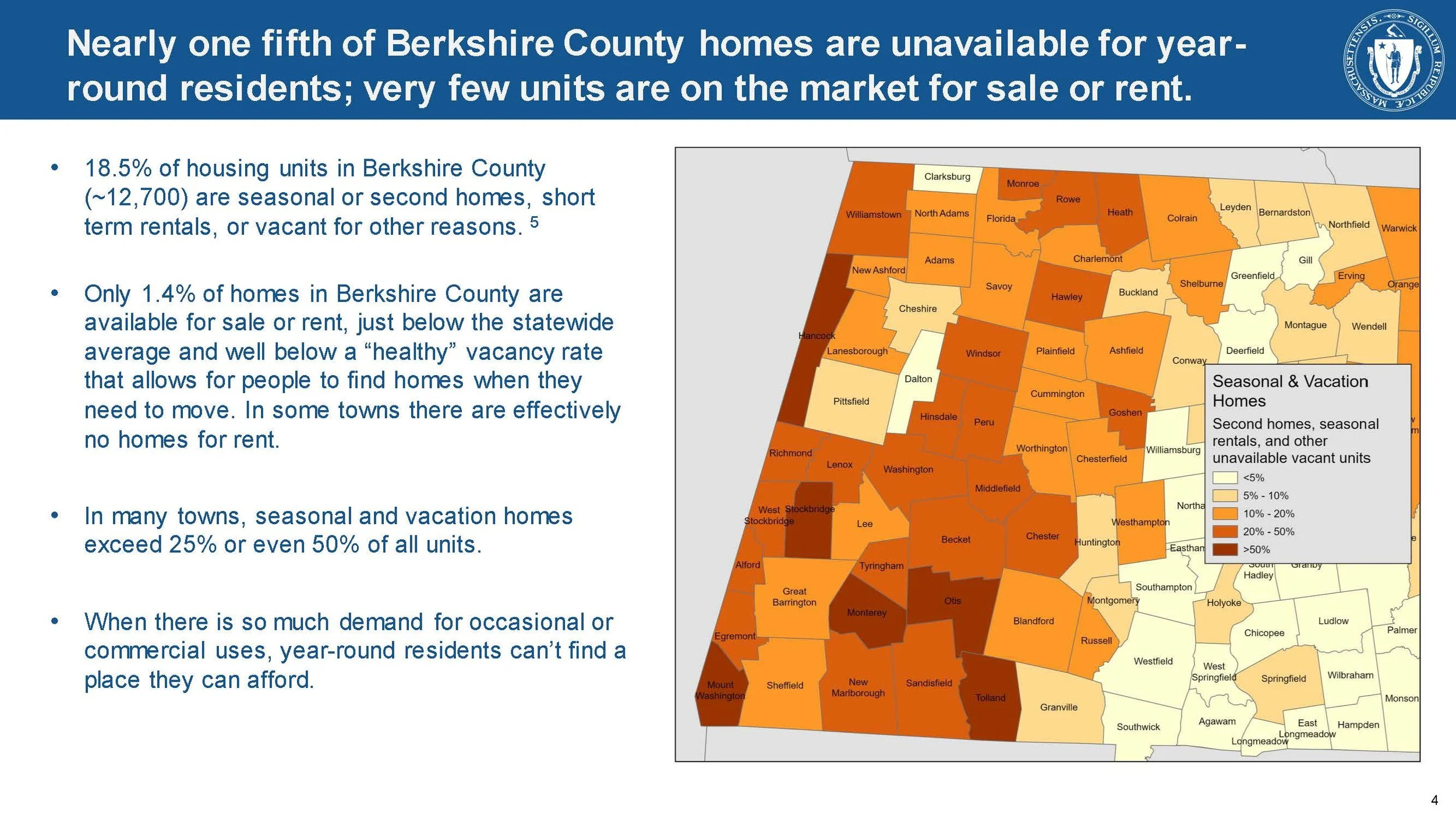
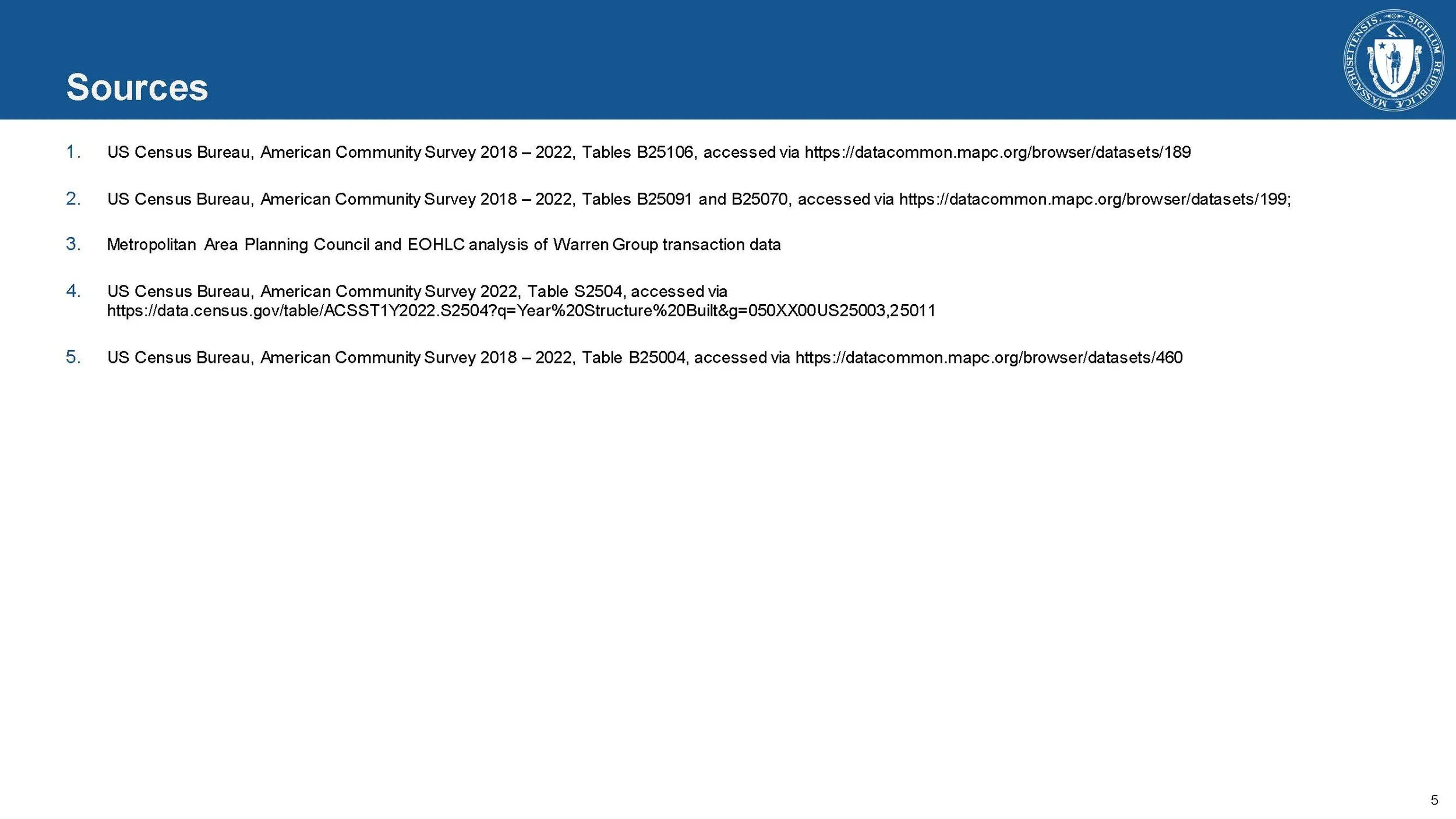
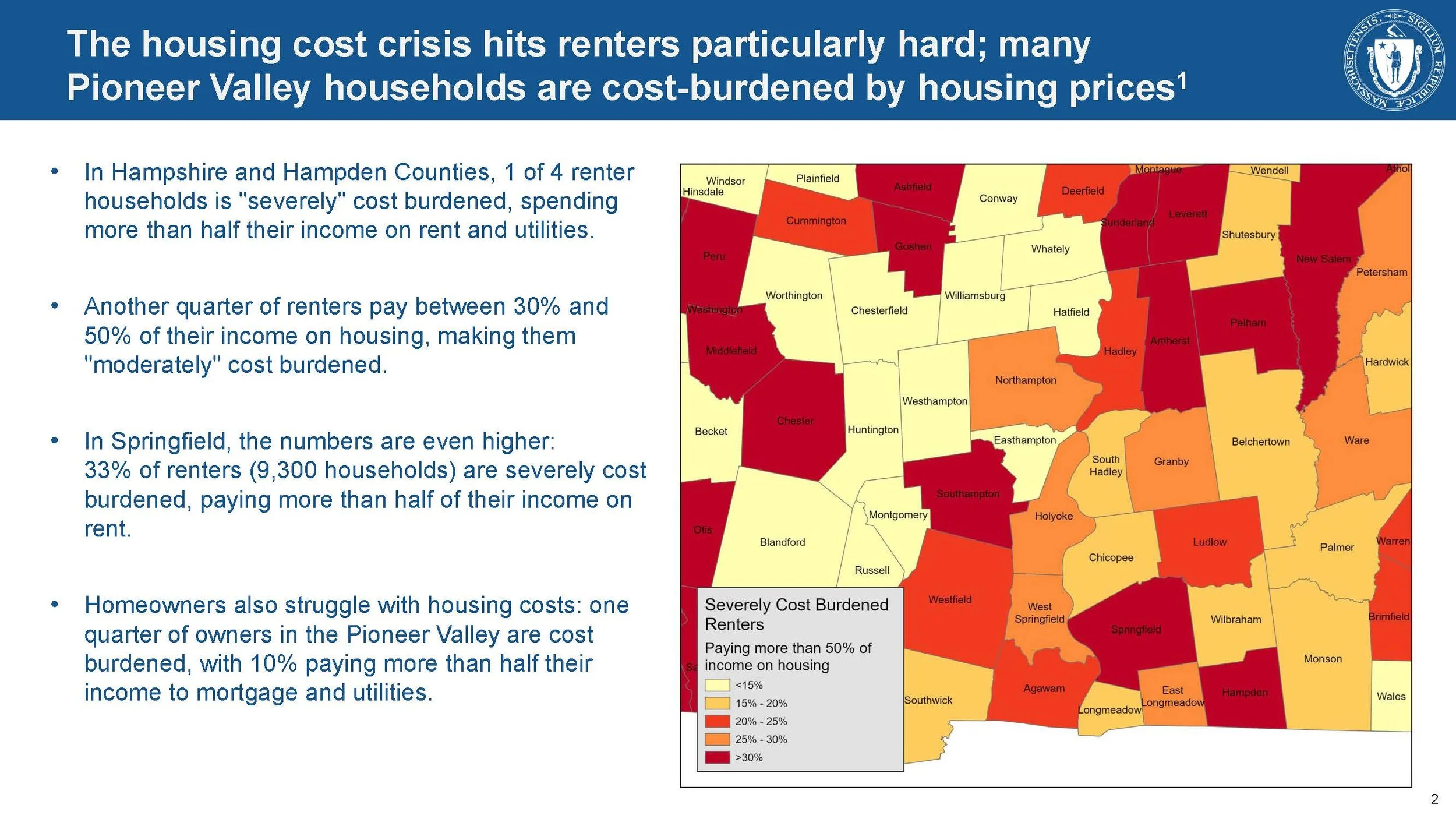
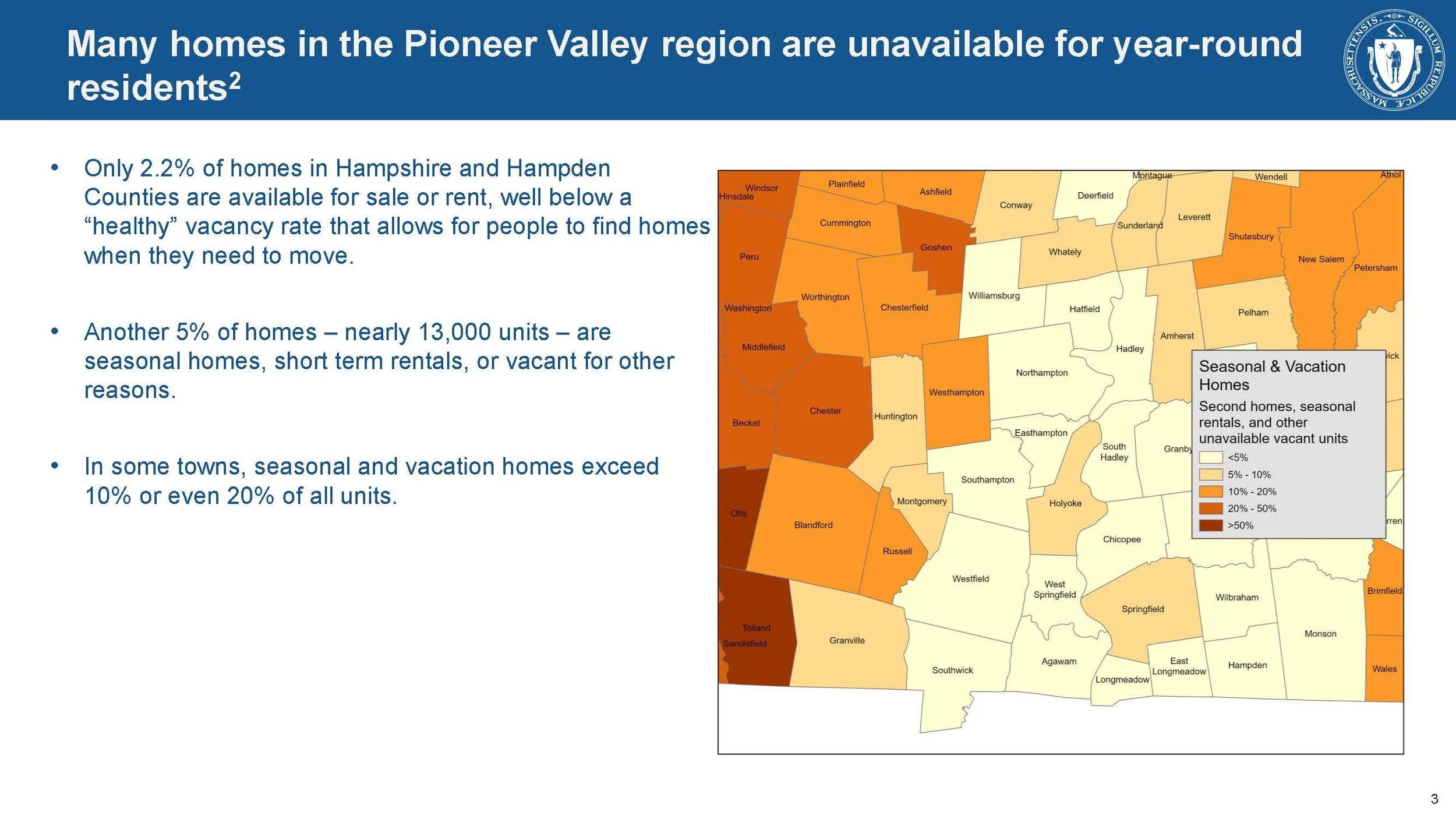
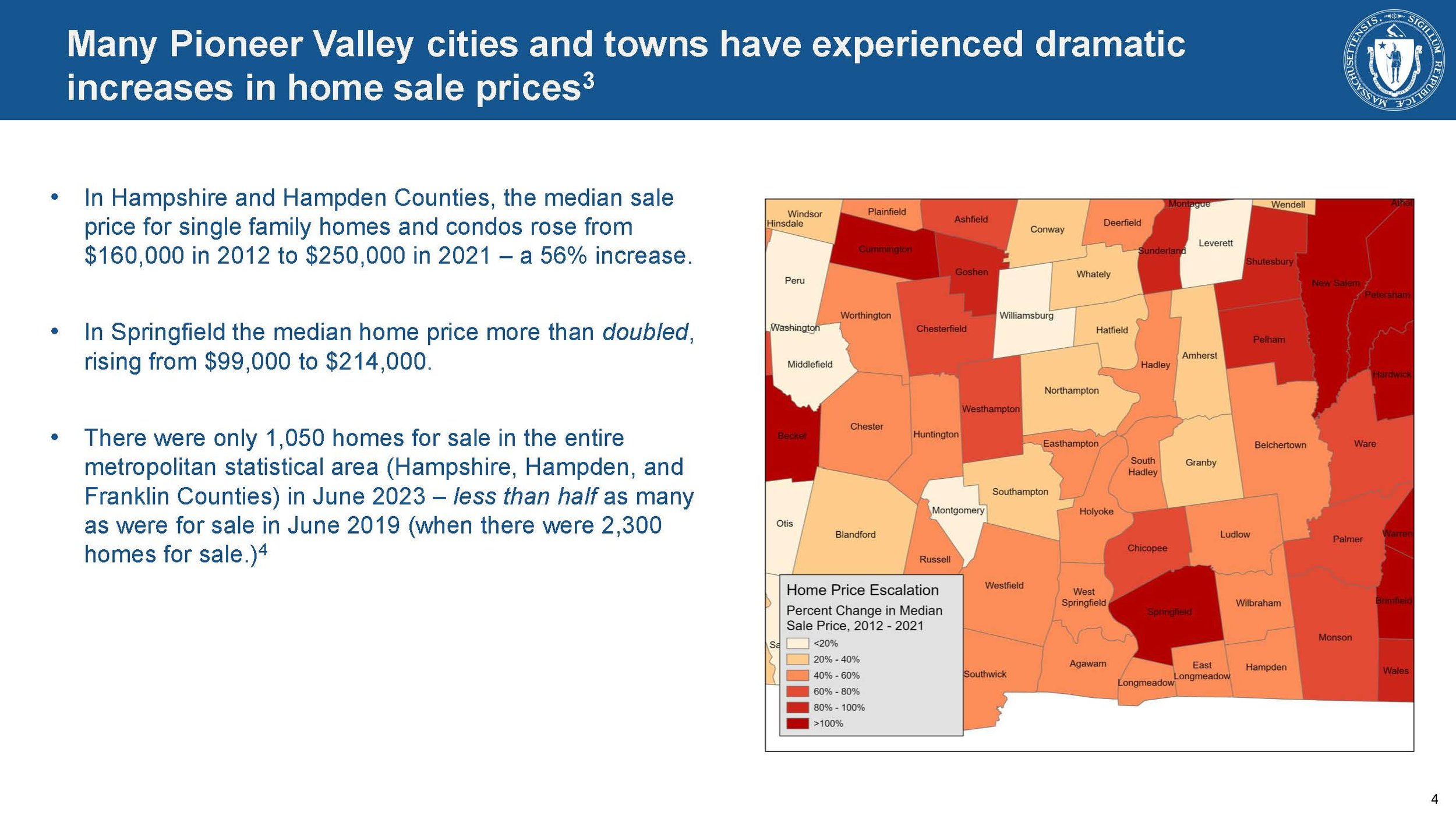
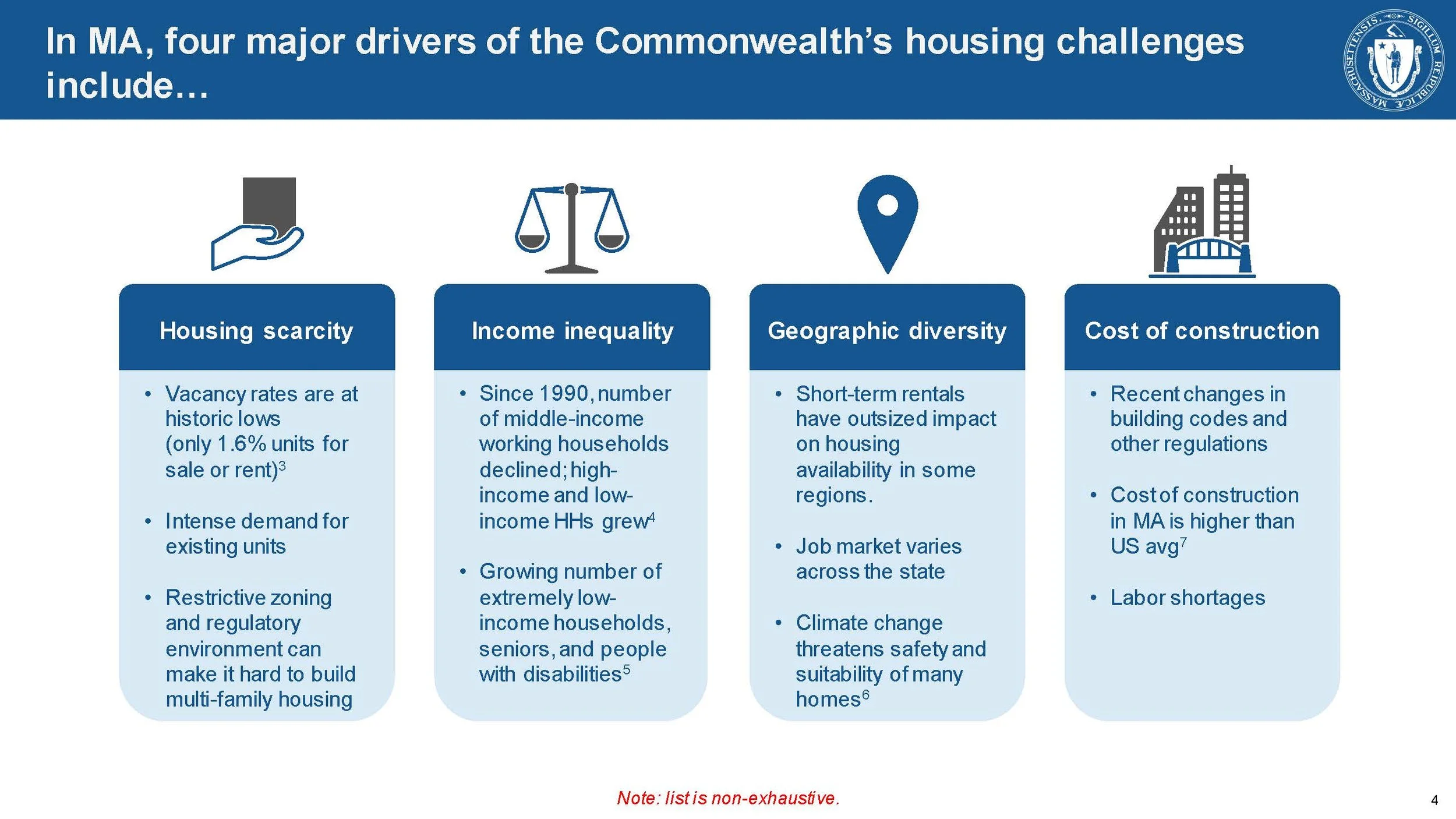
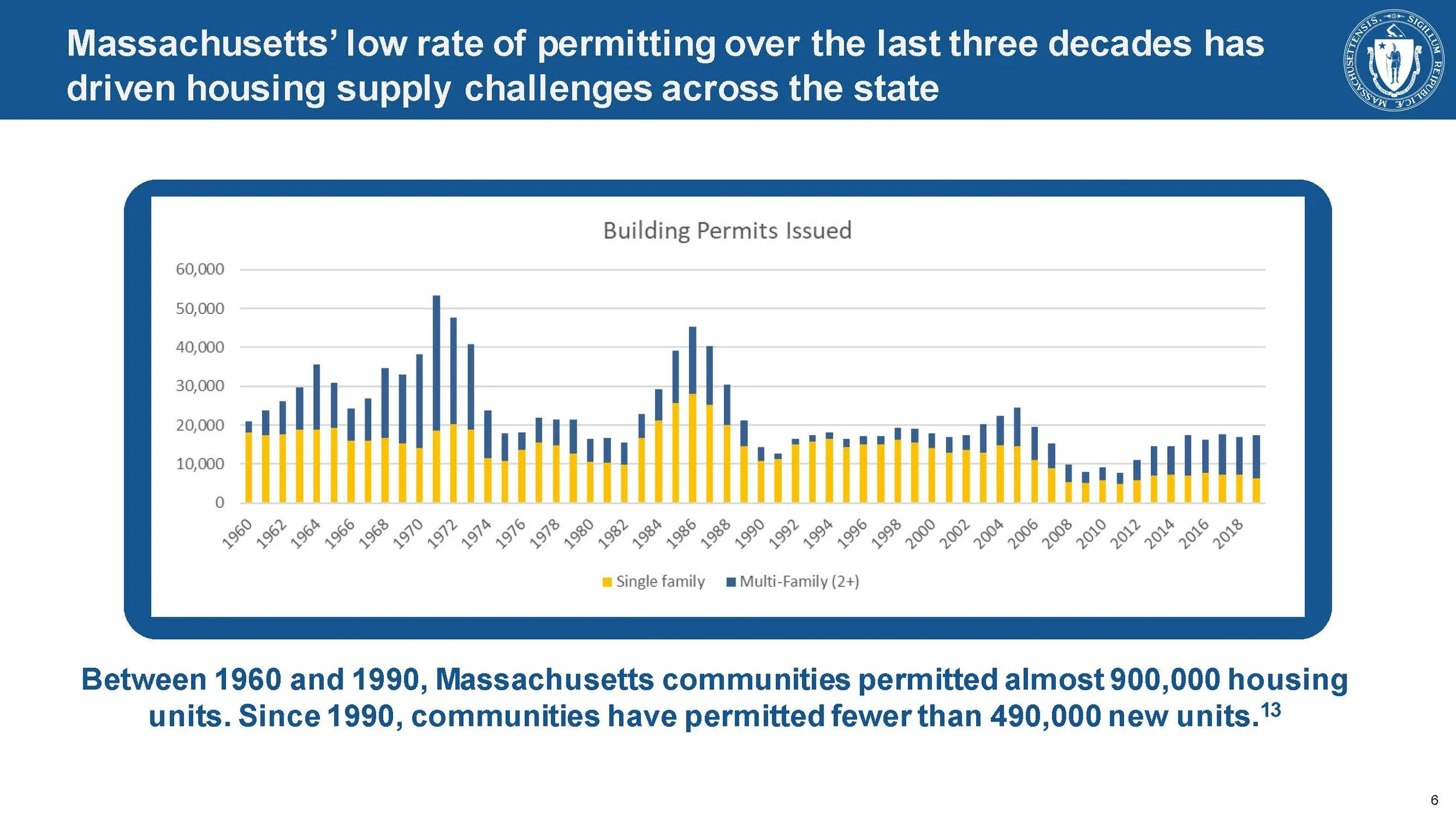
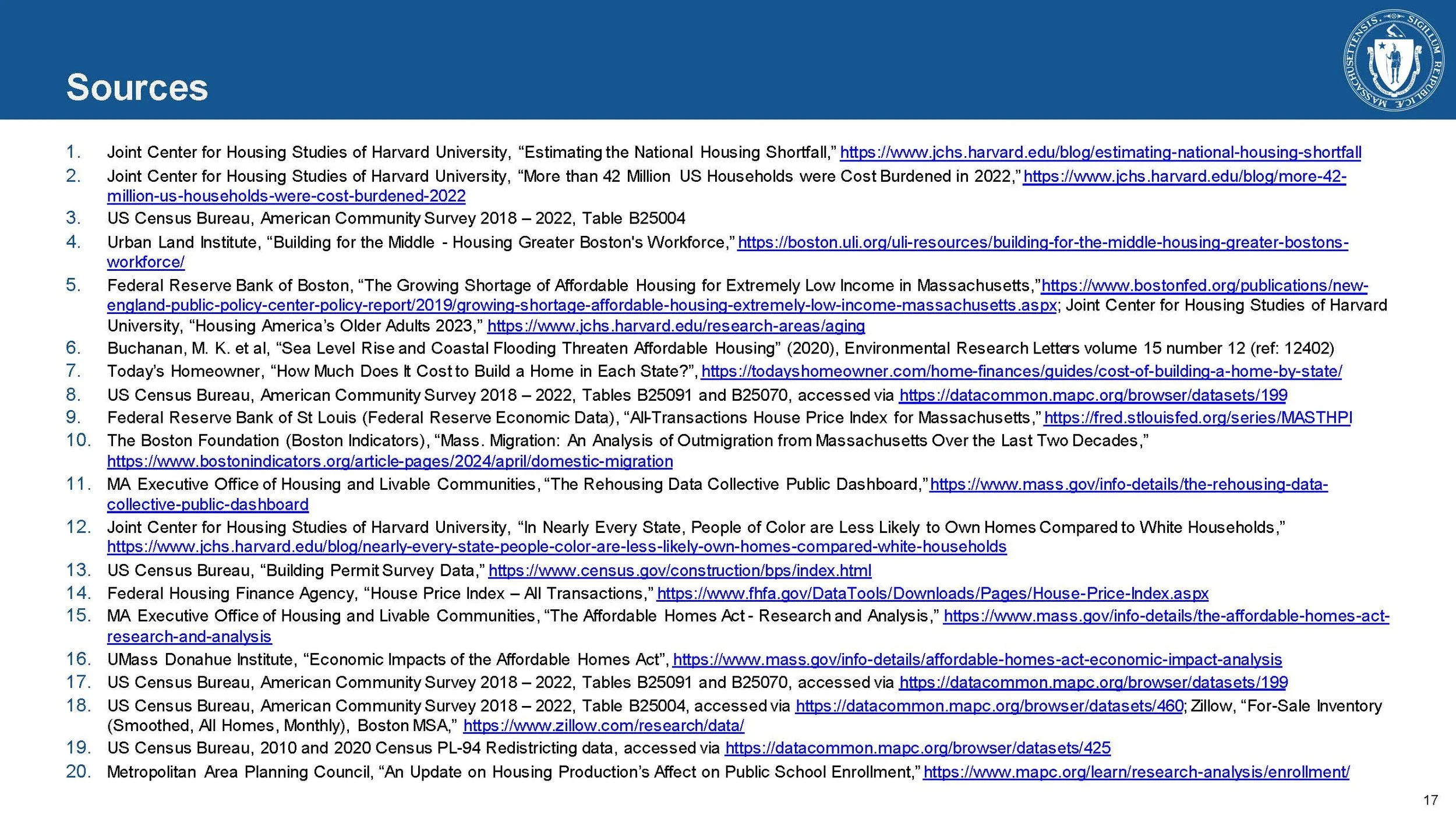
Established through Executive Orders filed in conjunction with the Affordable Homes Act, the Housing Advisory Council and Commission on Unlocking Housing Production is bringing together a broad range of stakeholders from across Massachusetts to advise the Healey-Driscoll administration on strategies to address the state’s housing challenges. A regional listening session was held in May 2024 (see the data below). If you missed them, you can still provide feedback here.






Western Mass Public Health Data
The U.S. Center for Disease Control’s Suicide Prevention Strategies for Communities support the implementation of a public health approach that uses data to drive decision-making. Massachusetts does not publish comprehensive data surrounding the deaths of service members and veterans. The chart below includes data for deaths in Hampden, Berkshire, Hampshire, and Franklin County.